
How to estimate numbers
Answer in short
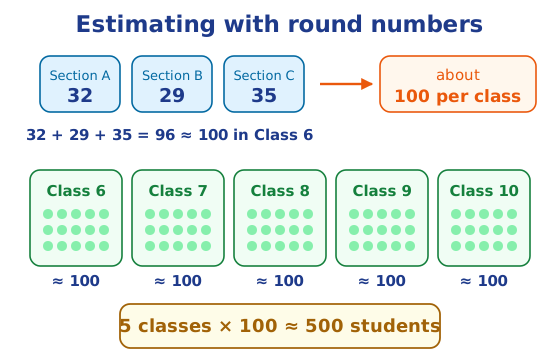
Estimating means finding a sensible, rounded answer when an exact count is not needed. Round the numbers, use simple multiplication and check that the answer makes sense. Paromita's class has 32, 29 and 35 students in three sections, about 100, so a school with five such classes has about 500 students.
Stuck on a question? Take a photo and Lagnever AI explains it step by step. Try it for 7 days for ₹2. Get it on Google Play
What is an estimate?
Sometimes we do not know, or do not need, the exact number. Your headmaster knows exactly how many students are enrolled, but you can still say something useful: is it about 150, about 400 or about a thousand? A sensible, rounded answer like this is an estimate. Estimating is a fun exercise, and it helps you notice the numbers all around you.
Paromita’s school
Paromita’s section has 32 children, and the other two sections of her class have 29 and 35. She rounds: 32 + 29 + 35 = 96, about 100 in her class. Her school has Classes 6 to 10, each with 3 sections. Assuming about 100 students in each class, she estimates about 5 × 100 = 500 students in the school.
Tips for good estimates
- Round to easy numbers before you calculate: 29, 32 and 35 all become ‘about 30’ or the total becomes ‘about 100’.
- Break the question into steps: per minute, then per hour, then per day.
- Use something you know: one of your steps is about half a metre, a bucket holds about 15 to 20 mugs of water.
- Check that the answer makes sense, and compare your method with friends’. Different sensible methods give answers that are close.
- Say ‘about’, and do not give an exact-looking number.
Estimating things around you
Steps. Count your steps across the classroom once. If the ground is about 100 metres long and one step is about half a metre, crossing it takes about 200 steps. A home 1 km away is about 2,000 steps.
Blinks and breaths. Extra: people blink roughly 15 to 20 times a minute, so about 1,000 times an hour, and over 15,000 times in a waking day. A child at rest breathes about 20 times a minute: about 1,200 times an hour and nearly 30,000 times a day.
Big collections. Things in the thousands include the grains of rice in a 100 g packet; things in the tens of thousands or more include the grains in a 5 kg bag of rice or the hairs on your head.
Quick checks
- Words in your maths textbook: more or less than 5000? More. A page has about 200 words, so just 25 pages make 5,000, and the book has many more pages.
- Roshan’s fruit custard for 5 people for ₹100? Probably too little. A litre of milk alone costs about ₹55 to ₹70 in many places, and three kinds of fruit add more. Prices differ from place to place, so check them where you live.
- Gandhinagar to Kohima? Using the scale on a map of India, roughly 2,200 km in a straight line; the road is longer.
- 13,000 hours in school by Grade 6? About 6 hours × 200 days = 1,200 hours a year; even 8 years make under 10,000 hours, so 13,000 is too high.
How long would a walk take?
Earlier, people walked long distances. A normal walking pace is about 5 km an hour.
- A favourite place 2 km away: about 25 minutes.
- A neighbouring state’s capital, say 250 km away: about 50 hours of walking, or about 6 days walking 8 hours a day.
- From the southern tip to the northern tip of the mainland, about 3,200 km: about 640 hours of walking, or about 80 days at 8 hours a day.
Litres and holidays
A mug holds about 1 litre, a bucket about 15 to 20 litres and an overhead tank at home about 500 to 1,000 litres. For holidays in a year, add up Sundays (52), other weekly holidays, festivals and the long vacations, taking care not to count a Sunday twice when it falls in a vacation. Then check your estimate against your school calendar.
Estimation is one of many ways to play with numbers. For puzzles and patterns, read palindromic numbers and the Collatz conjecture. For the textbook’s questions, see the Chapter 3 NCERT solutions; for the whole chapter, see the Chapter 3 notes.
Practice
-
Three sections have 31, 34 and 33 students. About how many students is that?
Show answer
Answer: (b) About 100
-
Walking at about 5 km an hour, about how long would 3,200 km take without stopping?
Show answer
Answer: (b) About 640 hours
-
Which is the most sensible estimate of the water a bucket holds?
Show answer
Answer: (b) About 15 to 20 litres
-
Sheetal in Grade 6 says she has spent about 13,000 hours in school. Do you agree?
Show answer
Answer: No. About 6 hours a day for about 200 school days is about 1,200 hours a year. Even 8 years, counting nursery and KG, gives under 10,000 hours, so 13,000 is too high.
-
About how many times do you blink in an hour if you blink about 15 times a minute?
Show answer
Answer: 15 × 60 = 900, so about 900 to 1,000 times an hour.
Questions students ask
What is estimation in maths?
Finding an approximate answer that is close enough for the purpose, using round numbers and simple calculations. You may not know the exact number of students in your school, but you can estimate it as about 150, 400 or a thousand.
How did Paromita estimate the number of students in her school?
Her class has sections of 32, 29 and 35 children, about 100 in all. Her school has Classes 6 to 10, each with 3 sections, so she assumed about 100 per class and estimated about 5 × 100 = 500 students.
How far is Gandhinagar from Kohima?
Roughly 2,200 km in a straight line, as you can estimate from a map of India using its scale; the road is longer. An estimate between 2,000 and 2,500 km is sensible.
Stuck on a question?
Take a photo and Lagnever AI explains it step by step. Try it for 7 days for ₹2.
Get it on Google Play Open in browser
For parents: after the trial, the plan renews monthly by UPI or card autopay. You can cancel anytime in the app.