
The Collatz conjecture
Answer in short
Start with any whole number. If it is even, halve it; if it is odd, multiply it by 3 and add 1; then repeat. In 1937, Lothar Collatz guessed that every starting number eventually reaches 1. Every number tried so far does, but nobody has proved it, so it is still one of the most famous unsolved problems in mathematics.
Stuck on a question? Take a photo and Lagnever AI explains it step by step. Try it for 7 days for ₹2. Get it on Google Play
The rule
Pick any whole number and follow one rule again and again:
- If the number is even, take half of it.
- If the number is odd, multiply by 3 and add 1.
Stop when you reach 1 (after 1, the rule would only give 4, 2, 1 again). The list of numbers you get is a Collatz sequence.
The book’s four sequences
| Start | Sequence | Steps |
|---|---|---|
| 12 | 12, 6, 3, 10, 5, 16, 8, 4, 2, 1 | 9 |
| 17 | 17, 52, 26, 13, 40, 20, 10, 5, 16, 8, 4, 2, 1 | 12 |
| 21 | 21, 64, 32, 16, 8, 4, 2, 1 | 7 |
| 22 | 22, 11, 34, 17, 52, 26, 13, 40, 20, 10, 5, 16, 8, 4, 2, 1 | 15 |
Notice that 22 reaches 17 and then follows exactly the same path as the sequence from 17. Different starting numbers often join the same path, like streams flowing into one river.
A sequence from 7
The numbers in a Collatz sequence go up and down, a bit like hailstones in a cloud, before they come down to 1.
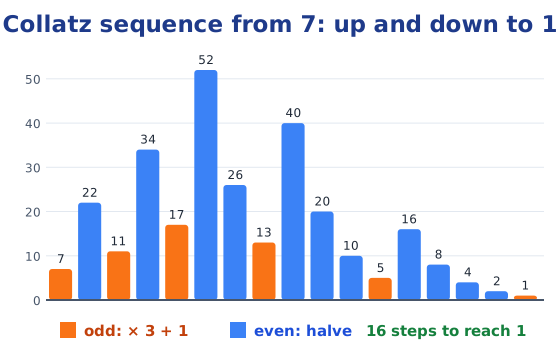
Starting at 7, the sequence climbs to 52 and reaches 1 after 16 steps. Odd numbers (orange) jump up; even numbers (blue) halve.
Powers of 2 are easy
The powers of 2 are 2, 4, 8, 16, 32, 64, …, each made by multiplying 2 by itself. Every power of 2 is even, and half of it is again a power of 2. So the sequence just keeps halving: 64, 32, 16, 8, 4, 2, 1. That is why the conjecture is clearly true for every starting number in this list.
Longer journeys
Starting at 100, the sequence is 100, 50, 25, 76, 38, 19, 58, 29, 88, 44, 22, 11, 34, 17, 52, 26, 13, 40, 20, 10, 5, 16, 8, 4, 2, 1: it reaches 1 in 25 steps. Some small numbers take surprisingly long. Extra: starting at 27, the sequence takes 111 steps and climbs as high as 9232 before it comes down to 1.
Do we always reach 1?
In 1937, the German mathematician Lothar Collatz guessed that the answer is yes, whatever whole number you start with. A guess like this, believed but not proved, is called a conjecture. Extra: computers have checked enormous numbers, far bigger than any you could write in a notebook, and every one reaches 1.
But checking examples is not a proof. A proof must show that every number, without exception, reaches 1. Nobody has managed that, and nobody has found a number that fails either. So Collatz’s conjecture remains one of the most famous unsolved problems in mathematics.
Easy to ask, hard to answer
The chapter’s summary makes a striking point: many questions about numbers are very easy to pose but very hard to solve. A Class 6 student can understand the Collatz rule in a minute, yet even the world’s leading mathematicians have not been able to settle it. Try making your own sequences: do they all reach 1?
For another famous pattern, read Kaprekar’s routine and 6174. For the textbook’s questions, see the Chapter 3 NCERT solutions; for the whole chapter, see the Chapter 3 notes.
Practice
-
In a Collatz sequence, what comes after 13?
Show answer
Answer: (b) 40
-
The conjecture that every sequence reaches 1 was made by:
Show answer
Answer: (b) Lothar Collatz
-
Starting from 16, how many steps does it take to reach 1?
Show answer
Answer: (b) 4
-
Write the Collatz sequence starting at 6.
Show answer
Answer: 6, 3, 10, 5, 16, 8, 4, 2, 1 (8 steps).
-
Why does every power of 2 reach 1?
Show answer
Answer: A power of 2, like 32 = 2 × 2 × 2 × 2 × 2, is even, so we halve it. The result is again a power of 2, so we keep halving: 32, 16, 8, 4, 2, 1. We never meet an odd number before 1.
Questions students ask
What is the Collatz conjecture?
The guess that if you start with any whole number and repeatedly halve it when it is even, or multiply it by 3 and add 1 when it is odd, you always end up at 1. Lothar Collatz made this conjecture in 1937.
Is the Collatz conjecture true?
Nobody knows. Every starting number tried so far reaches 1, but there is no proof, so it remains one of the most famous unsolved problems in mathematics.
Does 100 reach 1?
Yes: 100, 50, 25, 76, 38, 19, 58, 29, 88, 44, 22, 11, 34, 17, 52, 26, 13, 40, 20, 10, 5, 16, 8, 4, 2, 1. That is 25 steps.
Stuck on a question?
Take a photo and Lagnever AI explains it step by step. Try it for 7 days for ₹2.
Get it on Google Play Open in browser
For parents: after the trial, the plan renews monthly by UPI or card autopay. You can cancel anytime in the app.