
NCERT Solutions Class 6 Maths Chapter 3: Number Play
Answers to every question in Chapter 3, Number Play, of Ganita Prakash (Reprint 2026-27): the in-text questions, every Figure it Out, the puzzles, the number-pattern sums and the estimation tasks. The page numbers match the book, and the answers are checked against NCERT’s own solutions printed with the chapter; where we differ, we explain why. Many questions have more than one correct answer, so ours are examples. Short notes: Chapter 3 notes.
Numbers around us (page 55)
Five situations where we use numbers: telling the time, dates on a calendar, counting money, marks in a test, and measuring height and weight. Others: phone numbers, bus numbers, page numbers, scores in a game and prices in a shop.
3.1 Numbers can tell us things (pages 55–56)
Each child says how many of their neighbours are taller.
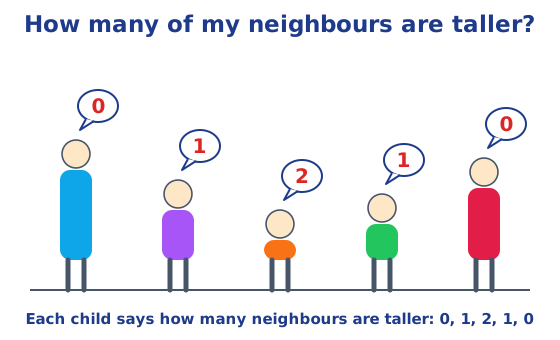
- No. A child at an end has only one neighbour, so they can say 0 or 1, never 2.
- Only if all the children are the same height. If the heights are different, the shortest child has at least one taller neighbour and says 1 or 2.
- Yes. If the children stand in order of height, the neighbours in the middle all say 1.
- Yes. Stand in order from shortest to tallest: each child has one taller neighbour (says 1), and the tallest, at the end, says 0.
- No. The tallest child has no taller neighbour, so someone must say 0.
- Yes. For example, heights in the order tallest, shorter, shortest, a bit taller, second tallest (like 5, 3, 1, 2, 4) give 0, 1, 2, 1, 0.
- At most 2 children can say 2. An end child cannot say 2, and two neighbours cannot both say 2 (each would have to be shorter than the other), so only the 2nd and 4th places can. Example: heights 5, 1, 4, 2, 3 give 0, 2, 0, 2, 0.
3.2 Supercells (pages 57–59)
A supercell’s number is greater than the numbers in all its neighbouring cells.
1. In 6828, 670, 9435, 3780, 3708, 7308, 8000, 5583, 52 the supercells are 6828, 9435 and 8000.
2. The coloured cells are the 2nd, the 4th (1258) and the 9th. One answer: 5346, 8000, 1000, 1258, 1100, 2000, 3000, 9635, 9999. Check: 8000 is bigger than 5346 and 1000; 1258 is bigger than 1000 and 1100; 9999 is bigger than 9635; and every other cell has a bigger neighbour.
3 and 4. For as many supercells as possible, make every other cell big: 300, 120, 450, 160, 520, 140, 610, 180, 700. Here 300, 450, 520, 610 and 700 are supercells, so there are 5.
5. With n cells in a row, the largest number of supercells is half of n, rounded up:
| Cells in the row | Most supercells |
|---|---|
| 1 or 2 | 1 |
| 3 or 4 | 2 |
| 5 or 6 | 3 |
| 7 or 8 | 4 |
| 9 or 10 | 5 |
Method: start with a supercell in the first cell and then make every other cell a supercell (big, small, big, small, …).
6. No. The cell with the largest number is bigger than all its neighbours, so there is always at least one supercell.
7. The largest number is always a supercell. The smallest number can never be a supercell, because its neighbours are bigger.
8. Put the second largest next to the largest: 1, 3, 2, 9, 8, 4, 5, 7, 6. Here 8 is next to 9, so it is not a supercell.
9. Yes, it is possible: 2, 1, 5, 3, 9, 8, 4, 7, 6. The second smallest, 2, is at the end next to 1, so it is a supercell, while the second largest, 8, sits next to 9 and is not.
10. Sample variations: fill 9 cells so that exactly 3 are supercells; fill a row so that the second smallest number is a supercell but the third largest is not; fill a 3 × 3 grid with exactly 4 supercells.
Grid tables. In the book’s Table 1, the coloured cells 7500, 9870, 8632 and 6034 are supercells. Note that 5785 (bottom left) is also greater than both its neighbours, 4580 and 1944, so by the rule it is a supercell too, though the book does not colour it.
Table 2, one way to fill it with numbers made from 1, 0, 6, 3 and 9 (coloured cells marked ★):
| Row | Column 1 | Column 2 | Column 3 | Column 4 |
|---|---|---|---|---|
| 1 | 96,310 ★ | 96,301 | 36,109 | 63,910 ★ |
| 2 | 90,613 | 13,609 | 60,319 ★ | 19,306 |
| 3 | 30,196 | 10,639 | 60,193 | 31,690 |
| 4 | 10,369 | 10,963 ★ | 10,693 | 93,160 ★ |
- The top-left cell must be 96,310, the only arrangement bigger than 96,301. It is the biggest number in the table.
- The cells next to 10,963 must be smaller than it, so they come from 10,369, 10,396, 10,639, 10,693 and 10,936.
- In this table, the smallest even number is 19,306 and the smallest number greater than 50,000 is 60,193. Other correct fillings can give a different smallest even number; NCERT’s answer key, for example, uses 10,396.
3.3 Patterns on the number line (page 59)
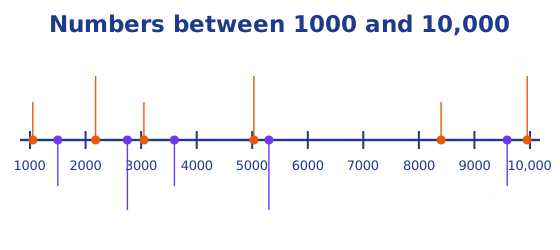
Figure it Out. Two labelled marks tell you the gap between marks:
- a. 2010 and 2020 are two marks apart, so the marks go up in 5s: 1990, 1995, 2000, 2005, 2010, 2015, 2020, 2025, 2030, 2035. Smallest 1990, largest 2035.
- b. Marks go up in 1s: 9993, 9994, 9995, 9996, 9997, 9998, 9999, 10,000, 10,001, 10,002. Smallest 9993, largest 10,002.
- c. Marks go up in 1s: 15,077, 15,078, 15,079, 15,080, 15,081, 15,082, 15,083, 15,084, 15,085, 15,086. Smallest 15,077, largest 15,086.
- d. Marks go up in 1000s: 83,705, 84,705, 85,705, 86,705, 87,705, 88,705, 89,705, 90,705, 91,705, 92,705. Smallest 83,705, largest 92,705.
3.4 Playing with digits (pages 60–61)
| Digits | How many numbers |
|---|---|
| 1 | 9 (1–9) |
| 2 | 90 (10–99) |
| 3 | 900 (100–999) |
| 4 | 9,000 (1000–9999) |
| 5 | 90,000 (10,000–99,999) |
1. Digit sum 14. Other numbers: 77, 95, 149, 239, 707, 1157, 2525. The smallest number with digit sum 14 is 59 (a 1-digit number can only reach 9, and among 2-digit numbers the tens digit must be at least 5). The largest 5-digit one is 95,000. There is no biggest number with digit sum 14: 95, 950, 9,500, 95,000, 9,50,000 and so on keep growing as you add zeros.
2. Digit sums from 40 to 70.
| Numbers | Digit sums |
|---|---|
| 40–49 | 4, 5, 6, 7, 8, 9, 10, 11, 12, 13 |
| 50–59 | 5, 6, 7, 8, 9, 10, 11, 12, 13, 14 |
| 60–69 | 6, 7, 8, 9, 10, 11, 12, 13, 14, 15 |
| 70 | 7 |
Within each ten the digit sum goes up by 1; moving to the next ten (49 to 50) it drops by 8; and each new ten starts 1 higher than the last.
3. Consecutive digits. 123 → 6, 234 → 9, 345 → 12, 456 → 15, 567 → 18, 678 → 21, 789 → 24. The sums go up by 3 and each is 3 times the middle digit. The list stops at 789, since there are only seven such numbers with increasing digits, though the rule also works for decreasing ones such as 210 (3) and 987 (24).
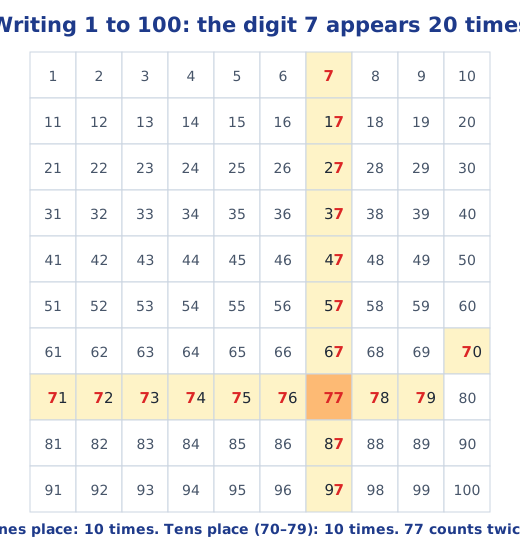
Digit Detectives. From 1 to 100 the digit 7 is written 20 times: 10 times in the ones place and 10 times in 70 to 79 (77 counts twice). From 1 to 1000 it is written 300 times: 100 times in each of the ones, tens and hundreds places.
3.5 Pretty palindromic patterns (pages 61–62)
3-digit palindromes using 1, 2 and 3: 111, 121, 131, 212, 222, 232, 313, 323, 333.
Reverse and add. For example, 57 + 75 = 132, 132 + 231 = 363; and 68 + 86 = 154, 154 + 451 = 605, 605 + 506 = 1111. Starting with any 2-digit number, you always reach a palindrome, although 89 and 98 take 24 steps. For 3-digit numbers nobody knows; 196 is suspected never to give one. More in palindromic numbers.
Puzzle time. The number is 12,421: twelve thousand four hundred twenty-one. The units digit must be odd, and 4 × units must be a single digit, so units 1, tens 2, hundreds 4, and the palindrome repeats 2 and 1.
3.6 The magic number of Kaprekar (pages 62–63)
Different 4-digit numbers all reach 6174. For example 2026: 5994, 5355, 1998, 8082, 8532, 6174.
3-digit numbers reach 495, which repeats (954 − 459 = 495). Example: 321 → 321 − 123 = 198 → 981 − 189 = 792 → 972 − 279 = 693 → 963 − 369 = 594 → 954 − 459 = 495. More in Kaprekar’s routine and 6174.
3.7 Clock and calendar numbers (pages 64–65)
Times on a 12-hour clock:
- All digits the same (like 4:44): 1:11, 2:22, 3:33, 4:44, 5:55 and 11:11.
- Hour repeated as minutes (like 10:10): 1:01, 2:02, …, 9:09 (written 01:01 to 09:09), 10:10, 11:11 and 12:12.
- Palindromes (like 12:21): 10:01, 11:11 and 12:21, and on a clock like 1:21 also six for each hour from 1 to 9 (1:01, 1:11, 1:21, 1:31, 1:41, 1:51, …, 9:59): 57 in all.
Dates like Manish’s (20/12/2012), where the day and month repeat as the year: 20/01/2001, 20/02/2002, …, 20/11/2011, and earlier 19/01/1901 to 19/12/1912.
Dates like Meghana’s (11/02/2011), reading the same both ways: since 2000 there are eight: 10/02/2001, 20/02/2002, 01/02/2010, 11/02/2011, 21/02/2012, 02/02/2020, 12/02/2021 and 22/02/2022. (NCERT’s key lists 01/02/2001 and 02/02/2002, but these do not read the same backwards: 01022001 reversed is 10022010.)
Can a calendar be reused? Yes, when a year starts on the same day of the week and is of the same type (leap or not). A year that is not a leap year gets its calendar back after 6 or 11 years: 2025’s calendar returns in 2031 and 2026’s in 2037. A leap year’s calendar returns after 28 years: 2024’s in 2052. (The rule ‘after 5 or 6 years’ in NCERT’s key does not always work; 2026 is an example.)
Figure it Out
1. Examples (no leading zeros, as these are 4-digit numbers):
- a. Digits 9, 8, 1, 0: 9810 − 1089 = 8721, more than 5085.
- b. Digits 5, 4, 3, 2: 5432 − 2345 = 3087, less than 5085.
- c. Digits 9, 8, 7, 6: 9876 + 6789 = 16,665, more than 9779.
- d. Digits 4, 3, 2, 1: 4321 + 1234 = 5555, less than 9779.
2. Smallest 5-digit palindrome 10,001, largest 99,999. Sum 1,10,000; difference 89,998.
3. From 10:01, the next palindromic time is 11:11, after 70 minutes; the one after that is 12:21, 140 minutes after 10:01.
4. Keeping zeros as leading digits, 5683 takes 7 rounds: 8653 − 3568 = 5085, 8550 − 0558 = 7992, 9972 − 2799 = 7173, 7731 − 1377 = 6354, 6543 − 3456 = 3087, 8730 − 0378 = 8352, 8532 − 2358 = 6174. NCERT’s answer key writes the smallest number from 5, 0, 8, 5 as 5058 and so counts 8 rounds; both reach 6174.
3.8 Mental maths (pages 65–67)
Making the side numbers (each middle number can be used many times):
| Number | One way |
|---|---|
| 38,800 | 25,000 + 13,000 + 400 + 400 |
| 3,400 | 1,500 + 1,500 + 400 |
| 28,000 | 25,000 + 1,500 + 1,500 |
| 63,000 | 60,000 + 1,500 + 1,500 |
| 61,600 | 60,000 + 400 + 400 + 400 + 400 |
| 19,500 | 13,000 + 1,500 × 3 + 400 × 5 |
| 31,000 | 25,000 + 1,500 × 4 |
| 20,900 | 13,000 + 1,500 × 5 + 400 |
1,000? No. The only middle number below 1,000 is 400, and 400, 800, 1,200 skip 1,000. 14,000 = 1,500 × 8 + 400 × 5; 15,000 = 13,000 + 400 × 5; 16,000 = 13,000 + 1,500 × 2. Every other thousand can be made, so only 1,000 cannot.
Adding and subtracting: 45,000 = 40,000 + 12,000 − 7,000; 5,900 = 7,000 − 800 − 300; 17,500 = 12,000 + 7,000 − 1,500; 21,400 = 12,000 + 7,000 + 800 + 800 + 800.
Figure it Out 1.
| Case | Example |
|---|---|
| 5-digit + 5-digit, sum more than 90,250 | 50,000 + 45,000 = 95,000 |
| 5-digit + 3-digit, 6-digit sum | 99,500 + 600 = 1,00,100 |
| 4-digit + 4-digit, 6-digit sum | Not possible: 9,999 + 9,999 = 19,998 has only 5 digits |
| 5-digit + 5-digit, 6-digit sum | 60,000 + 50,000 = 1,10,000 |
| 5-digit + 5-digit = 18,500 | Not possible: the smallest sum is 10,000 + 10,000 = 20,000 |
| 5-digit − 5-digit, difference less than 56,503 | 60,000 − 20,000 = 40,000 |
| 5-digit − 3-digit, 4-digit difference | 10,500 − 900 = 9,600 |
| 5-digit − 4-digit, 4-digit difference | 15,000 − 7,000 = 8,000 |
| 5-digit − 5-digit, 3-digit difference | 20,500 − 20,000 = 500 |
| 5-digit − 5-digit = 91,500 | Not possible: the largest difference is 99,999 − 10,000 = 89,999 |
Figure it Out 2. Always, sometimes, never?
- a. Only sometimes true: 20,000 + 30,000 = 50,000, but 60,000 + 50,000 = 1,10,000.
- b. Only sometimes true: 1,000 + 10 = 1,010, but 9,999 + 99 = 10,098.
- c. Never true: the biggest possible sum, 9,999 + 99 = 10,098, has only 5 digits.
- d. Only sometimes true: 90,000 − 10,000 = 80,000, but 12,000 − 10,000 = 2,000.
- e. Never true: the smallest possible difference, 10,000 − 99 = 9,901, still has 4 digits.
3.9 Playing with number patterns (pages 67–68)
Group equal numbers and multiply instead of adding one by one. (NCERT’s key does not give these sums; we counted the figures.)
- a. Twelve 40s and ten 50s: 480 + 500 = 980.
- b. 64 squares; 20 dark squares have 5 dots and 44 have 1 dot: 100 + 44 = 144.
- c. Thirty-two 32s and sixteen 64s: 1,024 + 1,024 = 2,048.
- d. 35 dice faces, 18 with 4 dots and 17 with 3: 72 + 51 = 123.
- e. 22 each of 15, 25 and 35: 22 × 75 = 1,650.
- f. 1,000 in the centre, four 500s, eight 250s and eighteen 125s: 1,000 + 2,000 + 2,000 + 2,250 = 7,250.
3.10 The Collatz conjecture (pages 68–69)
More sequences: 6: 6, 3, 10, 5, 16, 8, 4, 2, 1. 9: 9, 28, 14, 7, 22, 11, 34, 17, 52, 26, 13, 40, 20, 10, 5, 16, 8, 4, 2, 1. Every sequence we try reaches 1.
Do you believe it? It is reasonable to believe it, since every number ever checked reaches 1, but nobody has proved it, so we cannot be sure. NCERT’s key argues that we ‘will reach 1 for sure’, but that would be a proof, and none is known: that is exactly why the book calls it an unsolved mystery. More in the Collatz conjecture.
3.11 Simple estimation (pages 69–71)
Estimates differ; what matters is a sensible method. More in how to estimate numbers.
1. Steps (one step is about half a metre): to the classroom door, about 10 to 20; across a 100 m ground, about 200; from the classroom to the school gate, perhaps 100 to 300; to a home 1 km away, about 2,000.
2. Blinks and breaths: about 15 to 20 blinks a minute, 1,000 an hour, over 15,000 in a waking day; about 20 breaths a minute, 1,200 an hour, nearly 30,000 a day.
3. Objects: a few thousand: grains of rice in a 100 g packet, bricks in a school wall; more than ten thousand: grains of rice in a 5 kg bag, hairs on your head.
Estimate the answer
- More than 5000. About 200 words a page; 25 pages already make 5,000.
- It depends on your school. Count the students on one bus and multiply by the number of buses.
- Probably not. A litre of milk is about ₹55 to ₹70 in many places, and three kinds of fruit for 5 people add more, so ₹100 is too little. Check the prices where you live.
- About 2,200 km in a straight line, using the map’s scale; the road is longer.
- No. About 6 hours a day × 200 days is 1,200 hours a year; even 8 years make under 10,000 hours.
- At about 5 km an hour: a. a place 2 km away, about 25 minutes; b. a capital 250 km away, about 50 hours of walking (about 6 days at 8 hours a day); c. about 3,200 km from south to north, about 640 hours (about 80 days at 8 hours a day).
- Sample questions: How many students are in your school? How many chapatis does your family eat in a month? How many litres of water does your home use in a day?
3.12 Games and winning strategies (pages 71–72)
Game 1 (add 1, 2 or 3; reach 21). The first player can always win. Aim for 21, and before that 17, 13, 9, 5 and 1: each is 4 less than the next. Say 1 first; whatever the other player adds, add the rest to make 4.
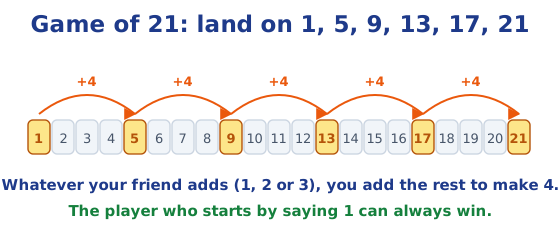
Game 2 (add 1 to 10; reach 99). The key numbers are 99, 88, 77, …, 22, 11 (11 apart). The first player must say a number from 1 to 10, so the second player says 11 and then keeps to 22, 33, …, 99, and always wins.
Your own variations: if each turn adds 1 to k, the key numbers are the target minus multiples of (k + 1). For example, add 1 to 4 and reach 30: the key numbers are 5, 10, 15, 20, 25, 30, so the second player wins.
Figure it Out (pages 72–73)
1. Only 62,871 is a supercell. Swap the 6 and the 1 to make 12,876. Then 39,344, 23,609, 45,306 and 50,319 each become bigger than all their neighbours: 4 supercells.
2. For a birth year of 2014, keeping zeros as leading digits: 4210 − 0124 = 4086, 8640 − 0468 = 8172, 8721 − 1278 = 7443, 7443 − 3447 = 3996, 9963 − 3699 = 6264, 6642 − 2466 = 4176, 7641 − 1467 = 6174: 7 rounds. Try your own year.
3. Largest 73,999; smallest 35,111; closest to 50,000 is 51,111 (the nearest below, 39,999, is much further).
4. Sample estimate: 52 Sundays, about 12 more weekly holidays, about 15 festival and national holidays and about 50 days of vacations, minus Sundays already in the vacations: roughly 120 to 140 days. Then count them on your school calendar.
5. A mug about 1 litre, a bucket about 15 to 20 litres, an overhead tank about 500 to 1,000 litres.
6. 17,870 + 400 + 400 = 18,670. Another: 18,000 + 300 + 370.
7. Choosing 360: a ring of eight 30s around a centre of 120 (240 + 120 = 360), or a 3 × 3 square of nine 40s.
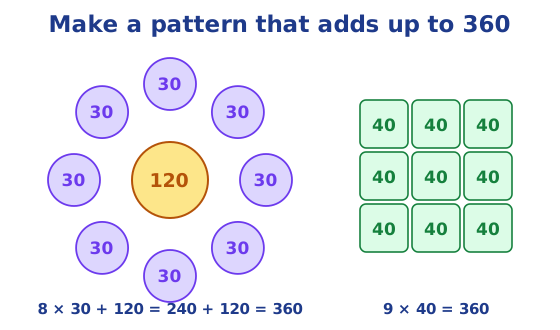
8. Every power of 2 is even and half of it is again a power of 2, so the sequence only halves: for example 128, 64, 32, 16, 8, 4, 2, 1. It never meets an odd number before reaching 1.
9. Yes: 100, 50, 25, 76, 38, 19, 58, 29, 88, 44, 22, 11, 34, 17, 52, 26, 13, 40, 20, 10, 5, 16, 8, 4, 2, 1 (25 steps).
10. The key numbers are 22, 18, 14, 10, 6 and 2. The first player says 2 (adding 2 to 0) and then always makes the total up by 4: 6, 10, 14, 18, 22.
For more practice, read palindromic numbers, Kaprekar’s routine and 6174, the Collatz conjecture and how to estimate numbers.
Practice
-
How many 2-digit numbers are there?
Show answer
Answer: (b) 90
-
What is the digit sum of 4,096?
Show answer
Answer: (a) 19
-
Which 4-digit number gives itself back in Kaprekar's routine?
Show answer
Answer: (b) 6174
-
Write the Collatz sequence starting at 10.
Show answer
Answer: 10, 5, 16, 8, 4, 2, 1.
-
In the game of 21, your friend has just said 11. What should you say?
Show answer
Answer: 13, by adding 2. The winning numbers are 1, 5, 9, 13, 17 and 21.
Stuck on a question?
Take a photo and Lagnever AI explains it step by step. Try it for 7 days for ₹2.
Get it on Google Play Open in browser
For parents: after the trial, the plan renews monthly by UPI or card autopay. You can cancel anytime in the app.