
What are herbs, shrubs and trees?
Answer in short
Herbs, shrubs and trees are groups of plants sorted by height, type of stem and where the branches start. Herbs, like tomato, are short with soft, green stems. Shrubs, like rose, have many hard, woody stems branching close to the ground. Trees, like mango, are tall with a thick, hard, brown trunk that branches high up.
Stuck on a question? Take a photo and Lagnever AI explains it step by step. Try it for 7 days for ₹2. Get it on Google Play
Grouping plants by height and stem
Plants vary a lot in their stems: some are thin and soft, others thick and hard; some are short, others taller than a house. In Activity 2.4 of the book, you go on a nature walk and look closely at each plant:
- Height: is the plant shorter than you, about as tall as you, or taller than you?
- Stem: is it green or brown? Touch it and bend it gently: is it tender and easy to bend, or stiff and hard? Is it thick or thin?
- Branches: do they start close to the ground or higher up on the stem?
Your answers place the plant in one of three groups: herbs, shrubs or trees.
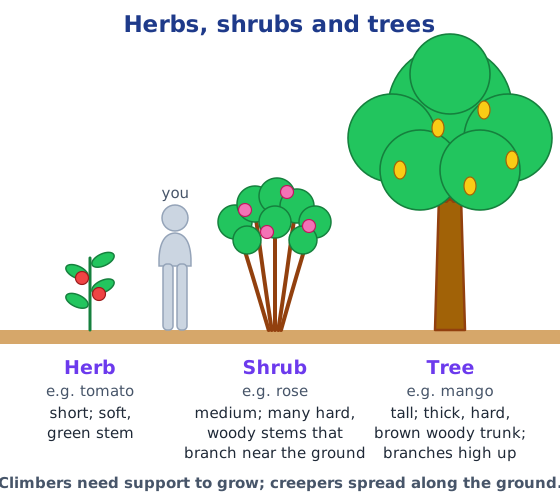
Trees
Some plants grow really tall and have hard, thick, brown and woody stems, called trunks. Their branches usually start high up on the stem, away from the ground. These are trees. A mango tree is an example; neem, peepal and jamun are trees too.
Shrubs
Some plants are not as tall as trees. They often have many brown, woody stems that branch very close to the ground. The stems are hard but not as thick as a tree trunk. These plants are shrubs. A rose plant is a shrub, and so is a hibiscus (gudhal).
Herbs
Some plants are small, with soft and green stems. These are herbs. A tomato plant is a herb; mint (pudina), coriander and wheat are herbs as well.
The three groups compared
Here is how the book’s examples from Table 2.3 fit:
| Plant | Height | Stem | Branches start | Group |
|---|---|---|---|---|
| Mango | Tall | Brown, hard, thick | Higher up on the stem | Tree |
| Rose | Medium | Brown, hard, thin | Close to the ground | Shrub |
| Tomato | Short | Green, tender, thin | Close to the ground | Herb |
You can add plants from your own school or street. For example, a neem is tall with a thick, hard trunk branching high up, so it is a tree; mint is short with a soft, green stem, so it is a herb.
Climbers and creepers
Some plants have stems too weak to stand upright. Plants with weak stems that need support to climb and grow are called climbers; they wind around a stick, a fence or another plant. Plants that spread along the ground are called creepers.
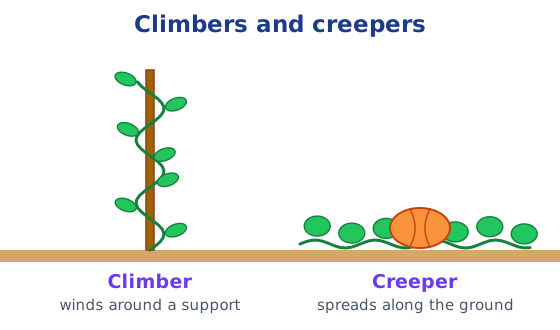
A money plant or a pea plant is a climber; pumpkin and watermelon plants are creepers.
How to check a plant’s group
Suppose a friend says a hibiscus (gudhal) is a shrub. To check, ask:
- How tall is it compared with you and with a tree?
- Is the stem green and soft, or brown, hard and woody?
- Is the stem thick like a trunk, or are there several thinner stems?
- Do the branches start close to the ground or high up on the stem?
A hibiscus is of medium height, not as tall as a tree, with several hard, brown stems that branch near the ground, so it is a shrub.
Why grouping matters
Grouping plants by their features makes it easier to study the huge variety around us. Height and stem are only one basis: plants can also be grouped by their leaves, roots and seeds, which you can read about in leaf venation and roots. For the whole chapter, see the Chapter 2 notes.
Practice
-
A plant is short and has a soft, green stem. It is a:
Show answer
Answer: (c) herb
-
Which plant is a tree?
Show answer
Answer: (c) Mango
-
A plant with a weak stem that winds around a stick to grow upwards is a:
Show answer
Answer: (b) climber
-
How is a shrub different from a tree?
Show answer
Answer: A shrub is shorter and has many hard but thin woody stems that branch close to the ground; a tree is tall, with one thick, hard trunk whose branches start high up.
-
Name one creeper and one climber.
Show answer
Answer: A pumpkin or watermelon plant is a creeper; a money plant or a pea plant is a climber.
Questions students ask
How do we group plants into herbs, shrubs and trees?
By three features: height (short, medium or tall), the nature of the stem (green and tender, or brown, hard and woody; thin or thick) and where the branches start (close to the ground or higher up on the stem).
Is hibiscus (gudhal) a herb, shrub or tree?
A shrub. It has several hard, brown, woody stems that branch close to the ground, and it is not as tall as a tree. Our solutions page lists the questions you can ask to check this for any plant.
What is the difference between climbers and creepers?
Both have weak stems. Climbers take support from a stick, wall or another plant to climb up, like a money plant or pea. Creepers spread along the ground, like pumpkin and watermelon.
Stuck on a question?
Take a photo and Lagnever AI explains it step by step. Try it for 7 days for ₹2.
Get it on Google Play Open in browser
For parents: after the trial, the plan renews monthly by UPI or card autopay. You can cancel anytime in the app.