
What are leaf venation and the types of roots?
Answer in short
Venation is the pattern of veins on a leaf. Reticulate venation is a net of veins around a thick middle vein, as in hibiscus; in parallel venation the veins run side by side, as in grass. A taproot is one main root with side roots; fibrous roots are many similar thin roots. Dicots usually have reticulate venation and taproots.
Stuck on a question? Take a photo and Lagnever AI explains it step by step. Try it for 7 days for ₹2. Get it on Google Play
Veins and venation
Look closely at a leaf and you will see thin lines running through it. These are veins, and the pattern they make on the leaf is called venation. Holding a leaf against the light makes them easy to see.
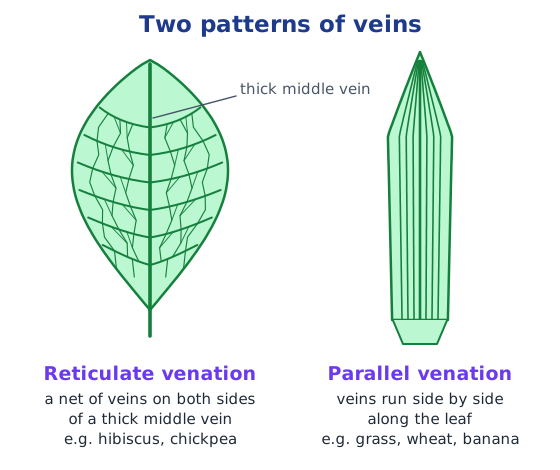
- Reticulate venation: a net-like pattern of veins on both sides of a thick middle vein. Hibiscus leaves show it.
- Parallel venation: the veins run parallel to each other. Banana and grass leaves show it.
So leaves give us one more way to group plants.
Two kinds of roots
Do all plants have similar roots? In Activity 2.6, you wet the soil around a few small herbs, loosen it with a khurpi (trowel) and gently dig them out without damaging the roots. After washing and observing the roots, you replant the herbs so they can keep growing.
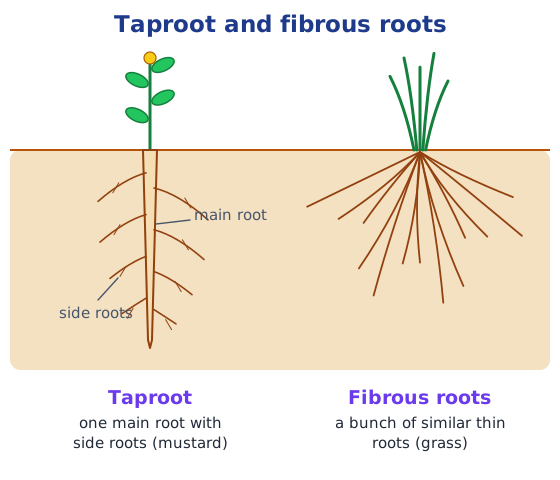
- Taproot: one main root with small side roots arising from it, as in a mustard plant. Hibiscus has a taproot too.
- Fibrous roots: a bunch of similar-sized thin roots growing from the base of the stem, as in common grass. Other grasses have fibrous roots as well.
Venation and roots go together
In Activity 2.7, you collect saplings of five common plants, for example lemongrass, marigold and sadabahar (periwinkle), and record their venation and roots before planting them in the school garden. A pattern appears:
| Plant | Leaf venation | Roots |
|---|---|---|
| Lemongrass | Parallel | Fibrous |
| Sadabahar | Reticulate | Taproot |
| Chickpea (chana) | Reticulate | Taproot |
| Wheat | Parallel | Fibrous |
Generally, plants with reticulate venation have taproots, and plants with parallel venation have fibrous roots.
Seeds: dicots and monocots
Are all seeds alike? In Activity 2.8, you soak chickpea and maize seeds in water for two or three days and remove the seed coat of a chickpea. The chickpea splits into two parts; each part is a cotyledon. Maize has a single thin cotyledon.
- Plants whose seeds have two cotyledons are dicotyledons, or dicots.
- Plants whose seeds have one cotyledon are monocotyledons, or monocots.
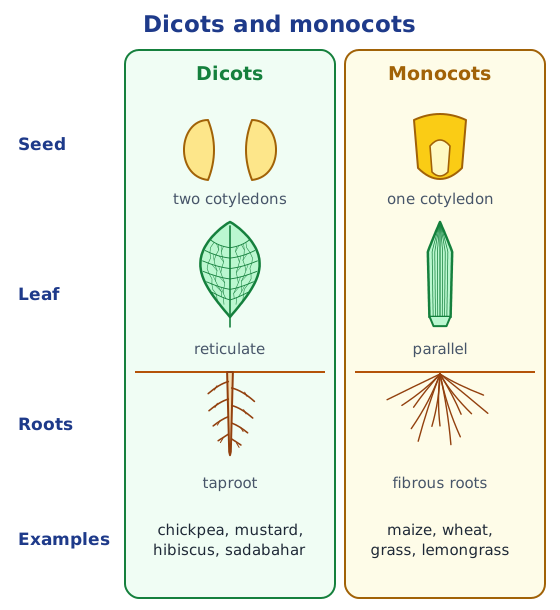
Now the three features line up: dicots have reticulate venation and a taproot system, while monocots have parallel venation and a fibrous root system.
| Dicots | Monocots | |
|---|---|---|
| Cotyledons in the seed | Two | One |
| Leaf venation | Reticulate | Parallel |
| Roots | Taproot | Fibrous |
| Examples | chickpea, mustard, hibiscus, sadabahar, kidney bean | maize, wheat, grass, lemongrass, banana |
Try it yourself
Collect a peepal or mango leaf and a blade of grass or a maize leaf. Hold each against the light: the peepal leaf shows a thick middle vein with a fine net of smaller veins, while the grass blade shows many thin veins running side by side from base to tip. Then gently dig out a small weed and a tuft of grass after watering the soil. Compare their roots, note what you see in your notebook, and replant them.
Using the pattern
Because these features usually go together, one clue tells you about the others. A radish is a thick taproot that stores food, so you can expect net-like veins in its leaves. Wheat grains have one cotyledon, so a wheat plant will have parallel venation and fibrous roots. For herbs, shrubs and trees, see herbs, shrubs and trees; for every textbook question, see the Chapter 2 NCERT solutions.
Practice
-
Leaves of a grass plant have:
Show answer
Answer: (b) parallel venation
-
A mustard plant has:
Show answer
Answer: (b) a taproot
-
A seed that splits into two cotyledons belongs to a:
Show answer
Answer: (b) dicot
-
Wheat has parallel venation in its leaves. What kind of roots would you expect it to have?
Show answer
Answer: Fibrous roots. Plants with parallel venation, like wheat, are generally monocots, which have fibrous roots.
-
How can you see the veins of a leaf clearly?
Show answer
Answer: Hold the leaf up against light, or look at its underside: the veins stand out as thin lines, and you can see whether they form a net or run parallel.
Questions students ask
What is the difference between reticulate and parallel venation?
In reticulate venation, the veins form a net-like pattern on both sides of a thick middle vein, as in hibiscus leaves. In parallel venation, the veins run parallel to each other, as in banana and grass leaves.
What is the difference between a taproot and fibrous roots?
A taproot is one main root with small side roots arising from it, as in mustard and hibiscus. Fibrous roots are a bunch of similar-sized thin roots growing from the base of the stem, as in grasses.
What are dicots and monocots?
Plants whose seeds have two cotyledons are dicotyledons (dicots), like chickpea; plants whose seeds have a single cotyledon are monocotyledons (monocots), like maize. Dicots generally have reticulate venation and a taproot; monocots, parallel venation and fibrous roots.
Stuck on a question?
Take a photo and Lagnever AI explains it step by step. Try it for 7 days for ₹2.
Get it on Google Play Open in browser
For parents: after the trial, the plan renews monthly by UPI or card autopay. You can cancel anytime in the app.