
NCERT Solutions Class 6 Science Chapter 2: Diversity in the Living World
Answers to Activities 2.1 to 2.10, the in-text questions and all 10 questions of “Let us enhance our learning” in Chapter 2, Diversity in the Living World, of Curiosity (Reprint 2026-27). The page numbers match the book. Many tasks are observations you make yourself, so the answers show sample entries; your own lists will differ. Short notes: Chapter 2 notes.
Activity 2.1: plants and animals around us (pages 10–12)
Table 2.1, with sample entries (the first two rows and part of the others are given in the book):
| Plant | Stem | Leaves | Flowers | Other features |
|---|---|---|---|---|
| Common grass | Soft and thin | A single leaf grows alternately from different points on the stem | Not easily seen | Green leaves |
| Tulsi | Hard and thin | A pair of leaves in opposite directions | Pinkish purple | Strong smell when crushed |
| Hibiscus | Hard | Broad leaves with jagged edges, one at each point on the stem | Large, often red, five petals | Has a taproot |
| Neem | Hard and thick | Leaves with smooth surfaces | Small and white | A tall tree giving shade |
Similarities and differences among the plants: all have stems, leaves and roots, and most have flowers. They differ in height; in whether the stem is hard or soft, thick or thin; in the shape and arrangement of leaves; and in the colour, shape and scent of their flowers.
Table 2.2, with sample entries:
| Animal | Where it lives | Food | How it moves | Other features |
|---|---|---|---|---|
| Crow | Tree | Insects | Flies and walks | Carries a twig in its beak |
| Ant | Nest in soil, burrow | Leaves, seeds, insects | Walks | Has six legs |
| Cow | Shed and fields | Grasses, leaves | Walks | Four legs and two horns |
| Frog | Pond and nearby land | Insects | Hops and swims | Moist skin, long back legs |
| Fish | Pond or river | Small water plants and animals | Swims | Fins and a tail |
Similarities and differences among the animals: some live on land, some on trees, some in water, and some, like frogs, both on land and in water. They eat different foods and move in different ways: walking, flying, hopping or swimming.
Activity 2.2: let us appreciate (page 13)
Answers will vary. The class usually draws many different plants (mango, rose, tulsi, banyan) and animals (dog, cat, cow, peacock, butterfly). Even so, there are many more kinds of plants and animals than a whole class can draw: this variety in a region is its biodiversity.
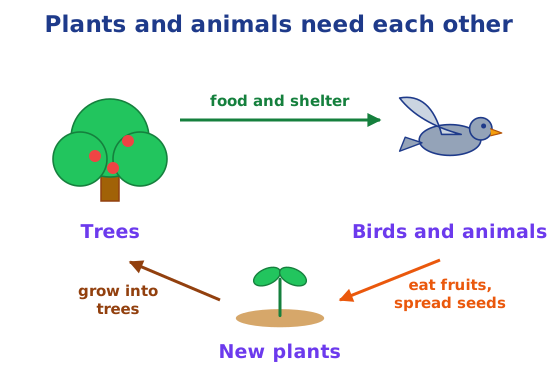
More examples of living things depending on each other (page 14)
- Birds build nests in trees and eat insects that feed on the leaves.
- Bees and butterflies drink nectar from flowers and carry pollen from flower to flower, which helps plants make fruits and seeds.
- Cows and goats eat grass, and their dung enriches the soil in which plants grow.
- Earthworms loosen the soil, which helps roots grow and take in water and air.
Grouping and Activity 2.3 (pages 14–15)
How would you arrange your books and notebooks? By subject (all Science books together), by type (textbooks and notebooks apart) or by size. Yes, grouping helps: you find what you need quickly and the bag stays organised.
Why do different groups use different bases? Each group picks a different common feature. Some group plants by height, others by the presence or absence of flowers or by hard or soft stems; animals may be grouped by what they eat, where they live, their colour or how they move. Every basis is correct if it is applied consistently.
Activity 2.4: herbs, shrubs and trees (pages 15–17)
Table 2.3, with three more plants:
| Plant | Height | Stem | Branches start | Group |
|---|---|---|---|---|
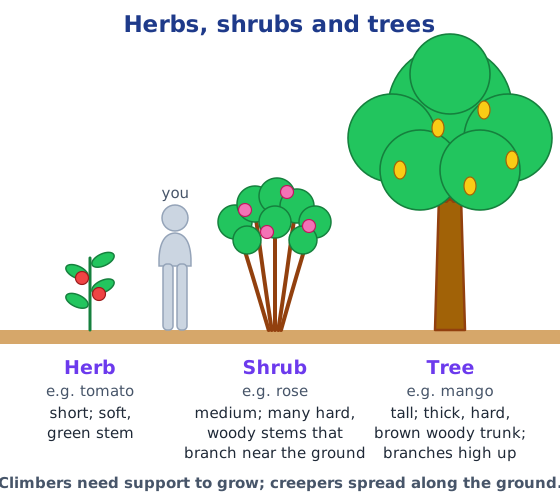
| Mango | Tall | Brown, hard, thick | Higher up on the stem | Tree |
| Rose | Medium | Brown, hard, thin | Close to the ground | Shrub |
| Tomato | Short | Green, tender, thin | Close to the ground | Herb |
| Neem | Tall | Brown, hard, thick | Higher up on the stem | Tree |
| Hibiscus | Medium | Brown, hard, thin | Close to the ground | Shrub |
| Mint | Short | Green, tender, thin | Close to the ground | Herb |
Differences among herbs, shrubs and trees: trees are tall with hard, thick, brown, woody stems branching high up; shrubs are of medium height with many hard, woody stems branching close to the ground; herbs are short with soft, green stems. So the height, the nature of the stem and where the branches start decide the group.
Activity 2.5: venation (page 17)
Differences between the veins in Fig. 2.4a and Fig. 2.4b: the hibiscus leaf has a thick middle vein with a net of smaller veins on both sides (reticulate venation); in the banana leaf, the veins run parallel to each other (parallel venation).
Can plants be grouped by venation? Yes: into plants with reticulate venation and plants with parallel venation.
Activity 2.6: roots (page 18)
Similarities and differences in the roots: all the roots hold the plant in the soil, but some plants have one thick main root with thin side roots, while others have a bunch of thin roots of similar size.
Fig. 2.5a and Fig. 2.5b: the mustard plant has a taproot, one main root with side roots; the grass has fibrous roots, similar thin roots growing from the base of the stem.
Other grasses in your collection? Grasses such as doob grass have fibrous roots too.
Activity 2.7: venation and roots (page 19)
Table 2.4, with sample entries:
| Plant | Leaf venation | Roots |
|---|---|---|
| Lemongrass | Parallel | Fibrous |
| Marigold | Reticulate | Taproot |
| Sadabahar | Reticulate | Taproot |
| Maize | Parallel | Fibrous |
| Tulsi | Reticulate | Taproot |
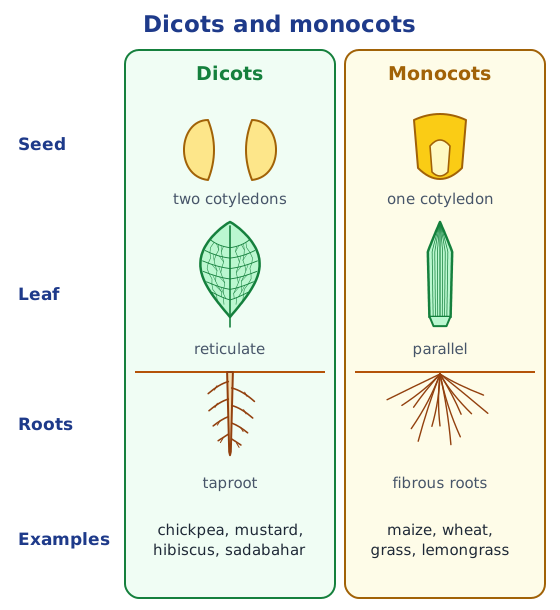
Is there a relation? Yes. Plants with reticulate venation have taproots, and plants with parallel venation have fibrous roots, generally. Chickpea (reticulate, taproot) and wheat (parallel, fibrous) follow the same rule.
Activity 2.8: seeds (page 20)
Are the chickpea and maize seeds similar? No. The soaked chickpea splits into two parts, two cotyledons; maize has a single thin cotyledon.
Relation between venation, roots and cotyledons: dicots (two cotyledons, like chickpea) have reticulate venation and a taproot; monocots (one cotyledon, like maize) have parallel venation and fibrous roots.
Activity 2.9: movement in animals (pages 21–22)
Table 2.5, completed with a few more animals:
| Animal | Type of movement | Body parts used |
|---|---|---|
| Ant | Walks | Legs |
| Goat | Walks and jumps | Legs |
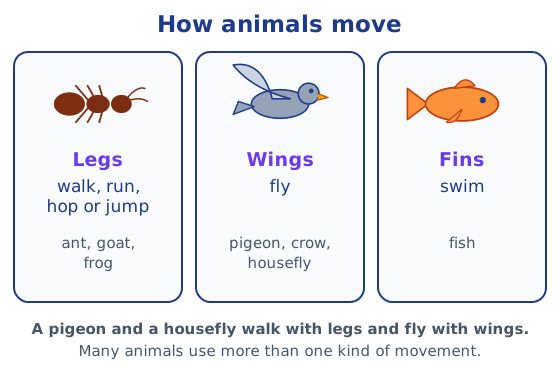
| Pigeon | Walks and flies | Legs and wings |
| Housefly | Walks and flies | Legs and wings |
| Fish | Swims | Fins (and tail) |
| Frog | Hops and swims | Legs |
| Snake | Crawls (slithers) | Whole body |
| Duck | Walks, swims and flies | Legs, webbed feet and wings |
Conclusions: different animals move in different ways (they fly, run, crawl, walk, hop or jump, and swim) and use different body parts: legs, wings, fins or the whole body. Animals can be grouped by movement, for example into those that fly, those that swim and those that walk or crawl.
Activity 2.10: living things in different surroundings (pages 23–24)
Does movement depend on the surroundings? Yes. Fish live in water and swim with fins and streamlined bodies; goats live in grassy areas and walk with legs.
Table 2.6, with sample entries:
| In the desert | On the mountains | In the ocean | In the forest |
|---|---|---|---|
| Camel | Deodar tree | Fish | Lion |
| Cactus | Yak | Whale | Tiger |
| Khejri tree | Rhododendron | Octopus | Elephant |
Observations: the plants and animals of one kind of region are different from those of another. Biodiversity varies from region to region because the conditions differ, and living things have features that suit their region.
Camels and other adaptations (pages 25–26)
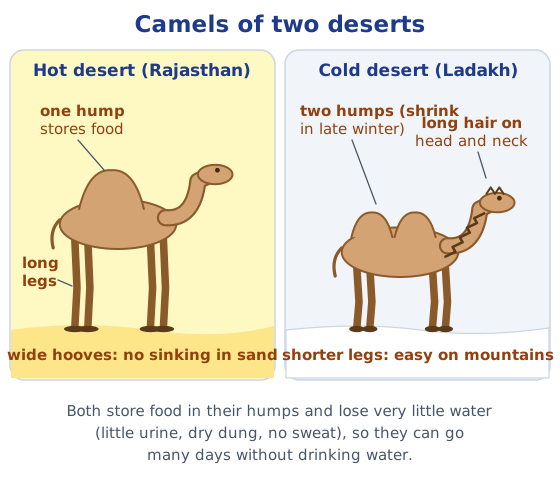
Differences between the two camels, and their advantages: the hot-desert camel has long legs and wide hooves, which keep it from sinking into sand, and one hump to store food. The cold-desert camel is shorter, with short legs for walking in mountainous regions, two humps that store food for the late winter, and long hair from head to neck for warmth.
Other features that help camels survive in the desert: they pass small amounts of urine, their dung is dry and they do not sweat, so they lose little water and can go many days without drinking. (Extra: their long eyelashes help keep sand out of their eyes.)
Habitats (pages 27–29)
What would happen if a habitat is damaged? The plants and animals lose their homes, food and other resources; many die or move away, and biodiversity is lost. A goat without grass would go hungry, and a fish cannot survive without water.
Plants and animals your elders saw more often as children: answers will vary. Many families mention house sparrows, vultures, fireflies or certain trees and wild flowers that are less common now.
Sacred groves in your region: answers depend on where you live. (Extra: sacred groves have local names, such as devrai in Maharashtra, kavu in Kerala, orans in Rajasthan and sarna in Jharkhand.)
Let us enhance our learning (pages 31–33)
1. Wheat and kidney beans: differences in roots and leaf venation
Wheat is a monocot: its plants have fibrous roots and leaves with parallel venation. Kidney bean (rajma) is a dicot: its plants have a taproot and leaves with reticulate venation.
2. Group the animals by habitat
- A, aquatic: dolphin, whale.
- B, terrestrial: horse, sheep, squirrel, earthworm, pigeon, tortoise.
- C, both: frog, crocodile.
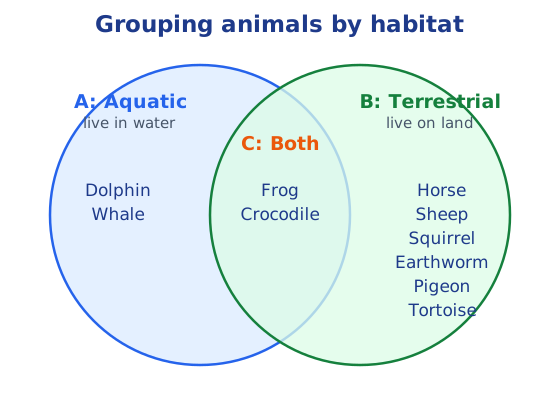
A tortoise lives on land; its relatives the turtles spend much of their lives in water.
3. Radish: type of root and venation
A radish is a taproot: one thick main root (which stores food) with thin side roots. So its leaves would show reticulate venation.
4. Mountain goat and goat of the plains
Similarities: both have four legs with hooves, horns, a body covered with hair, and both eat plants.
Differences: the mountain goat has a very thick, long, shaggy white coat and sturdy legs and hooves for rocky slopes; the goat of the plains has a short, thin coat.
Reason: each is adapted to its habitat. The thick coat keeps the mountain goat warm in the cold, snowy mountains, and its sturdy legs help it climb; the plains are warmer, so a thin coat is enough.
5. Group the animals by another feature
Using the backbone, a feature not discussed in the chapter:
- Animals with a backbone: cow, pigeon, bat, tortoise, whale, fish, lizard.
- Animals without a backbone: cockroach, grasshopper.
Another way is by how the young are born: animals that give birth to young ones (cow, bat, whale) and animals that lay eggs (cockroach, pigeon, tortoise, fish, grasshopper, lizard).
6. Forests being cut down
Effects: animals and plants lose their habitats, so biodiversity is lost; wild animals may wander into towns and farms; the soil is washed away more easily by rain, and floods can increase; places become hotter and the air dustier; and people who depend on forests lose food, fuel and medicines.
What we can do: plant and care for trees, protect forests through protected areas and community efforts such as sacred groves, use paper and wood carefully and recycle, choose places for roads and buildings that avoid cutting forests, and raise awareness, as the Save Silent Valley movement did.
7. The flowchart: examples of A and B
A (has leaves, with reticulate venation): hibiscus, mango, rose, mustard, chickpea or neem.
B (has leaves, without reticulate venation, so parallel venation): grass, wheat, maize, banana or lemongrass.
8. Is gudhal (hibiscus) a shrub? Sanjay’s questions
- How tall is the plant: shorter than you, as tall as you, or as tall as a tree?
- Is its stem green and soft, or brown, hard and woody?
- Is the stem thick like a tree trunk, or are there several thinner stems?
- Do the branches start close to the ground or high up on the stem?
If the plant is of medium height with several hard, brown, woody stems branching near the ground, Raj is right: it is a shrub.
9. Examples for groups A and B
| Group | Seed | Root | Examples |
|---|---|---|---|
| A | Dicot | Taproot | chickpea, mustard, kidney bean, hibiscus, mango, sadabahar |
| B | Monocot | Fibrous roots | wheat, maize, rice, grass, lemongrass, banana |
(a) Plants of group A also have leaves with reticulate venation.
(b) Plants of group B also have leaves with parallel venation.
10. The duck’s feet
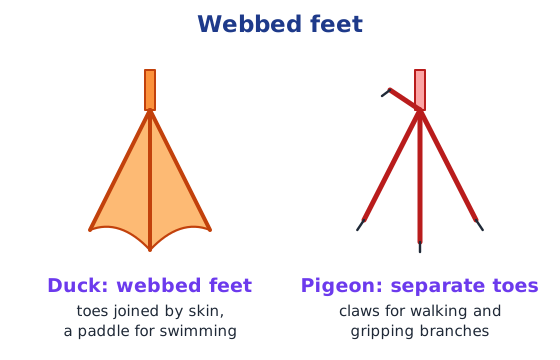
The duck’s toes are joined by a thin skin: it has webbed feet. Other birds, like the pigeon, have separate toes with claws for walking and gripping branches. The webbed feet work like paddles, so the duck can swim in water.
Learning further (pages 33–34)
A brief report on a scientist or wildlife biologist: include who they are, where they work, which plants, animals or places they study or protect, what they found or achieved, and why it matters for India’s biodiversity.
Extra: starting points for the seven names in the book (check the details in books or reliable websites):
| Name | Known for |
|---|---|
| Divya Mudappa | Restoring rainforests in the Anamalai Hills of the Western Ghats |
| Usha Lachungpa | Studying and protecting the wildlife of Sikkim |
| Ghazala Shahabuddin | Studying birds and forests, and how people and wildlife can share land |
| Nandini Velho | Studying wildlife and hunting in the forests of Arunachal Pradesh |
| Vidya Athreya | Research on leopards that live close to people |
| Uma Ramakrishnan | Studying the genes of tigers and other wild animals |
| Divya Karnad | Protecting marine life through sustainable fishing |
The other tasks (labelling school plants, a class biodiversity register, a presentation on Project Tiger, a group report on protecting biodiversity, and a scrapbook from talks with elders) are projects for you and your class. For more practice, read herbs, shrubs and trees, leaf venation and roots, habitat and adaptation and what is biodiversity.
Practice
-
Which of these plants is a monocot?
Show answer
Answer: (c) Maize
-
Frogs are called amphibians because they:
Show answer
Answer: (b) live in water as well as on land
-
The Save Silent Valley movement saved a forest in:
Show answer
Answer: (a) Kerala
-
Why do camels of the hot desert have wide hooves?
Show answer
Answer: Long legs and wide hooves help them walk on the sandy desert without sinking into the sand.
-
Name two terrestrial and two aquatic habitats.
Show answer
Answer: Terrestrial: forests and deserts (also grasslands and mountains). Aquatic: ponds and oceans (also lakes and rivers).
Stuck on a question?
Take a photo and Lagnever AI explains it step by step. Try it for 7 days for ₹2.
Get it on Google Play Open in browser
For parents: after the trial, the plan renews monthly by UPI or card autopay. You can cancel anytime in the app.