
What is a habitat, and what is an adaptation?
Answer in short
A habitat is the place where a plant or an animal lives; it gives food, water, air and shelter. An adaptation is a special feature that helps a living thing survive in its region. A cactus stores water in its fleshy stem in the desert, and a deodar's cone shape and sloping branches let snow slide off on mountains.
Stuck on a question? Take a photo and Lagnever AI explains it step by step. Try it for 7 days for ₹2. Get it on Google Play
Different places, different living things
On a nature walk you may notice that different animals live in different surroundings. In Activity 2.10, the class lists living things from different regions: a camel in the desert, a deodar tree on the mountains, fish in the ocean and a lion in the forest. The plants and animals of one kind of region are different from those of another. Why?
Each region has its own conditions: how much water there is, how hot or cold it gets, whether it snows. Living things that survive there have features that suit those conditions. That is why biodiversity varies from region to region.
Adaptations
The special features that enable plants and animals to survive in a particular region are called adaptations.
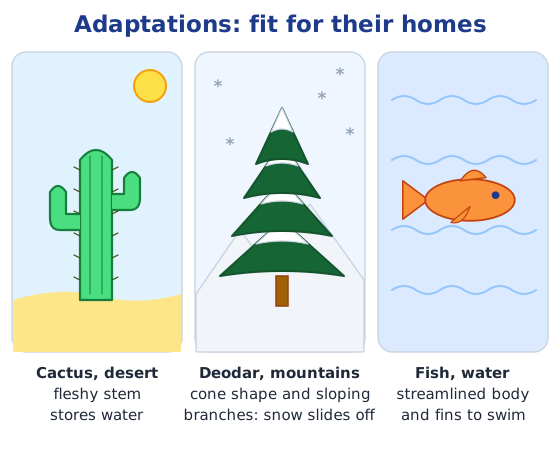
- Cactus (desert): a hot desert has very little water and is very hot by day and very cold at night. The thick, fleshy stem of a cactus stores water and helps it tolerate the heat.
- Deodar (snowy mountains): mountains in very cold regions get frequent snowfall. The cone shape and sloping branches of a deodar let the snow slide off easily.
- Fish (water): fish have streamlined bodies and fins, which make swimming in water easier. A goat on land moves with its legs instead.
- Rhododendron (mountains): in the Shola forests of the Nilgiris, rhododendrons are short with small leaves, which helps them survive heavy winds on mountain tops; in Sikkim they grow taller. The same plant shows different features in different regions.
Camels of two deserts
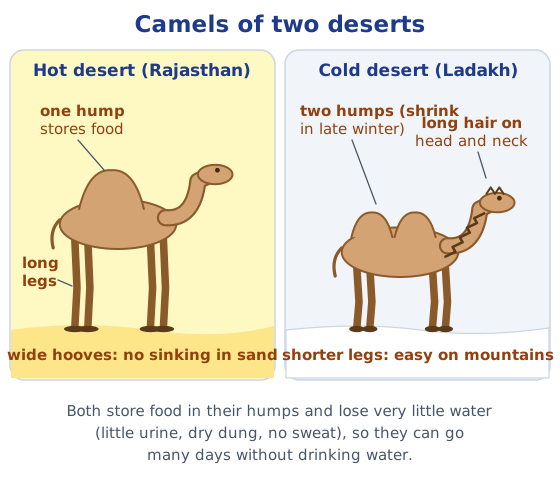
| Feature | Camel of the hot desert (Rajasthan) | Camel of the cold desert (Ladakh) |
|---|---|---|
| Legs and height | Long legs, taller | Shorter legs and height |
| Why it helps | Long legs and wide hooves keep it from sinking into sand | Short legs help it walk in mountainous regions |
| Humps | One hump, storing food | Two humps, which shrink in late winter as stored food is used |
The cold-desert camel also grows long hair from its head to its neck, which helps it survive the cold winters of Ladakh. Camels also lose very little water: they pass small amounts of urine, their dung is dry and they do not sweat, so they can survive many days without drinking.
Habitat
The place where plants and animals live is their habitat. The habitat of sea turtles is the sea or the ocean; of a camel, the hot or cold desert; of a rhododendron, the mountains. A habitat provides food, water, air, shelter and other needs. Many kinds of plants and animals can share the same habitat, so habitats shape the biodiversity of a region.
Terrestrial and aquatic habitats
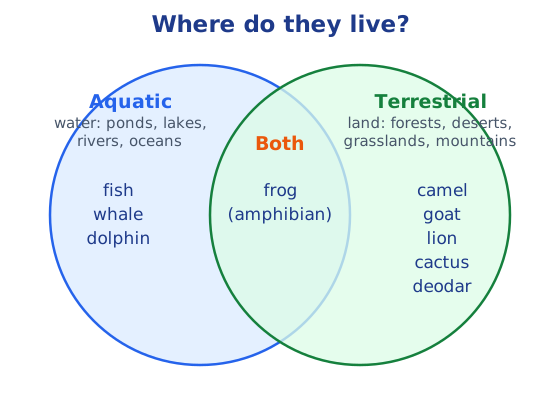
One simple way to group plants and animals by habitat is land or water:
- Terrestrial habitats (on land): forests, deserts, grasslands and mountains.
- Aquatic habitats (in water): ponds, lakes, rivers and oceans.
- Amphibians, such as frogs, can live in water as well as on land.
When a habitat is damaged
What would happen if a goat got no grass to eat, or a fish had no water? Living things depend on their habitat. When habitats are damaged, plants and animals lose their homes, food and other resources, and the region loses biodiversity. Read how biodiversity is protected in what is biodiversity, and see the Chapter 2 notes for the whole chapter.
Practice
-
The fleshy stem of a cactus helps it to:
Show answer
Answer: (b) store water
-
Which of these is an aquatic habitat?
Show answer
Answer: (c) Pond
-
Camels of the cold desert of Ladakh have:
Show answer
Answer: (b) two humps and long hair on the head and neck
-
How does the shape of a deodar tree help it survive in snowy mountains?
Show answer
Answer: Its cone shape and flexible, sloping branches let snow slide off easily, so the snow does not pile up on the tree.
-
What would happen to a fish taken out of water?
Show answer
Answer: It cannot survive. Water is its habitat: it breathes, finds food and moves with its fins only in water.
Questions students ask
What is a habitat?
The place where a plant or an animal lives. It provides food, water, air, shelter and other needs. The sea is the habitat of sea turtles, a hot or cold desert of camels, and the mountains of rhododendrons.
What is an adaptation? Give examples.
A special feature that enables a plant or an animal to survive in a particular region. Examples: the water-storing fleshy stem of a cactus, the cone shape of a deodar, the streamlined body and fins of a fish, and the long legs and wide hooves of a desert camel.
What are terrestrial and aquatic habitats?
Terrestrial habitats are on land, such as forests, deserts, grasslands and mountains. Aquatic habitats are in water, such as ponds, lakes, rivers and oceans.
Stuck on a question?
Take a photo and Lagnever AI explains it step by step. Try it for 7 days for ₹2.
Get it on Google Play Open in browser
For parents: after the trial, the plan renews monthly by UPI or card autopay. You can cancel anytime in the app.