
What is biodiversity?
Answer in short
Biodiversity is the variety of plants and animals found in a particular region. Each member has a role: trees give birds food and shelter, and animals spread seeds. Biodiversity differs from region to region because conditions differ. When habitats are damaged, it is lost, so India protects it through Project Tiger, the Cheetah project and protected areas.
Stuck on a question? Take a photo and Lagnever AI explains it step by step. Try it for 7 days for ₹2. Get it on Google Play
The meaning of biodiversity
On the nature walk at the start of the chapter, the students meet grasses, bushes and large trees, birds on branches, butterflies moving from flower to flower and monkeys jumping between trees. Dr Raghu points out that each bird has its own unique chirp: an example of diversity in nature.
In Activity 2.2, every student closes their eyes, thinks of one plant and one animal they have admired, and draws them on the blackboard. The class ends up with many different plants and animals, and there are many more that nobody drew. The variety of plants and animals found in a particular region is called its biodiversity.
Every member has a role
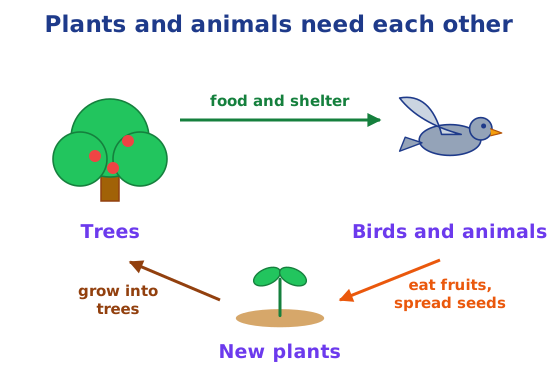
Each plant and animal in a region plays its part. Trees provide food and shelter to birds and other animals; animals help spread seeds after eating fruits. Plants and animals depend on each other.
Grouping helps us study biodiversity
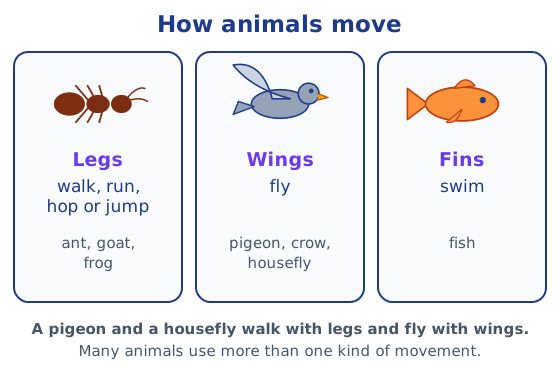
With so much variety, scientists group living things by their similarities and differences. Plants can be grouped as herbs, shrubs and trees, or as dicots and monocots; animals by how they move, what they eat or where they live.
Why biodiversity differs between regions
A hot desert, a snowy mountain, an ocean and a forest have very different conditions, so they hold different plants and animals, each with features that suit its home. Read about these features in habitat and adaptation.
How biodiversity is lost
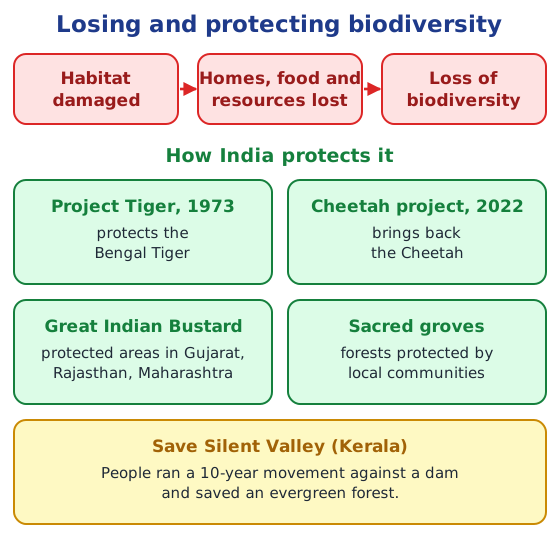
Ask your parents, grandparents and neighbours which plants, birds or insects they saw often as children but rarely see now. Such changes often happen when habitats are damaged. Plants and animals then lose their homes, food and other resources, and biodiversity is lost.
In India, the populations of the Bengal Tiger, the Cheetah and the Great Indian Bustard declined because human activities destroyed their natural habitats.
How India protects biodiversity
- Project Tiger, started in 1973, protects the declining population of the Bengal Tiger.
- The Cheetah Reintroduction Project, started in 2022, aims to restore the Cheetah’s population.
- The habitats of the Great Indian Bustard have been declared protected areas in Gujarat, Rajasthan and Maharashtra.
- Sacred groves are undisturbed patches of forest, found all over India and protected by local communities: no one may cut trees, harm animals or disturb the area.
- Save Silent Valley: in Palakkad district of Kerala, common people, many living far from the forest, fought a proposed hydroelectric dam on the Kunthipuzha river for 10 years, through awareness programmes, letters, articles, seminars and petitions in court, and saved this moist evergreen forest.
People who protected biodiversity
Janaki Ammal (1897–1984), an Indian botanist, helped document and preserve India’s plant diversity, played a key role in the Save Silent Valley movement and, as head of the Botanical Survey of India, started programmes to record the country’s plants.
Salim Ali (1896–1987), the ‘Birdman of India’, travelled across India to study birds, their travel routes and habitats, and helped conserve places such as Keoladeo National Park in Bharatpur, Rajasthan, and Ranganathittu Bird Sanctuary in Mandya, Karnataka. He wrote a landmark series of 10 books on the birds of the Indian subcontinent and received the Padma Vibhushan in 1976.
We must protect biodiversity so that our planet stays full of life. For the textbook’s questions, see the Chapter 2 NCERT solutions; for the whole chapter, see the Chapter 2 notes.
Practice
-
Biodiversity of a region means:
Show answer
Answer: (b) the variety of plants and animals found there
-
Project Tiger was started in:
Show answer
Answer: (b) 1973
-
Who is called the ‘Birdman of India’?
Show answer
Answer: (b) Salim Ali
-
Give two examples of how plants and animals depend on each other.
Show answer
Answer: Trees give food and shelter to birds and other animals; animals eat fruits and spread the seeds, which grow into new plants.
-
What are sacred groves?
Show answer
Answer: Undisturbed patches of forest, small or very large, protected by the local community. No one may cut trees, harm animals or disturb the area, so they are a treasure of biodiversity, including many medicinal plants.
Questions students ask
What is biodiversity?
The variety of plants and animals found in a particular region. A nature walk shows it: grasses, bushes and trees, birds with their own chirps, butterflies, insects and monkeys all add to the biodiversity of a place.
Why is biodiversity lost?
Mainly because habitats are damaged, for example when forests are cut. Plants and animals then lose their homes, food and other resources. In India, the Bengal Tiger, the Cheetah and the Great Indian Bustard declined because human activities destroyed their natural habitats.
How is biodiversity protected in India?
Through projects such as Project Tiger (1973) and the Cheetah Reintroduction Project (2022), protected areas for the Great Indian Bustard in Gujarat, Rajasthan and Maharashtra, sacred groves guarded by communities, and people's movements such as Save Silent Valley.
Stuck on a question?
Take a photo and Lagnever AI explains it step by step. Try it for 7 days for ₹2.
Get it on Google Play Open in browser
For parents: after the trial, the plan renews monthly by UPI or card autopay. You can cancel anytime in the app.