
Class 6 Science Chapter 2: Diversity in the Living World Notes
This chapter in five lines
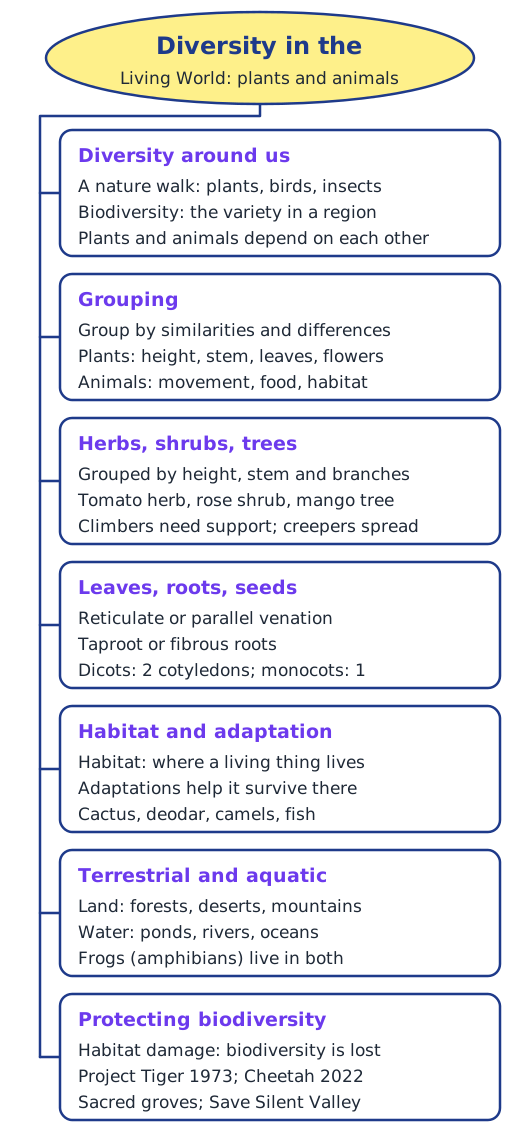
We are surrounded by a huge variety of plants and animals, and the variety found in a region is its biodiversity. Grouping living things by their similarities and differences makes them easier to study. Plants can be grouped into herbs, shrubs and trees, and into dicots and monocots: dicots usually have reticulate venation and a taproot, monocots parallel venation and fibrous roots. Animals can be grouped by how they move. Adaptations help living things survive in their habitats, and damaging habitats causes a loss of biodiversity.
A walk through biodiversity
The chapter opens with an old saying: trees stand in the Sun and give shade and fruit to others, just as good people work for the welfare of others. Then the class goes on a nature walk with Dr Raghu, a scientist, and Maniram chacha, an elder who can mimic bird calls and name many plants and animals. The students see grasses, bushes and big trees, birds on branches, butterflies on flowers and monkeys jumping from tree to tree, and they learn that each bird has its own chirp.
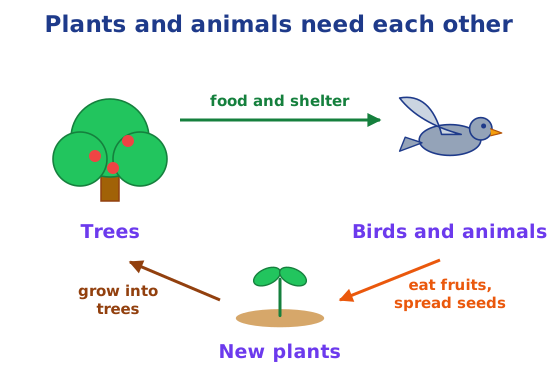
In Activity 2.1 they record the stems, leaves and flowers of plants such as grass, tulsi, hibiscus and neem, and the homes, food and movement of animals such as a crow and an ant. Plants differ in height and hardness of stem, in the shape and arrangement of leaves, and in the colour, shape and scent of flowers. The variety of plants and animals found in a particular region is called its biodiversity. Each member has a role: trees give food and shelter to birds and other animals, and animals spread seeds after eating fruits.
Why group plants and animals?
Arranging your books and notebooks in groups helps you organise your school bag. In the same way, grouping living things by their similarities and differences makes them easier to study. Different groups may choose different features: the height of plants, the presence or absence of flowers, a hard or soft stem, or, for animals, what they eat, where they live, their colour or how they move.
Herbs, shrubs and trees
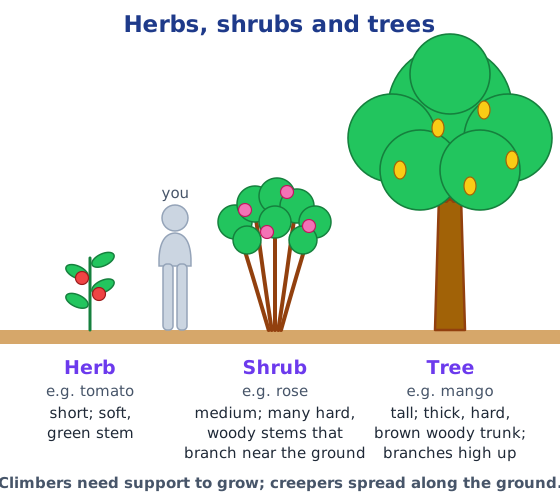
By height, type of stem and where the branches start, plants are grouped into herbs, shrubs and trees. Read more in herbs, shrubs and trees.
| Plant | Height | Stem | Branches | Group |
|---|---|---|---|---|
| Mango | Tall | Brown, hard, thick | Higher up on the stem | Tree |
| Rose | Medium | Brown, hard, thin | Close to the ground | Shrub |
| Tomato | Short | Green, tender, thin | Close to the ground | Herb |
Plants with weak stems that need support to climb are climbers; plants that creep along the ground are creepers.
Leaves, roots and seeds
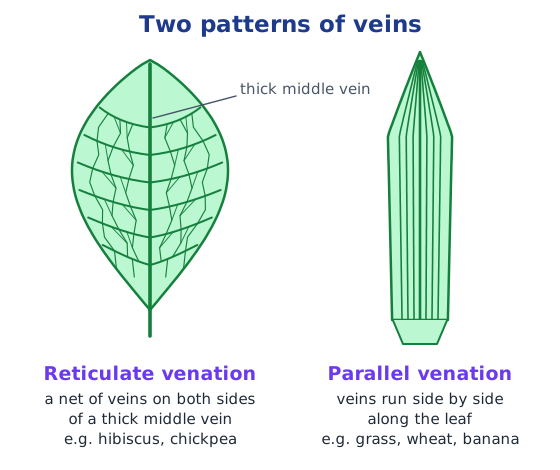
The thin lines on a leaf are veins, and their pattern is venation. Hibiscus leaves have reticulate venation, a net of veins on both sides of a thick middle vein; banana and grass leaves have parallel venation. Roots differ too: a mustard plant has a taproot, one main root with side roots, while grass has fibrous roots, a bunch of similar thin roots.
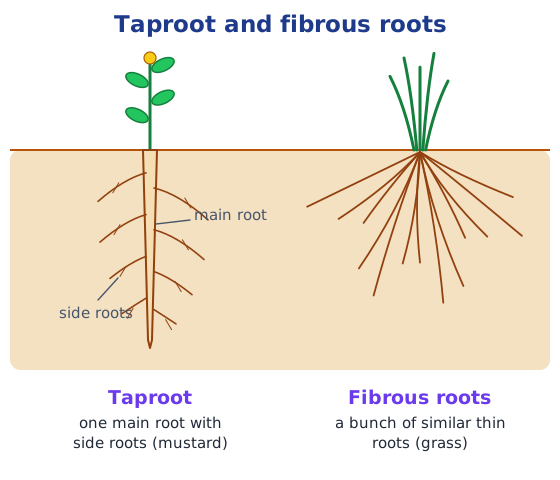
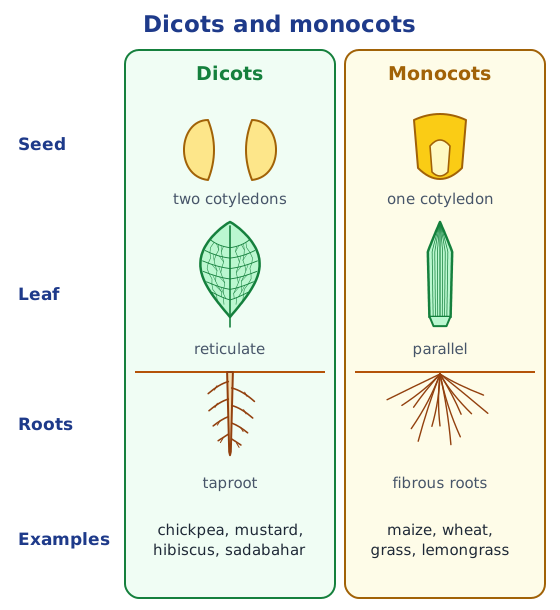
A soaked chickpea seed splits into two parts, each a cotyledon; maize has a single thin cotyledon. Plants with two cotyledons are dicots and plants with one are monocots. The sadabahar and chickpea (dicots) have a taproot and reticulate venation; lemongrass and wheat (monocots) have fibrous roots and parallel venation. Read more in leaf venation and roots.
Grouping animals by movement
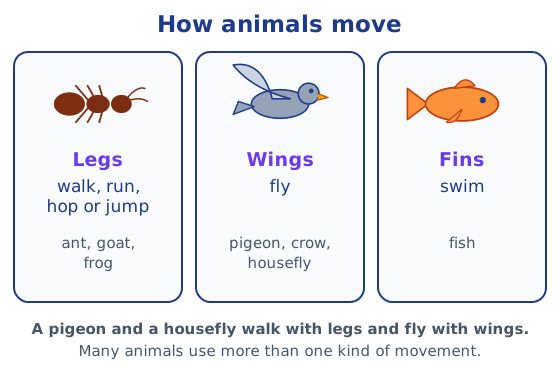
Animals walk, run, crawl, hop, jump, fly or swim, using different body parts. An ant walks with its legs, a goat walks and jumps, a fish swims with its fins, and a pigeon and a housefly both walk with legs and fly with wings. Animals also differ in shape, size, colour and food, and any of these can be used to group them.
Habitats and adaptations
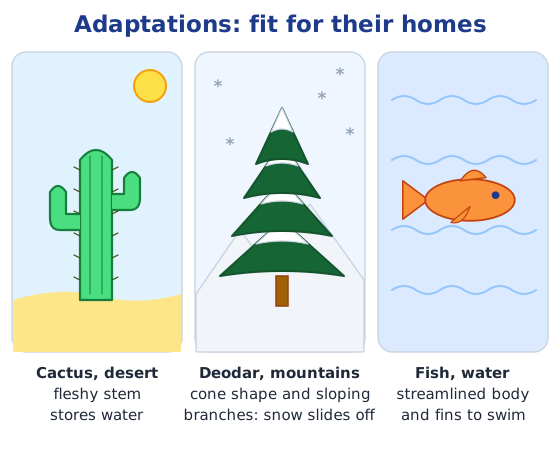
Different regions have different plants and animals: camels in the desert, deodar trees on mountains, fish in the ocean and lions in the forest. A hot desert has little water and is hot by day and cold at night, so a cactus stores water in its thick, fleshy stem. On snowy mountains, the cone shape and sloping branches of the deodar let snow slide off. Fish have streamlined bodies and fins for swimming.
Camels show it too. The camel of the hot desert of Rajasthan has long legs and wide hooves for sandy ground and one hump to store food. The camel of the cold desert of Ladakh is shorter, with two humps that shrink in late winter and long hair on its head and neck. Camels pass little urine, have dry dung and do not sweat, so they can go many days without water. Rhododendrons on the windy hilltops of the Nilgiris are short with small leaves, while those in Sikkim grow taller.
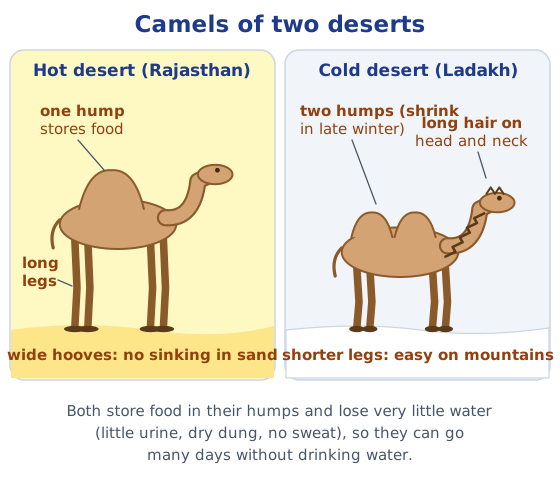
Such special features are adaptations. The place where a plant or an animal lives, which gives it food, water, air and shelter, is its habitat: the sea for sea turtles, a hot or cold desert for camels, the mountains for rhododendrons. Read more in habitat and adaptation.
Terrestrial and aquatic habitats
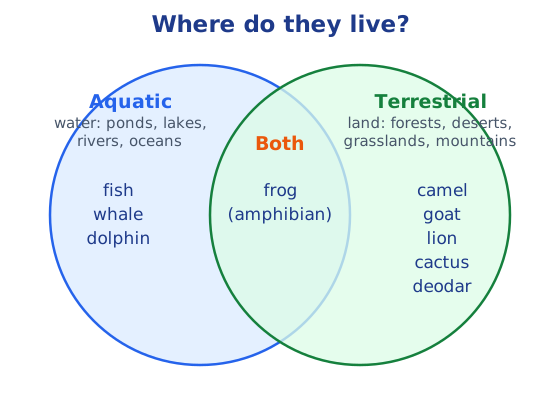
Plants and animals living on land have terrestrial habitats such as forests, deserts, grasslands and mountains. Those living in water have aquatic habitats such as ponds, lakes, rivers and oceans. Frogs can live in water as well as on land; they are amphibians.
Protecting biodiversity
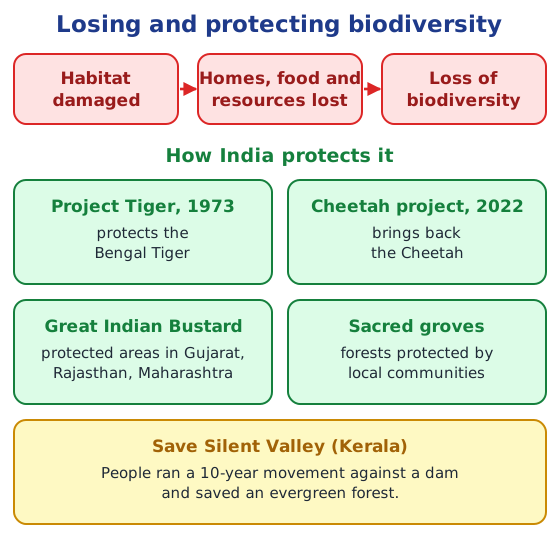
When habitats are damaged, plants and animals lose their homes, food and other resources, and biodiversity is lost. The Bengal Tiger, the Cheetah and the Great Indian Bustard declined in India because human activities destroyed their habitats. Project Tiger began in 1973, the Cheetah Reintroduction Project in 2022, and the Great Indian Bustard’s habitats are protected areas in Gujarat, Rajasthan and Maharashtra. Sacred groves, protected by local communities, and the people’s movement that saved Silent Valley in Kerala show how ordinary people protect biodiversity. Botanist Janaki Ammal documented India’s plant diversity, and Salim Ali, the ‘Birdman of India’, studied birds and helped preserve places like Keoladeo National Park. Read more in what is biodiversity.
Answers to every activity and question are in the NCERT solutions for Chapter 2.
Key terms
| Term | Meaning |
|---|---|
| Biodiversity | The variety of plants and animals found in a particular region. |
| Grouping | Arranging things into groups based on their common features, which makes them easier to understand and study. |
| Herbs, shrubs and trees | Herbs are small with soft, green stems; shrubs have many hard, woody stems branching near the ground; trees are tall with a thick, hard, brown trunk branching high up. |
| Climbers and creepers | Plants with weak stems: climbers need support to climb and grow, creepers spread along the ground. |
| Venation | The pattern of veins on a leaf. In reticulate venation the veins form a net on both sides of a thick middle vein; in parallel venation they run side by side. |
| Taproot | One main root with small side roots growing from it, as in mustard and hibiscus. |
| Fibrous roots | A bunch of similar, thin roots growing from the base of the stem, as in grasses. |
| Cotyledon | A part of a seed. A chickpea seed splits into two cotyledons; a maize seed has a single thin cotyledon. |
| Dicots and monocots | Plants whose seeds have two cotyledons (dicots) or one cotyledon (monocots). |
| Habitat | The place where a plant or an animal lives, which gives it food, water, air, shelter and other needs. |
| Adaptation | A special feature that helps a plant or an animal survive in a particular region, such as the fleshy stem of a cactus. |
| Terrestrial and aquatic | Living on land (forests, deserts, grasslands, mountains) or in water (ponds, lakes, rivers, oceans). |
| Amphibians | Animals, such as frogs, that can live in water as well as on land. |
| Sacred groves | Undisturbed patches of forest protected by the local community, where no one may cut trees or harm animals. |
Topics in this chapter
Practice
-
Which of these plants is a shrub?
Show answer
Answer: (b) Rose
-
Leaves of a banana plant show:
Show answer
Answer: (b) parallel venation
-
A plant with seeds that have two cotyledons usually has:
Show answer
Answer: (b) a taproot
-
The special features that help a plant or an animal survive in a particular region are called:
Show answer
Answer: (b) adaptations
-
In which year was ‘Project Tiger’ started?
Show answer
Answer: (b) 1973
Questions students ask
What are the main topics of Class 6 Science Chapter 2?
Biodiversity around us, why we group plants and animals, herbs, shrubs and trees, leaf venation, taproot and fibrous roots, dicots and monocots, movement in animals, habitats and adaptations, terrestrial and aquatic habitats, and how biodiversity is protected.
Is Diversity in the Living World in the new Curiosity book?
Yes. Diversity in the Living World is Chapter 2 of Curiosity, the Class 6 Science textbook (Reprint 2026-27). It comes after Chapter 1, The Wonderful World of Science.
How many questions does Chapter 2 have at the end?
The “Let us enhance our learning” section has 10 questions, followed by Learning further tasks. Our NCERT solutions page answers all of them, along with Activities 2.1 to 2.10 and the in-text questions.
Stuck on a question?
Take a photo and Lagnever AI explains it step by step. Try it for 7 days for ₹2.
Get it on Google Play Open in browser
For parents: after the trial, the plan renews monthly by UPI or card autopay. You can cancel anytime in the app.