
Standard units of length
Answer in short
Standard units are units of measurement that are the same for everyone, unlike handspans or strides. Countries use the International System of Units (SI), and the SI unit of length is the metre (m). Smaller and larger units come from it: 1 km = 1000 m, 1 m = 100 cm and 1 cm = 10 mm.
Stuck on a question? Take a photo and Lagnever AI explains it step by step. Try it for 7 days for ₹2. Get it on Google Play
Why body units do not work
People have long measured with their bodies: cloth by the length of the arm, fields by counting strides or feet, and small lengths in angula, the width of a finger. When Deepa’s mother asks the tailor to add char angula, she means the width of four fingers. In the chapter, five friends measure the same table in handspans (balisht) and get five different answers, from 13 to 14, because their hands are different sizes.
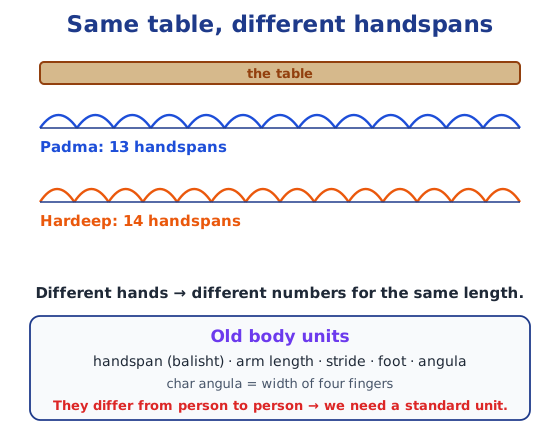
Every measurement has two parts, a number and a unit. In 13 handspans, 13 is the number and the handspan is the unit. A good unit must give the same result whoever does the measuring, and the handspan does not.
From many local units to SI units
India has a rich history of measurement. The angula, its multiples, the dhanusa and the yojana appear in ancient Indian literature and were used in making objects and buildings and in planning towns, and carpenters and tailors still use the angula. Objects with ruled markings that could be scales have been excavated from Harappan sites.
Different parts of the world developed their own systems. When people began travelling from place to place, these created confusion, so countries came together and adopted a common set of standard units: the International System of Units, or SI units.
The metre and its family
The SI unit of length is the metre, symbol m. A metre scale is divided into 100 equal parts called centimetres (cm). On a 15-cm scale, each centimetre is divided into 10 smaller parts called millimetres (mm), so 1 mm = 0.1 cm. One millimetre is the smallest length you can measure with that scale. For long distances, such as the railway track between two cities, we use the kilometre (km).
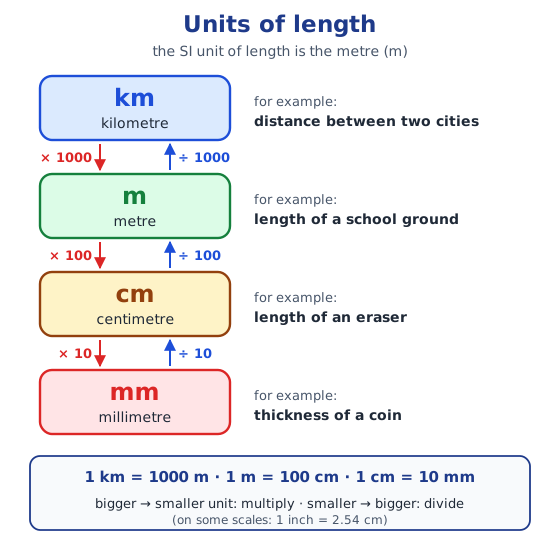
| Unit | Equal to |
|---|---|
| 1 kilometre (km) | 1000 m |
| 1 metre (m) | 100 cm, or 1000 mm |
| 1 centimetre (cm) | 10 mm |
| 1 millimetre (mm) | 0.1 cm |
The metre would be clumsy for the distance between two cities, which runs into thousands of metres, and for the thickness of a page, which is a tiny part of a metre. That is why we have bigger and smaller units.
Changing units
To change a bigger unit into a smaller one, multiply; to change a smaller unit into a bigger one, divide.
- 1.5 km = 1.5 × 1000 = 1500 m.
- A friend 1.42 m tall is 1.42 × 100 = 142 cm, or 142 × 10 = 1420 mm.
- A crayon 75 mm long is 75 ÷ 10 = 7.5 cm.
- A 2500 m race is 2500 ÷ 1000 = 2.5 km.
Choosing a suitable unit
| Length | Suitable unit |
|---|---|
| Distance between Delhi and Lucknow | kilometre |
| Length of a school ground | metre |
| Length of an eraser | centimetre |
| Thickness of a coin | millimetre |
Inches and feet
Some scales have a second set of markings in inches, where 1 inch = 2.54 cm. Units such as the inch and the foot were used in earlier days and are still used by some people, but science and most of the world use SI units.
Writing lengths correctly
- Unit names, such as kilometre, metre, centimetre and millimetre, start with a lowercase letter, except at the beginning of a sentence.
- Their symbols, km, m, cm and mm, are also lowercase and never take an ‘s’ for the plural: 5 cm, not 5 cms.
- No full stop follows a symbol, except at the end of a sentence.
- Leave a space between the number and the unit: 9.4 cm.
To learn how to use a scale properly, read how to measure length correctly. For the textbook’s questions, see the Chapter 5 NCERT solutions; for the whole chapter, see the Chapter 5 notes.
Practice
-
Which of these is not a standard unit of length?
Show answer
Answer: (d) handspan
-
How many centimetres make a metre?
Show answer
Answer: (b) 100
-
Which unit suits the thickness of a coin?
Show answer
Answer: (d) millimetre
-
Express 1.5 km in metres.
Show answer
Answer: 1.5 × 1000 = 1500 m.
-
Express 1.42 m in centimetres and in millimetres.
Show answer
Answer: 1.42 × 100 = 142 cm, and 142 × 10 = 1420 mm.
Questions students ask
What is the SI unit of length?
The metre, with the symbol m. SI stands for the International System of Units, the standard units of measurement adopted by countries.
Why do we need standard units?
Units such as a handspan, a stride or a foot differ from person to person, so different people get different numbers for the same length. Standard units give the same result for everyone, everywhere.
How are km, m, cm and mm related?
1 km = 1000 m, 1 m = 100 cm and 1 cm = 10 mm. So 1 m = 1000 mm and 1 km = 100,000 cm.
Stuck on a question?
Take a photo and Lagnever AI explains it step by step. Try it for 7 days for ₹2.
Get it on Google Play Open in browser
For parents: after the trial, the plan renews monthly by UPI or card autopay. You can cancel anytime in the app.