
How to measure length correctly
Answer in short
Choose a suitable device: a 15-cm scale, a metre scale or a flexible tape. Place the scale along the object, touching it, with one end at zero, and keep your eye directly above the point you read. If the zero end is broken, start at a full mark and subtract it. Write the result with its unit.
Stuck on a question? Take a photo and Lagnever AI explains it step by step. Try it for 7 days for ₹2. Get it on Google Play
Choose the right device
First choose a device that suits the length:
- a 15-cm scale for small things, such as a pencil or an eraser;
- a metre scale or a measuring tape for the height of a room or the length of a table;
- a long measuring tape for a playground, such as when marking a kabaddi court;
- a flexible tape, like a tailor’s tape, for curved things, such as the girth of a tree or the size of your chest.
A rigid metre scale cannot wrap around a tree trunk or a waist, which is why some measuring devices are made of flexible materials.
Place the scale correctly
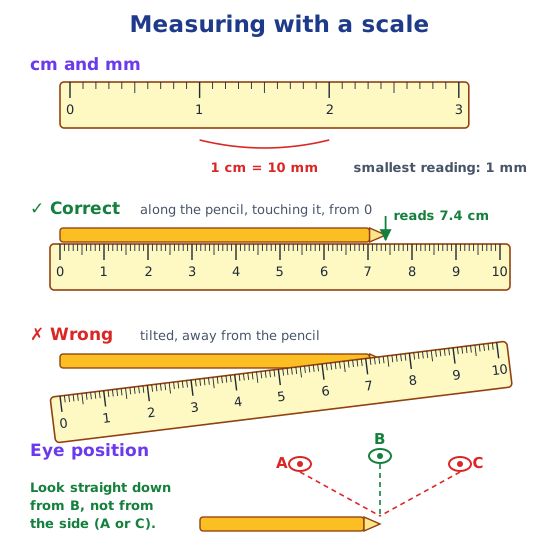
Place the scale in contact with the object, along its length, so that one end of the object is at the zero mark. A scale held at a slant, or away from the object, gives a wrong reading.
Keep your eye directly above the mark
While reading the scale, the position of your eye should be directly above the end of the object. If you look from one side or the other, the end seems to line up with a different mark, and your reading is wrong. In the book’s picture, the correct position is B, straight above the tip of the pencil.
Measuring with a broken scale
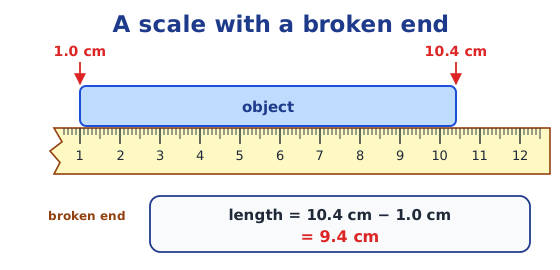
If the zero end of a scale is broken or its zero mark is unclear, you can still use it. Put one end of the object at any other full mark, say 1.0 cm, read the mark at the other end, say 10.4 cm, and subtract: 10.4 cm − 1.0 cm = 9.4 cm.
Visually challenged students use scales with raised markings that can be felt by touch.
Measuring a curved line
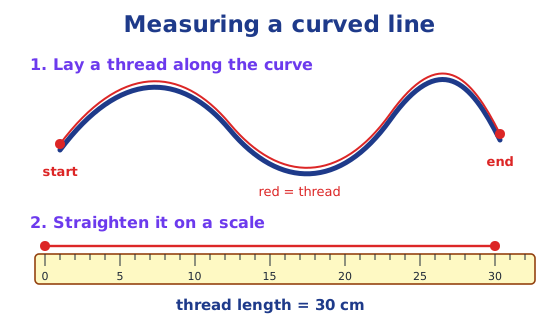
To find the length of string lights needed for curved arches, or of any curved line, use a flexible measuring tape, or lay a thread carefully along the curve, mark where it starts and ends, straighten the thread and measure it with a metre scale.
Why do friends get slightly different answers?
When classmates measure the same pencil, their answers may differ a little. The reasons can be that the scale was not exactly along the object, the eye was not directly above the mark, the starting point was not exactly at zero, or the reading fell between two millimetre marks and was rounded differently. Careful measurement keeps these differences small.
Very small and very long lengths
To find the thickness of one page, measure a stack of many sheets pressed together and divide by the number of sheets: if 100 sheets measure 1 cm (10 mm), one sheet is about 0.1 mm thick. For long distances along a road, you can count the turns of a bicycle wheel and multiply by the length of its outer edge, measured with a string.
Write the result properly
Every result has a number and a unit, with a space between them: 9.4 cm, 1.42 m. Unit symbols are lowercase and never take an ‘s’ or a full stop.
For the units themselves, read standard units of length. For the textbook’s questions, see the Chapter 5 NCERT solutions; for the whole chapter, see the Chapter 5 notes.
Practice
-
For the girth of a tree trunk, which device is the most suitable?
Show answer
Answer: (c) flexible measuring tape
-
One end of a pencil is at 2.0 cm and the other at 9.5 cm on a broken scale. Its length is:
Show answer
Answer: (b) 7.5 cm
-
Where should your eye be while reading a scale?
Show answer
Answer: (b) Directly above the mark
-
Why are some measuring tapes made of flexible materials?
Show answer
Answer: So that they can bend around curved or round objects, such as a tree trunk, a person's waist or chest, or the base of a bottle, which a rigid scale cannot follow.
-
How can you find the thickness of one page of a book with a scale?
Show answer
Answer: Press a stack of many pages together, measure its thickness and divide by the number of pages (sheets). For example, if 100 sheets are 1 cm (10 mm) thick, one sheet is 10 mm ÷ 100 = 0.1 mm.
Questions students ask
How do you measure length correctly with a scale?
Place the scale along the object, touching it, with one end of the object at the zero mark. Read the mark at the other end with your eye directly above it, and write the length with its unit.
How do you measure with a broken scale?
Put one end of the object at any full mark, such as 1.0 cm, read the other end, and subtract: if the other end is at 10.4 cm, the length is 10.4 cm − 1.0 cm = 9.4 cm.
How do you measure a curved line?
Use a flexible measuring tape, or lay a thread carefully along the curve, mark its ends, straighten the thread and measure it on a metre scale.
Stuck on a question?
Take a photo and Lagnever AI explains it step by step. Try it for 7 days for ₹2.
Get it on Google Play Open in browser
For parents: after the trial, the plan renews monthly by UPI or card autopay. You can cancel anytime in the app.