
NCERT Solutions Class 6 Science Chapter 5: Measurement of Length and Motion
Answers to Activities 5.1 to 5.7, the in-text questions, all 13 “Let us enhance our learning” questions and the Learning further tasks in Chapter 5, Measurement of Length and Motion, of Curiosity (Reprint 2026-27). The page numbers match the book. Measuring activities have sample readings; your own readings will differ. Short notes: Chapter 5 notes.
Deepa’s new uniform (page 79)
Are the tape and the rod similar to the scale in a geometry box? Yes. All three measure length and are marked in standard units, centimetres and millimetres. The metal rod is rigid like the scale but longer (often 1 m), while the tailor’s tape is flexible, so it can go around the body.
What did mother mean by char angula? The width of four fingers held together. Angula means a finger width, an old Indian unit of length, so the uniform was to be made longer by about four finger widths (roughly 7 cm for an adult’s hand).
Measuring with handspans (pages 80–81)
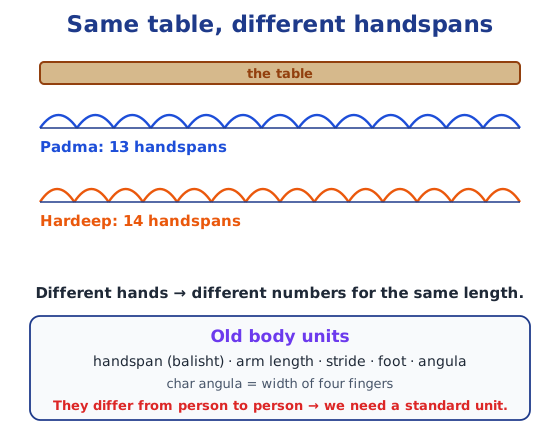
The five friends got different numbers for the same table (Table 5.1) because their handspans are of different sizes. A smaller handspan fits more times along the table. So the handspan is not a reliable unit: we need a unit that is the same for everyone.
Standard units (pages 82–83)
Would it be convenient to use the metre for the length of a railway track between two cities, or for the thickness of a page? No. The track is thousands of metres long, so the kilometre is easier; a page is only a tiny part of a millimetre thick, so millimetres suit it far better than metres.
Measuring length correctly (pages 84–86)
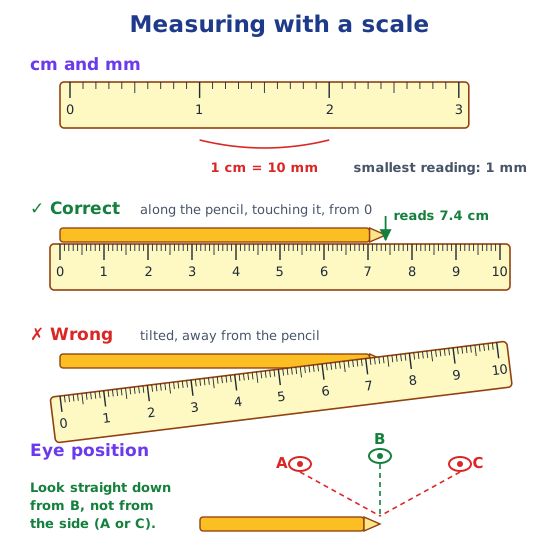
Will our results still be different with a metre scale? They will be the same, or only very slightly different, if everyone uses the scale correctly: along the table, touching it, starting from zero, with the eye directly above the reading.
The correct position of the eye is B, directly above the end of the pencil. With a broken scale, start from a full mark: 10.4 cm − 1.0 cm = 9.4 cm.
Why are some length-measuring devices made of flexible materials? So that they can bend around curved and round surfaces, such as a tree trunk, a person’s chest or waist, or the base of a bottle, which a rigid scale cannot follow.
Activity 5.1: Let us measure (page 86)
Sample readings with a metre scale:
| Object | Length of the object |
|---|---|
| Comb | 12.5 cm |
| Pen | 14.2 cm |
| Pencil | 17.6 cm |
| Eraser | 4.0 cm |
Friends’ readings of the same objects may differ slightly. Possible reasons: the scale was not placed exactly along the object, the object did not start exactly at zero, the eye was not directly above the mark, or the end fell between two millimetre marks and was read differently.
Measuring a curved line (page 87)
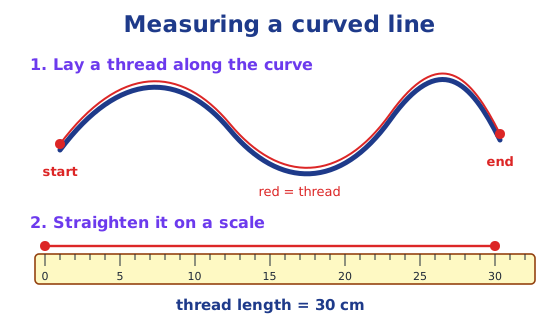
How would Anish’s family have measured the string lights? With a flexible measuring tape run along the arches, or by laying a thread along the curved arches, marking its ends, straightening it and measuring it on a metre scale.
Describing position (pages 87–89)
Who is correct about the garden and the school? All of them. Each friend measures from their own house: from Deepa’s and Anish’s houses the school is closer, from Tasneem’s and Padma’s the garden is closer, and Hardeep’s house is about midway. If all of them had measured from the same reference point, such as the bus stand, they would have agreed.
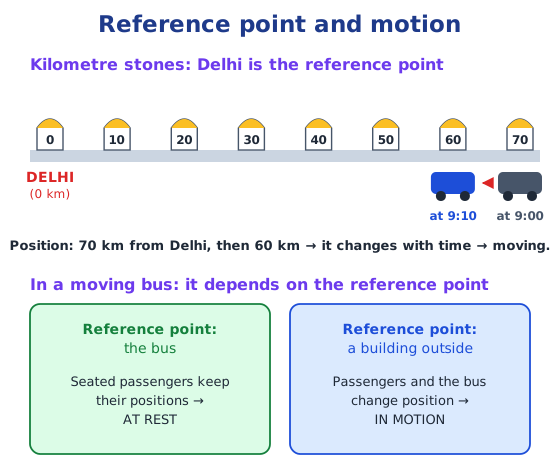
What do the kilometre stones indicate? The distance of that spot from Delhi, the reference point. Padma knew she was getting closer because the distance shown kept decreasing: 70 km, then 60 km.
Is Padma’s position changing with time? Yes. Her position with respect to Delhi changes from 70 km to 60 km as time passes. The position of an object changes with respect to a reference point when the object moves; if it does not move, its position stays the same.
Activity 5.2: Moving things (page 90)
Sample Table 5.3, using the ground and buildings around as the reference point:
| Object | In motion or at rest? Why? |
|---|---|
| Cow grazing in the field | In motion: its position keeps changing |
| Car on the road | In motion: it changes its position along the road |
| Bird flying | In motion: its position changes every moment |
| Blades of a running fan | In motion: they keep turning |
| Hands of a clock | In motion: they turn slowly |
| Tree | At rest: it stays in the same place |
| Classroom table | At rest: its position does not change |
| Parked bicycle | At rest: it stays where it was left |
| Electric pole | At rest: fixed in the ground |
| School building | At rest: it does not move |
How can one decide whether an object is in motion or at rest? Check whether its position changes with respect to a reference point with time: if it does, the object is in motion; if not, it is at rest.
Think it over: the ship with no window (page 91)
No. If the ship moves at a constant speed in a straight line on a calm sea, everything inside, including you, moves along with it, and nothing inside behaves any differently from when the ship is still. Without seeing anything outside to use as a reference point, you cannot tell whether the ship is moving. (Extra: the scientist Galileo described this idea using a ship.)
Activities 5.3 to 5.6: Types of motion (pages 91–94)
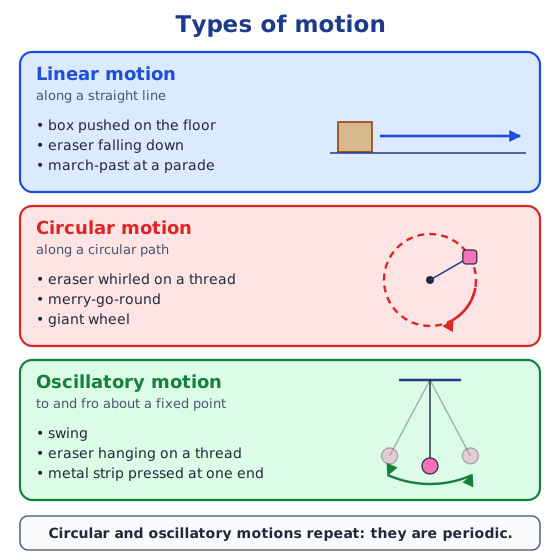
- Activity 5.3: a dropped eraser falls along a straight line, and so does an orange falling from a tree. Students in a march-past move along straight lines, and a pushed box moves in a straight line too: all are linear motion. Swings and merry-go-rounds are not linear motion.
- Activity 5.4: an eraser whirled on a thread moves along a circle, just like a merry-go-round: circular motion.
- Activity 5.5: the hanging eraser, pulled aside and released, moves to and fro like a swing: oscillatory motion.
- Activity 5.6: the loose end of the metal strip moves up and down about its resting position: oscillatory motion.
Activity 5.7: Motion in a children’s park (pages 94–95)
| Object | Type of motion and why |
|---|---|
| Swing | Oscillatory: moves to and fro |
| Slide | Linear: the child slides down a straight path |
| Merry-go-round | Circular: goes round a circular path |
| See-saw | Oscillatory: each end goes up and down about the middle |
| Skipping rope | Circular: the rope turns round and round |
Let us enhance our learning (pages 97–99)
1. Match the lengths with units
- Distance between Delhi and Lucknow: kilometre
- Thickness of a coin: millimetre
- Length of an eraser: centimetre
- Length of a school ground: metre
2. True or false
(i) True: the car moves along a straight line. (ii) True: that is the meaning of motion. (iii) False: 1 km = 1000 m = 100,000 cm.
3. Not a standard unit
(iv) Handspan: it differs from person to person.
4. Smallest value on scales and tapes
Sample table:
| Scale or tape | Smallest value it can measure |
|---|---|
| 15-cm scale | 1 mm |
| Metre scale | 1 mm (some show only cm) |
| Tailor’s tape | 1 mm or 0.5 cm, depending on its markings |
| Steel measuring tape | 1 mm |
| Long tape for the playground | 1 cm |
5. 1.5 km in metres
1.5 km = 1.5 × 1000 m = 1500 m.
6. Curved base of a tumbler or bottle
Wrap a thread once around the base, mark where it meets, straighten the thread and measure it on a scale. Sample: the base of a steel tumbler measured 22 cm around.
7. Height of a friend
Sample: 1.42 m = 142 cm = 1420 mm. (m × 100 = cm; cm × 10 = mm.)
8. Coins along a notebook
Sample: estimate 12 coins along the long side. Measure: the side is 24 cm and the coin is 2 cm across, so 24 cm ÷ 2 cm = 12 coins. Check by placing coins edge to edge without gaps; a small difference is normal.
9. Two examples of each type of motion
- Linear: a car on a straight road; a stone dropped from a height.
- Circular: the tip of a ceiling-fan blade; a giant wheel.
- Oscillatory: the pendulum of a wall clock; a swing.
10. Sizes of objects around us
| Size | Objects |
|---|---|
| mm | thickness of a coin, a pencil lead, a grain of rice |
| cm | an eraser, a pencil, a notebook |
| m | a classroom, a door’s height, a saree |
11. The rollercoaster track
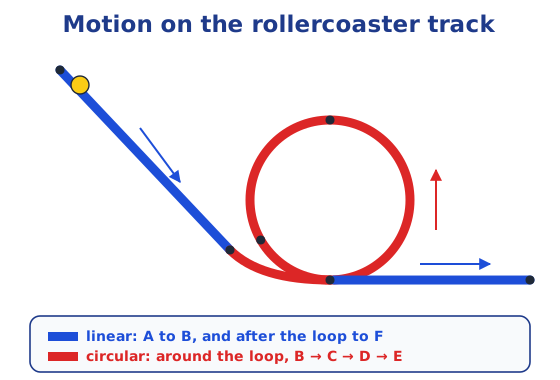
- A to B: the straight slope: linear motion.
- B to C to D to E: the ball goes round the loop: circular motion.
- After the loop, out through F: the straight track: linear motion again.
12. Tasneem’s metre scale
She should not use stretchable rubber or cloth: they stretch and sag, so the same scale would give different lengths at different times. Plywood and steel keep their length, so they make good scales. Paper keeps its length but tears, folds and wears out easily, so it can make only a rough scale that will not last.
13. A card game on units of length
Sample game, “Length Pairs”: make 20 cards in pairs of equal lengths, such as 1 m and 100 cm, 1 km and 1000 m, 5 cm and 50 mm, 2.5 m and 250 cm, 1.5 km and 1500 m. Shuffle and lay them face down. Players take turns turning over two cards; if the lengths are equal, they keep the pair. The player with the most pairs wins.
Learning further (pages 99–100)
- Thickness of one page: press 100 sheets of the book together, measure the stack, say 10 mm, and divide: 10 mm ÷ 100 = 0.1 mm per sheet.
- Leaves of one tree: sample from a mango tree: leaf lengths from 15.2 cm to 21.0 cm and breadths from 4.1 cm to 5.6 cm. Leaves of the same tree differ because of their age and position on the tree, and the light, water and food each one got.
- Old units: elders may mention the balisht (handspan), hath (forearm, about half a metre), gaj (about 0.9 m) and kos (a few kilometres); their values varied from place to place. (Extra: an ivory scale with fine markings was found at Lothal, a Harappan site in Gujarat.)
- A maze: use a 15-cm scale to draw lines of exactly 1 cm and 2 cm on squared paper, leave one path open from the entrance to the exit, and close all the others.
- How tall am I? Stand straight against a wall without shoes, ask an adult to mark the top of your head with a ruler held flat, measure from the floor, and repeat every three months.
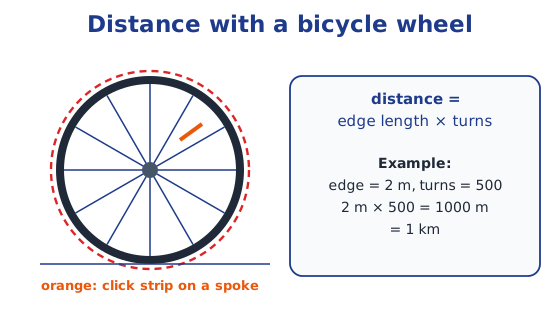
- Distance with a bicycle: distance = length of the wheel’s outer edge × number of turns; for example, 2 m × 500 turns = 1000 m = 1 km. A Jones Counter is a small counting device fixed to the front wheel of a bicycle; it counts the wheel’s turns, and race organisers use it to measure courses for road races such as marathons.
For more practice, read standard units of length, how to measure length correctly and types of motion.
Practice
-
An object runs from the 2.0 cm mark to the 8.6 cm mark of a broken scale. Its length is:
Show answer
Answer: (b) 6.6 cm
-
Which unit suits the length of a school ground?
Show answer
Answer: (c) metre
-
The motion of the hands of a clock is:
Show answer
Answer: (b) circular
-
Express 2.35 m in centimetres and millimetres.
Show answer
Answer: 2.35 × 100 = 235 cm, and 235 × 10 = 2350 mm.
-
A kilometre stone reads ‘Jaipur 45 km’ and the next one ‘Jaipur 44 km’. What is the reference point, and is the bus moving towards Jaipur or away from it?
Show answer
Answer: Jaipur is the reference point. The distance from Jaipur is decreasing, so the bus is moving towards Jaipur.
Stuck on a question?
Take a photo and Lagnever AI explains it step by step. Try it for 7 days for ₹2.
Get it on Google Play Open in browser
For parents: after the trial, the plan renews monthly by UPI or card autopay. You can cancel anytime in the app.