
Class 6 Science Chapter 5: Measurement of Length and Motion Notes
This chapter in five lines
To measure a length, we compare it with a fixed unit. Body parts such as the handspan give different results for different people, so countries use standard SI units; the SI unit of length is the metre (m), with 1 km = 1000 m, 1 m = 100 cm and 1 cm = 10 mm. A length is written as a number and a unit. An object is in motion if its position changes with time with respect to a reference point, and motion can be linear, circular or oscillatory.
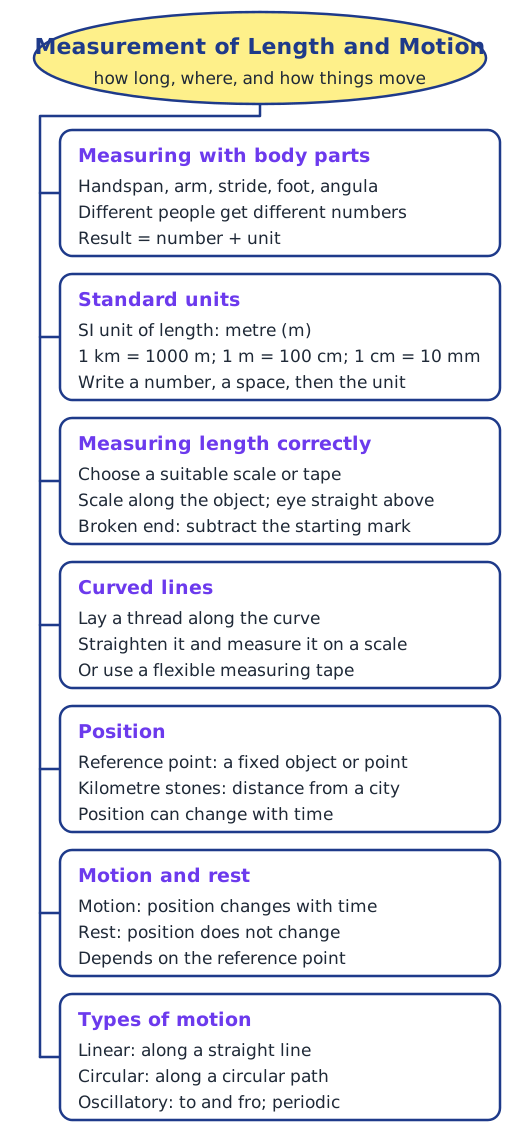
Measuring with body parts
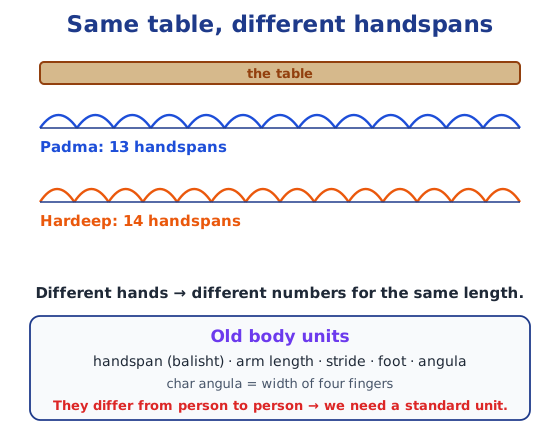
The chapter begins with Deepa, an eleven-year-old in Haryana, who needs a new uniform. The shopkeeper measures two metres of cloth with a metal rod, the tailor uses a flexible tape, and her mother asks the tailor to add char angula, the width of four fingers. Deepa’s friends recall people measuring cloth with an arm’s length and fields with strides or feet.
The friends measure their classroom table in handspans (balisht) and get different answers: 13, slightly more or less than 13, between 13 and 14, and 14. The reason is that their handspans are of different sizes. A measurement has two parts, a number and a unit: in 13 handspans, 13 is the number and the handspan is the unit. Because body units differ from person to person, we need a unit that gives everyone the same answer.
India has a rich history of measurement. Units such as the angula (finger width), its multiples, the dhanusa and the yojana appear in ancient Indian literature and were used in making objects, buildings and towns; carpenters and tailors still use the angula. Objects with ruled markings, which could be scales, have been excavated from Harappan sites.
Standard units
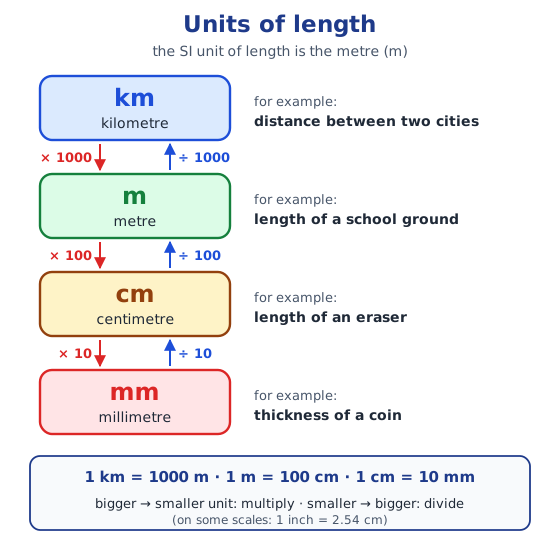
When people began to travel, different local units caused confusion, so countries agreed on standard units: the International System of Units, or SI units. The SI unit of length is the metre, symbol m. A metre is divided into 100 centimetres (cm), and each centimetre into 10 millimetres (mm); 1 mm is the smallest length a 15-cm scale can measure. For long distances we use the kilometre (km).
1 km = 1000 m · 1 m = 100 cm · 1 cm = 10 mm
Some scales also show inches, where 1 inch = 2.54 cm; units such as the inch and the foot are still used by some people. Read more in standard units of length.
Measuring length correctly
Choose a suitable device: a 15-cm scale for a pencil, a metre scale or measuring tape for the height of a room, and a flexible tape, like a tailor’s tape, for the girth of a tree or the size of your chest. Place the scale in contact with the object, along its length, and keep your eye directly above the point you read. If the end of a scale is broken, start from any full mark, such as 1.0 cm, and subtract it: an object from 1.0 cm to 10.4 cm is 10.4 cm − 1.0 cm = 9.4 cm long. Visually challenged students use scales with raised markings they can feel.
Write the number, a space and the unit, such as 9.4 cm. Unit names and symbols are written in lowercase, symbols never take an ‘s’ for the plural, and no full stop follows a symbol except at the end of a sentence. To measure a curved line, such as string lights along arches, use a flexible tape, or lay a thread along the curve, straighten it and measure it on a metre scale. Read more in how to measure length correctly.
Position and the reference point
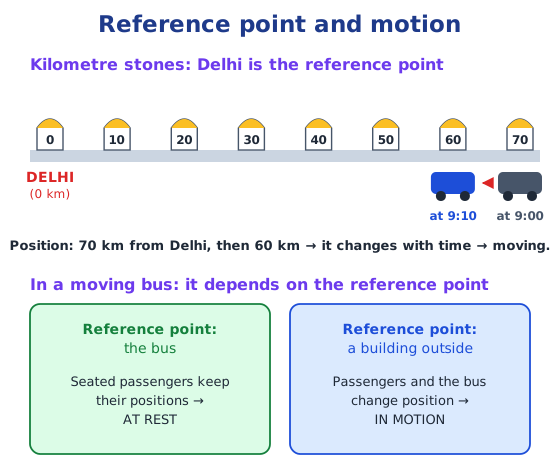
Deepa and her friends disagree about whether the school or the garden is closer, and all of them are right, because each measures from a different house. If they all measured from the same point, such as the bus stand, they would agree. A fixed object or point from which distance is stated is a reference point. On a road, kilometre stones that read ‘Delhi 70 km’ and then ‘Delhi 60 km’ give the position of a bus with Delhi as the reference point.
Motion and rest
An object is in motion if its position changes with respect to a reference point with time, and at rest if it does not. The reference point matters: passengers seated in a moving bus are at rest with respect to the bus, but in motion with respect to a building outside. The book asks you to think about a ship moving steadily in a straight line on a calm sea, with no windows: could you tell whether it is moving?
Types of motion
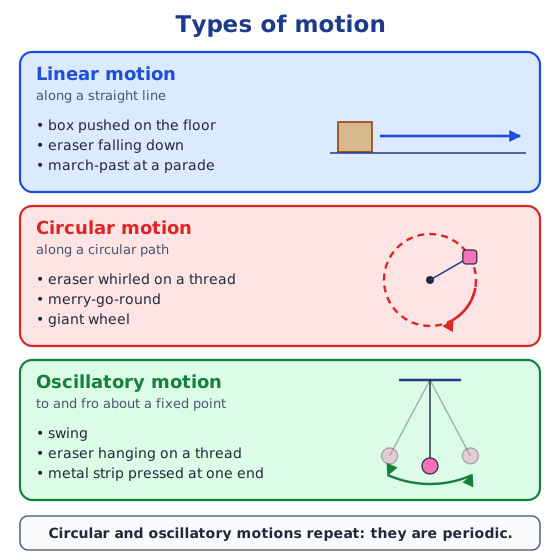
- Linear motion: along a straight line, such as an eraser dropped from a height, a heavy box pushed along the floor, or students in a march-past.
- Circular motion: along a circular path, such as an eraser whirled on a thread or a merry-go-round.
- Oscillatory motion: to and fro about a fixed position, such as a swing, an eraser hanging from a thread, or a metal strip pressed at one end and released.
If an object repeats its path after a fixed interval of time, its motion is periodic; circular and oscillatory motions are both periodic. Read more in types of motion.
Answers to every question are in the NCERT solutions for Chapter 5.
Key terms
| Term | Meaning |
|---|---|
| Unit | The fixed quantity with which a length is compared, such as a handspan or a metre; a measurement has a number and a unit, as in 13 handspans. |
| SI units | The International System of Units, the standard units of measurement adopted by countries. |
| Metre (m) | The SI unit of length; 1 m = 100 cm. |
| Centimetre (cm) and millimetre (mm) | Smaller units of length: 1 cm = 10 mm, and 1 mm = 0.1 cm is the smallest length a 15-cm scale can measure. |
| Kilometre (km) | A larger unit of length for long distances: 1 km = 1000 m. |
| Reference point | A fixed object or point with respect to which a distance or position is stated, such as Delhi on a kilometre stone. |
| Motion | An object is in motion if its position changes with respect to a reference point with time. |
| Rest | An object is at rest if its position does not change with respect to a reference point with time. |
| Linear motion | Motion along a straight line, such as a box pushed along the floor or an eraser falling straight down. |
| Circular motion | Motion along a circular path, such as an eraser whirled on a thread or a merry-go-round. |
| Oscillatory motion | Motion to and fro about a fixed position, such as a swing or an eraser hanging from a thread. |
| Periodic motion | Motion that repeats its path after a fixed interval of time; circular and oscillatory motions are periodic. |
Topics in this chapter
Practice
-
What is the SI unit of length?
Show answer
Answer: (b) metre
-
1 km is equal to:
Show answer
Answer: (b) 1000 m
-
The smallest length that a 15-cm scale can measure is:
Show answer
Answer: (b) 1 mm
-
A child on a swing shows:
Show answer
Answer: (c) oscillatory motion
-
Passengers sitting in a moving bus are at rest with respect to:
Show answer
Answer: (c) the bus
Questions students ask
What are the main topics of Class 6 Science Chapter 5?
Measuring with body parts and why standard units are needed, SI units and the metre, the correct way to measure length, measuring a curved line, describing position with a reference point, motion and rest, and linear, circular and oscillatory motion.
Is Measurement of Length and Motion in the new Curiosity book?
Yes. Measurement of Length and Motion is Chapter 5 of Curiosity, the Class 6 Science textbook (Reprint 2026-27). It comes after Chapter 4, Exploring Magnets.
How many questions does Chapter 5 have at the end?
The “Let us enhance our learning” section has 13 questions. Our NCERT solutions page answers all of them, along with Activities 5.1 to 5.7, the in-text questions and the Learning further tasks.
Stuck on a question?
Take a photo and Lagnever AI explains it step by step. Try it for 7 days for ₹2.
Get it on Google Play Open in browser
For parents: after the trial, the plan renews monthly by UPI or card autopay. You can cancel anytime in the app.