
Types of motion
Answer in short
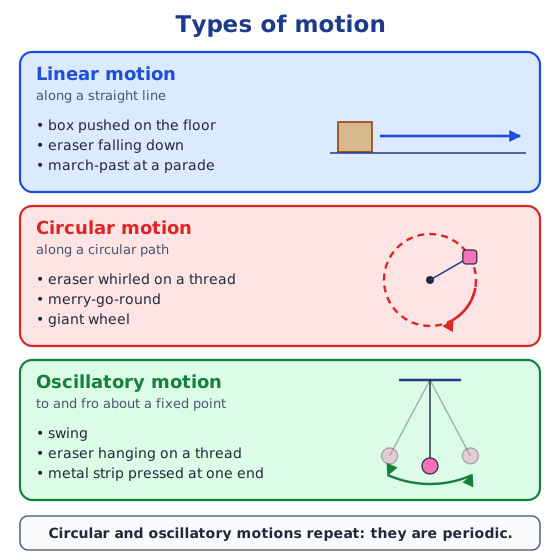
An object is in motion if its position changes with time with respect to a reference point. Motion along a straight line is linear motion, motion along a circular path is circular motion, and motion to and fro about a fixed position is oscillatory motion. Circular and oscillatory motions repeat after a fixed time, so they are periodic.
Stuck on a question? Take a photo and Lagnever AI explains it step by step. Try it for 7 days for ₹2. Get it on Google Play
Position and the reference point
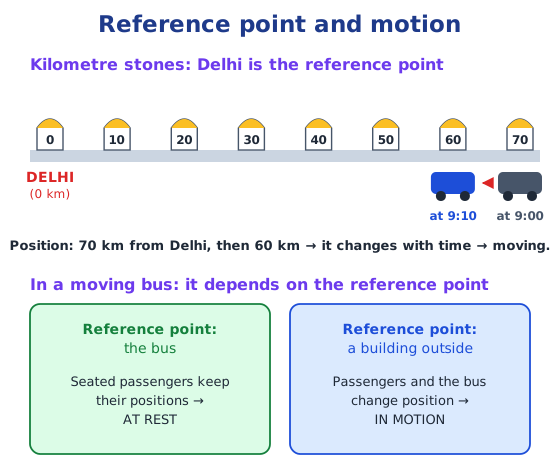
To say where something is, we measure its distance from a fixed object or point, called the reference point. In the chapter, Deepa and her friends disagree about whether the school or the garden is closer, and all of them are right, because each measures from a different house. Had they all measured from the bus stand, they would have agreed. On a road, a kilometre stone reading ‘Delhi 70 km’ gives your position with Delhi as the reference point.
Motion and rest
An object is in motion if its position changes with respect to a reference point with time. It is at rest if its position does not change with time. When Padma’s bus passes ‘Delhi 70 km’ and later ‘Delhi 60 km’, her position with respect to Delhi is changing, so she is moving towards Delhi.
The reference point decides the answer. Inside the bus, the seated passengers keep their places, so they are at rest with respect to the bus. Compared with a building outside, the same passengers and the bus are in motion. The book adds a puzzle: in a ship moving at a constant speed in a straight line on a calm sea, with no windows, is there any way to tell whether it is moving? Think about it before you check the NCERT solutions.
Linear motion
When an object moves along a straight line, its motion is linear motion. Examples: an eraser dropped from a height, an orange falling from a tree, a heavy box pushed along the floor, a car on a straight road, and students in a march-past.
Circular motion
When an object moves along a circular path, its motion is circular motion. Tie an eraser to a thread and whirl it: it goes round and round, like a merry-go-round. Other examples are a giant wheel and the tip of a ceiling-fan blade.
Oscillatory motion
When an object moves to and fro about a fixed position, its motion is oscillatory motion. Hang an eraser from a thread, pull it slightly to one side and let go: it swings back and forth, like a swing. Press one end of a thin metal strip to a table, press the loose end down and release it: the loose end moves up and down, which is also oscillatory motion.
Periodic motion
If an object repeats its path after a fixed interval of time, its motion is periodic. An object in circular motion goes round the same path again and again, and an object in oscillatory motion repeats its to-and-fro movement, so both are periodic.
Motion in a park and on a track
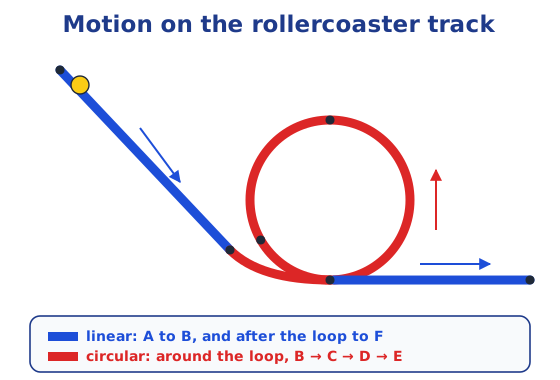
In a children’s park, a child sliding down a straight slide shows linear motion, a merry-go-round shows circular motion, and a swing or a see-saw shows oscillatory motion. One object can also change its type of motion along the way, as a ball does on a rollercoaster track:
For measuring the lengths and distances involved, read standard units of length. For the textbook’s questions, see the Chapter 5 NCERT solutions; for the whole chapter, see the Chapter 5 notes.
Practice
-
A ball rolling along a straight, flat path shows:
Show answer
Answer: (a) linear motion
-
The tip of a moving ceiling-fan blade shows:
Show answer
Answer: (b) circular motion
-
Which motion is oscillatory?
Show answer
Answer: (c) The pendulum of a wall clock
-
A tree is at rest. With respect to what?
Show answer
Answer: With respect to the ground or any building near it: its position does not change with time. (With respect to a moving car, the tree would seem to move.)
-
Why are circular and oscillatory motions called periodic?
Show answer
Answer: Because the object repeats its path after a fixed interval of time: round the same circle again and again, or to and fro about the same position again and again.
Questions students ask
What are the types of motion in Class 6 Science?
Linear motion (along a straight line), circular motion (along a circular path) and oscillatory motion (to and fro about a fixed position). Circular and oscillatory motions are also periodic.
What is a reference point?
A fixed object or point from which we state distance or position. On a kilometre stone that reads ‘Delhi 60 km’, Delhi is the reference point.
Is a swing an example of circular or oscillatory motion?
Oscillatory. The swing moves to and fro about its resting position; it does not go all the way round a circle.
Stuck on a question?
Take a photo and Lagnever AI explains it step by step. Try it for 7 days for ₹2.
Get it on Google Play Open in browser
For parents: after the trial, the plan renews monthly by UPI or card autopay. You can cancel anytime in the app.