
What is Indian Standard Time (IST)?
Answer in short
Indian Standard Time (IST) is the one standard time followed all over India. It is the local time of the meridian at 82°30′E, which passes near Mirzapur in Uttar Pradesh, and it is 5 hours 30 minutes ahead of Greenwich Mean Time (GMT). One standard time avoids the confusion of many local times.
Stuck on a question? Take a photo and Lagnever AI explains it step by step. Try it for 7 days for ₹2. Get it on Google Play
Why time depends on longitude
The Earth spins on its axis from west to east. Place a lamp beside a globe and turn the globe slowly eastward: some places are in morning light, others at midday, others in evening or night. When it is breakfast time in one country, it is lunchtime in another, and in a third people are fast asleep. So measuring the longitude of a place also tells us about its time.
The Earth makes one full turn, 360°, in about 24 hours. That is:
- 360° ÷ 24 = 15° every hour, and
- 60 minutes ÷ 15 = 4 minutes for every 1° of longitude.
Local time
Mark the meridians every 15° from Greenwich. Each one eastward adds an hour of local time; each one westward takes an hour away.
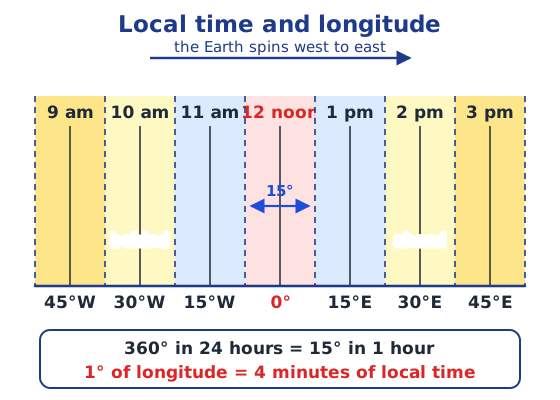
If it is 12 noon at Greenwich, it is 1 pm at 15°E, 2 pm at 30°E and 3 pm at 45°E. Going west it is the other way round: 11 am at 15°W, 10 am at 30°W and 9 am at 45°W.
To compare two places, multiply their difference in longitude by 4 minutes. The place to the east is ahead.
Example. Two friends talk on the phone late one afternoon, one in Tinsukia (Assam) and the other in Porbandar (Gujarat). The one in Tinsukia says the sun has set and it is dark; the one in Porbandar still has full daylight. Taking them to be about 30° apart, the difference in local time is 30 × 4 = 120 minutes, or 2 hours. The sun reaches Assam, far to the east, much earlier. (Extra: their real longitudes, about 95.4°E and 69.6°E, are nearly 26° apart: a difference of about 1 hour 43 minutes.)
Standard time and IST
Every meridian has its own local time, so a country using all of them would be confused: trains, offices and phone calls could not agree. That is why most countries adopt one standard time, based on a meridian passing through them.
India’s standard time, Indian Standard Time (IST), is 5 hours 30 minutes, or 5.5 hours, ahead of the local time at Greenwich, called Greenwich Mean Time (GMT). It is the local time of the meridian at 82°30′E, which passes near Mirzapur in Uttar Pradesh: 82.5 × 4 = 330 minutes, or 5 hours 30 minutes.
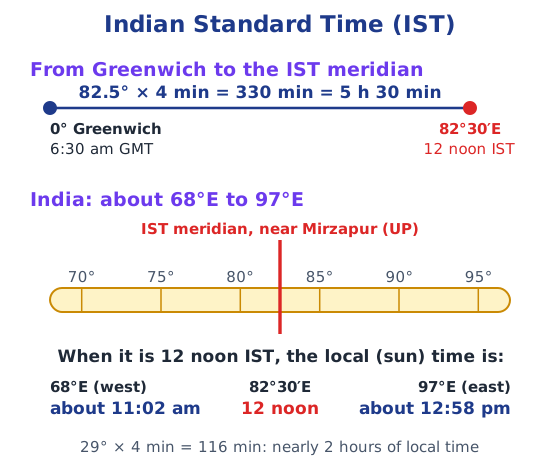
India stretches from about 68°E to 97°E, about 29° of longitude, which is nearly 2 hours of local time. When clocks everywhere show 12 noon IST, the sun time in the far west of Gujarat is close to 11 am, and in the far east of Arunachal Pradesh nearly 1 pm. In Assam, local time is ahead of IST, which is why the sun rises and sets early there.
Time zones of the world
Standard times are organised into time zones, which broadly follow 15° bands. The lines between them are not straight, though: they follow international borders so that each country keeps its own standard time. On a time zone map, a number like +5:30 (India) is added to GMT, while a number with a minus sign is subtracted from it.
Not every country has a single standard time. Russia, Canada and the USA are too large for one. The USA has six time zones and Russia has eleven, so travelling across Russia from east to west you would reset your watch 10 times.
The International Date Line
Opposite the Prime Meridian, at about 180° longitude, runs the International Date Line. The +12 and −12 time zones touch along it. Crossing it by ship or plane changes the date:
- travelling eastward, you subtract a day (Monday becomes Sunday);
- travelling westward, you add a day (Sunday becomes Monday).
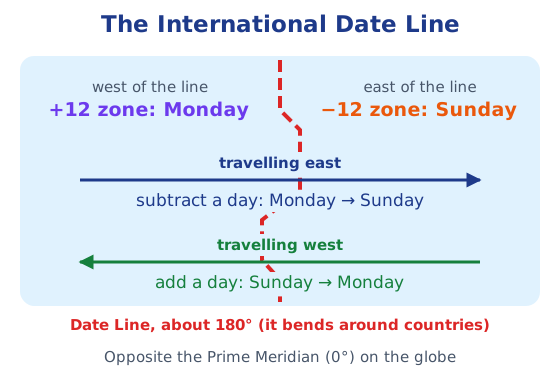
The line is only ‘approximately’ at 180° because it bends in places so that no country is divided into two different days. For latitudes and longitudes, see latitudes and longitudes; for every textbook question, see the Chapter 1 NCERT solutions.
Practice
-
IST is ahead of GMT by:
Show answer
Answer: (c) 5 hours 30 minutes
-
If it is 12 noon at Greenwich, the local time at 30°W is:
Show answer
Answer: (a) 10 am
-
Crossing the International Date Line travelling eastward, you:
Show answer
Answer: (b) subtract a day
-
Two places are 30° of longitude apart. What is the difference in their local times?
Show answer
Answer: 30 × 4 minutes = 120 minutes, that is 2 hours. The place to the east is ahead.
-
Why does India follow one standard time instead of many local times?
Show answer
Answer: Every meridian has its own local time, so using them all would confuse trains, offices, schools and phone calls. One standard time, IST, keeps every clock in India the same.
Questions students ask
What is Indian Standard Time?
IST is the standard time used all over India. It is based on the meridian at 82°30′E (82.5°E) and is 5 hours 30 minutes ahead of Greenwich Mean Time, so when it is 6:30 am in Greenwich it is 12 noon in India.
Why is IST 5 hours 30 minutes ahead of GMT?
Local time changes by 4 minutes per degree of longitude. The IST meridian is 82.5° east of Greenwich, and 82.5 × 4 = 330 minutes, which is 5 hours 30 minutes. Places to the east are ahead, so IST is ahead of GMT.
What is the difference between local time and standard time?
Local time depends on a place's own longitude, so it differs from town to town. Standard time is one time chosen for a whole country, based on a meridian passing through it, so every clock in that country shows the same time.
How many time zones do Russia and the USA have?
According to the chapter, the USA has six time zones and Russia has 11, so crossing Russia from east to west you would reset your watch 10 times.
Stuck on a question?
Take a photo and Lagnever AI explains it step by step. Try it for 7 days for ₹2.
Get it on Google Play Open in browser
For parents: after the trial, the plan renews monthly by UPI or card autopay. You can cancel anytime in the app.