
NCERT Solutions Class 6 Social Science Chapter 7: India's Cultural Roots
Answers to the Big Questions, every Let’s Explore and Think About It box, all 7 “Questions, activities and projects”, the 7 true-or-false statements and the class activity in Chapter 7, India’s Cultural Roots, of Exploring Society: India and Beyond (2026-27 session). The page numbers match the book. Discussion and imaginative questions have sample answers; yours may differ. Short notes: Chapter 7 notes.
The Big Questions (page 105)
1. What are the Vedas? What is their message?
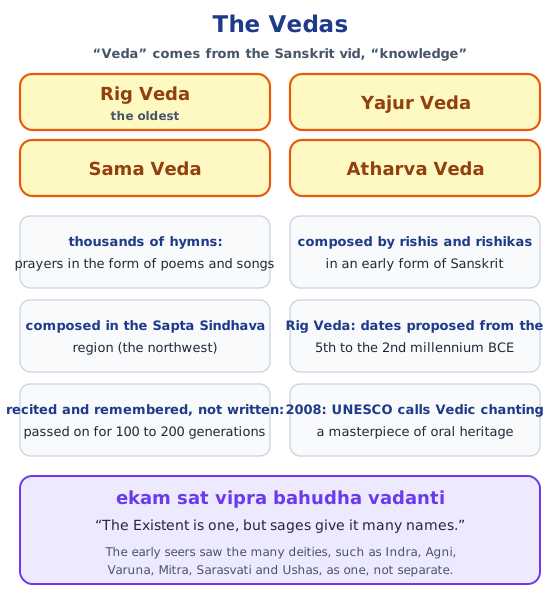
The Vedas, the Ṛig, Yajur, Sāma and Atharva Vedas, are India’s oldest texts. They hold thousands of hymns composed by rishis and rishikas in an early form of Sanskrit and passed on orally for 100 to 200 generations. Their message: the supreme reality is one though sages give it many names (ekam sat viprā bahudhā vadanti); truth and ṛitam, truth and order, must be upheld; and people should live in unity, with one mind and purpose. The Upaniṣhads add that everything shares one divine essence, so all creatures are connected, as in the prayer ‘May all creatures be happy’.
2. What new schools of thought emerged in the 1st millennium BCE? What are their core principles?
| School | Core principles |
|---|---|
| Vedanta | everything is one divine essence, brahman; the ātman is one with it |
| Yoga | methods to realise brahman in one’s consciousness |
| Buddhism | ignorance and attachment cause suffering; ahimsa; inner discipline |
| Jainism | ahimsa, anekāntavāda (many-sided truth), aparigraha (non-possession) |
| Chārvāka | only the material world exists; no life after death |
They shared dharma, karma, rebirth and the search for an end to suffering and ignorance.
3. What is the contribution of folk and tribal traditions to Indian culture?
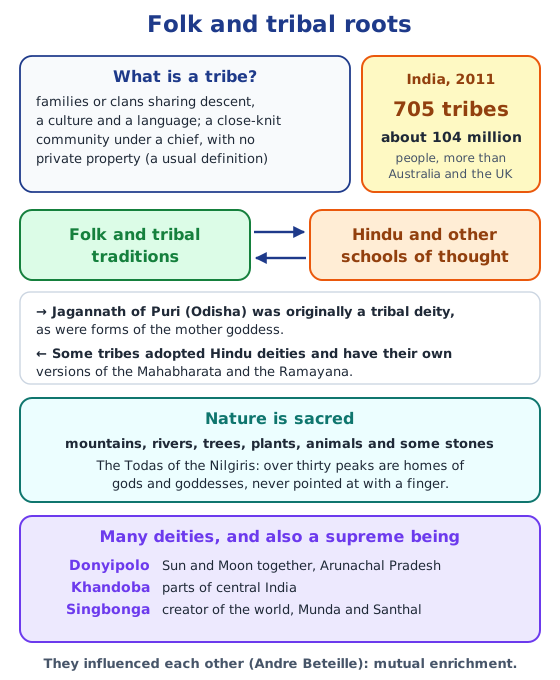
They passed on rich oral traditions; gave deities such as Jagannath of Puri and forms of the mother goddess; exchanged ideas, legends and rituals with Hinduism in both directions; kept alive the idea that mountains, rivers, trees and animals are sacred; and had their own concepts of a supreme being, such as Donyipolo and Singbonga. The result has been mutual enrichment.
Vedic society (page 109)
Let’s Explore: choosing our leaders (sample, about 120 words). A society where people select their leaders is a democracy. When people choose their leaders, the leaders know they must listen and work for everyone, or they may not be chosen again. People can share their ideas, ask questions and take part in decisions, so laws are more likely to be fair and accepted. Problems can be raised openly and solved peacefully. When people live under leaders they did not choose, those leaders may serve only themselves or a few friends. People may be afraid to speak, their needs may be ignored, and unfair rules may stay in place for a long time. The Vedic assemblies, the sabhā and samiti, show that the idea of gathering together to discuss is very old in India.
Vedic schools of thought (page 110)
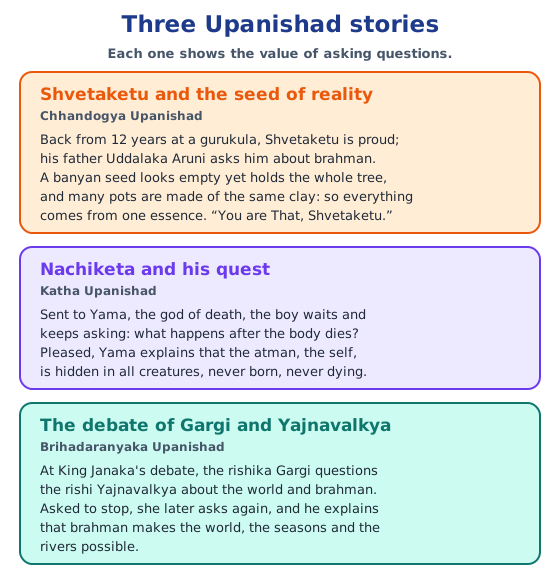
Think About It: a story with a message (sample). The Panchatantra story of the monkey and the crocodile: when the crocodile tricks the monkey to take his heart, the monkey says he left it on the tree and escapes. It teaches presence of mind in danger, and to be careful about whom we trust. The Upaniṣhad story of Nachiketa teaches another value: keep asking questions until you understand.
Buddhism (page 115)
Let’s Explore: the stone panel and where Buddhism lives on (sample).
- The panel: the Buddha stands at the centre, larger than everyone else, with a halo behind his head. His face is calm, his robe falls in soft folds, and one hand is raised as if he is teaching. The people around him turn towards him and listen, some with folded hands. Everything draws the eye to him and his words.
- Where Buddhism is a major religion today: in India, Ladakh, Sikkim and Arunachal Pradesh have large Buddhist communities, and Maharashtra has many Buddhists. Abroad: Sri Lanka, Myanmar, Thailand, Cambodia, Laos, Bhutan, Mongolia, Japan and Vietnam. Mark them on a world map.
Jainism (page 118)
Let’s Explore: the Jain temple panel (sample). A lion and a cow drink from the same bowl, side by side, each with its young nearby. What is striking is that a hunter and its usual prey share water peacefully. The message is ahimsa: where there is no violence, there is no fear, and all creatures can live together in harmony.
Think About It: ahimsa in thought. Ahimsa begins in the mind. When we notice an ill feeling towards someone, or towards ourselves, we can pause, avoid acting on it, and turn it into a kinder thought, such as wishing the person well.
Schools of thought, not just religions (page 119)
Think About It. The book avoids the word ‘religion’ because these schools have many sides: philosophical (questions about reality), spiritual (the search for a higher consciousness), religious (worship and rituals), ethical (values such as ahimsa) and social (ways of living together). For example, people of every faith practise Yoga as a discipline, and Buddhist and Jain teachings are also systems of ethics and philosophy. ‘Schools of thought’ captures this better.
Questions, activities and projects (page 123)
1. If you were Nachiketa (sample, about 120 words)
Respected Yama, you say the ātman is never born and never dies. Then who am I, really: my body, my mind or something deeper? If the self cannot die, why do people fear death so much, and how can I stop being afraid of it? Where does a person’s ātman go after death, and does it remember anything? Why must everything that is born also end? Is there anything in the world that never changes? How should I live so that my life is good and useful to others? Can a child like me know the truth for myself, or only great sages? And finally, why did you test me by making me wait for so long?
2. Central ideas of Buddhism
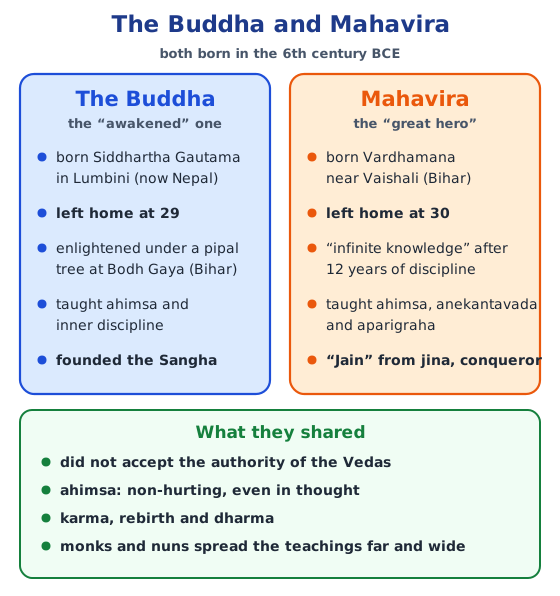
- Suffering has causes: avidyā (ignorance) and attachment; remove them and suffering ends.
- Ahimsa: non-hurting, in action and in thought.
- Inner discipline: purity comes from truth and dharma within, and conquering oneself is the greatest victory.
- The Sangha: a community of monks and nuns who practise and spread the teachings.
- Comment: these ideas are practical and open to everyone. They ask us to work on our own minds rather than blame others, and their stress on compassion, as in the Jātaka tale of the monkey-king, still guides people across Asia.
3. “Not by water is one made pure” (discussion points)
- Bathing in a sacred river cleans the body, but it cannot clean the mind of anger, greed or dishonesty.
- A person is truly pure when truth and dharma, right conduct, live in them.
- Winning over our own anger, fear and laziness is harder, and greater, than winning a thousand battles.
- In short: inner change matters more than outer rituals.
4. Central ideas of Jainism
- Ahimsa: no living creature should be killed, hurt, abused or driven away.
- Anekāntavāda: truth has many aspects; no single statement captures it fully.
- Aparigraha: non-possession; keep only what is truly necessary.
- Interdependence: all creatures, from humans to tiny organisms, support one another.
- Comment: anekāntavāda teaches us to respect other points of view, and aparigraha to consume less, which helps people get along and protects nature.
5. André Béteille’s thought (discussion points)
- Béteille says the castes and tribes of India have influenced each other’s beliefs and practices since before history, in both directions.
- Examples from the chapter: Jagannath of Puri and forms of the mother goddess came from tribal traditions, while some tribes adopted Hindu deities and have their own Mahābhārata and Rāmāyaṇa.
- So Indian culture is not the gift of one group to another; it grew through a long give-and-take, and tribal cultures deserve respect, not labels such as ‘primitive’.
6. Gods, goddesses and festivals (sample)
| Deity | Festival |
|---|---|
| Ganesha | Ganesh Chaturthi |
| Durga | Durga Puja and Navratri |
| Jagannath | Rath Yatra (Puri) |
| Krishna | Janmashtami |
| Rama | Ram Navami; Diwali |
| Lakshmi | Diwali |
| Shiva | Mahashivratri |
| Saraswati | Vasant Panchami |
| Surya | Chhath; Pongal |
Add the gods and goddesses of your own region and the festivals linked to them.
7. Tribal groups (sample; details beyond the book are Extra)
| Region | Tribal groups, art and beliefs |
|---|---|
| Jharkhand | Munda, Santhal: worship Singbonga (from the book); Sohrai wall paintings (Extra) |
| Arunachal Pradesh | several tribes, such as the Adi (Extra): worship Donyipolo, the Sun and Moon (from the book) |
| Tamil Nadu | Todas of the Nilgiris: sacred peaks (from the book); fine embroidery (Extra) |
| Maharashtra | Warli: Warli paintings of daily life (Extra) |
| Madhya Pradesh | Gond: Gond paintings of nature and stories (Extra) |
True or false (page 123)
- False. The hymns were recited and passed on orally, not written.
- True.
- True. It says the Existent is one, though sages give it many names.
- False. The Vedas are older; Buddhism arose in the 1st millennium BCE.
- False. Jainism spread at the same time as Buddhism, and its roots are said to be older still.
- True.
- False. Many tribes also have a supreme being, such as Donyipolo, Khandoba or Singbonga.
Class activity: Yama and the Nachiketas (sample plan)
One student plays Yama, seated calmly; a group of Nachiketas take turns to ask questions from Question 1, such as ‘Who am I?’ or ‘What happens after death?’. Yama answers with the chapter’s ideas: the ātman is never born and never dies, and everything is connected. End with each Nachiketa saying one thing they learnt.
Read more in what are the Vedas and Buddhism and Jainism.
Practice
-
In which year did UNESCO recognise Vedic chanting?
Show answer
Answer: (b) 2008
-
Siddhārtha Gautama attained enlightenment at:
Show answer
Answer: (c) Bodh Gaya
-
Aparigraha means:
Show answer
Answer: (b) non-possession
-
Where does the word ‘Jain’ come from?
Show answer
Answer: From jina, ‘conqueror’: one who conquers ignorance and attachments, not territory or enemies.
-
Name the supreme deity worshipped by the Munda and Santhal tribes.
Show answer
Answer: Singbonga, who is believed to have created the whole world.
Stuck on a question?
Take a photo and Lagnever AI explains it step by step. Try it for 7 days for ₹2.
Get it on Google Play Open in browser
For parents: after the trial, the plan renews monthly by UPI or card autopay. You can cancel anytime in the app.