
What are the Vedas?
Answer in short
The Vedas are India's oldest texts: the Ṛig, Yajur, Sāma and Atharva Vedas. ‘Veda’ means knowledge. They hold thousands of hymns by rishis and rishikas in early Sanskrit, memorised and passed on orally for 100 to 200 generations. Their message: the truth is one though sages give it many names, and people should live in unity.
Stuck on a question? Take a photo and Lagnever AI explains it step by step. Try it for 7 days for ₹2. Get it on Google Play
Knowledge passed from mouth to ear
The word Veda comes from the Sanskrit vid, ‘knowledge’, as in vidyā. There are four Vedas: the Ṛig Veda, the Yajur Veda, the Sāma Veda and the Atharva Veda. They are the most ancient texts of India and among the most ancient in the world.
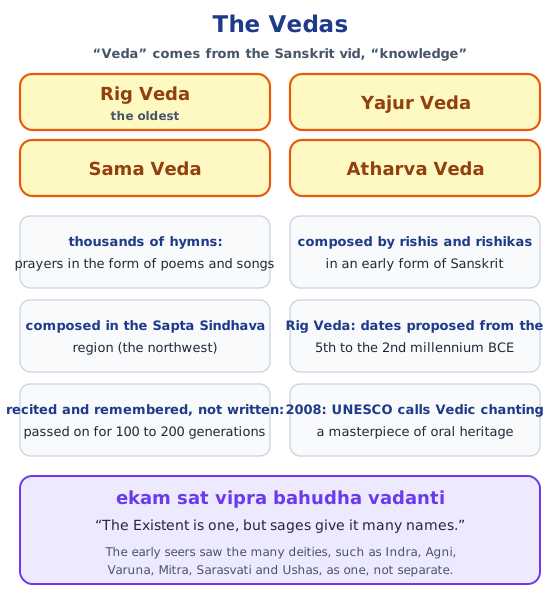
The Vedas are made of thousands of hymns, prayers in the form of poems and songs, composed in the Sapta Sindhava region of the northwest. They were recited, not written. Experts’ dates for the Ṛig Veda, the oldest, range from the 5th to the 2nd millennium BCE, so for 100 to 200 generations the hymns were memorised through rigorous training and passed on with hardly any change. That is why, in 2008, UNESCO recognised Vedic chanting as a masterpiece of the oral and intangible heritage of humanity.
Who composed them, and for whom
The hymns were composed by rishis, male seers or sages, and rishikas, female ones, in an early form of Sanskrit. They were addressed to many deities, such as Indra, Agni, Varuṇa, Mitra, Sarasvatī and Uṣhas, who with the seers sustained ṛitam, truth and order in human life and in the cosmos.
The message of the Vedas
The early seers saw the gods and goddesses as one, not as separate beings. A famous hymn says ekam sat viprā bahudhā vadanti: the Existent, the supreme reality, is one, but sages give it many names. Truth was a central value, often another name for God, and the last mantras of the Ṛig Veda ask people to come together, speak together and share one mind and purpose.
Vedic society
Early Vedic society was organised in janas, or clans. The Ṛig Veda alone lists over 30, such as the Bharatas, Purus, Kurus, Yadus and Turvaśhas, each linked to a region of the northwest. We know little about how they were governed, but the words rājā (king or ruler), sabhā and samiti (assemblies) give clues. The texts mention many professions: agriculturist, weaver, potter, builder, carpenter, healer, dancer, barber and priest.
Rituals, the Upaniṣhads and new schools
Vedic culture developed rituals called yajña, often read as ‘yagya’, usually prayers and offerings to Agni, the deity of fire, which grew more complex over time. A group of texts, the Upaniṣhads, built on Vedic ideas and introduced new ones, such as rebirth, taking birth again and again, and karma, our actions or their results.
In the school known as Vedanta, human life, nature and the universe are one divine essence called brahman, not to be confused with the god Brahmā. The ātman, the Self in every being, is ultimately one with brahman. Two mantras put it simply: aham brahmāsmi, ‘I am brahman’, and tat tvam asi, ‘You are That’. If all is one, everything is connected, which explains the prayer sarve bhavantu sukhinah, ‘May all creatures be happy’. Early in the 1st millennium BCE, more schools grew out of the Vedas, such as Yoga, which developed methods to realise brahman in one’s consciousness. Together, these became the foundations of what we call Hinduism today.
Stories that ask questions
The Upaniṣhads teach through stories in which men, women and children ask questions:
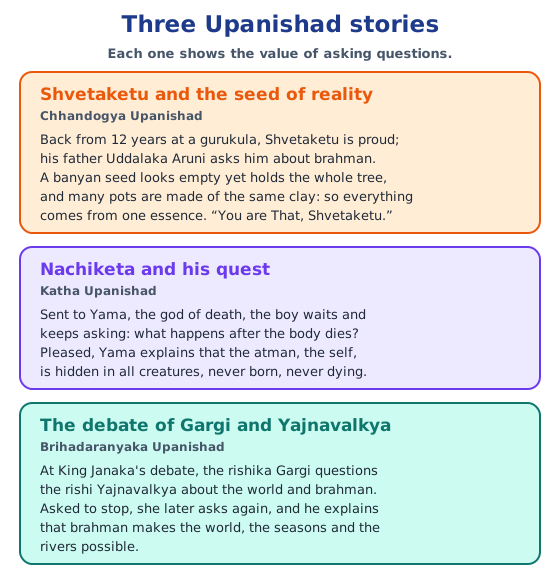
- Śhvetaketu: his father shows him that, as a banyan seed holds the whole tree, everything comes from one subtle essence: ‘You are That’.
- Nachiketa: he keeps asking Yama, the god of death, what happens after death, and learns that the ātman is never born and never dies.
- Gārgī: a rishika, she questions the rishi Yājñavalkya at King Janaka’s court until he explains brahman.
Read about the schools that did not accept the Vedas in Buddhism and Jainism. Answers to the textbook questions are in the NCERT solutions for Chapter 7; see all of Chapter 7 notes.
Practice
-
How many Vedas are there?
Show answer
Answer: (c) Four
-
Rishikas were:
Show answer
Answer: (b) female seers
-
Which idea did the Upaniṣhads introduce?
Show answer
Answer: (b) Rebirth and karma
-
Why did UNESCO recognise Vedic chanting in 2008?
Show answer
Answer: Because the hymns were memorised and passed on orally for thousands of years with hardly any change, a masterpiece of the oral and intangible heritage of humanity.
-
What do the words rājā, sabhā and samiti tell us about Vedic society?
Show answer
Answer: They are the few clues about how the janas were governed: rājā means a king or ruler, and sabhā and samiti both refer to an assembly or collective gathering.
Questions students ask
What are the four Vedas?
The Ṛig Veda, the oldest, the Yajur Veda, the Sāma Veda and the Atharva Veda. They are the most ancient texts of India and among the oldest in the world.
What is the message of the Vedas?
That the supreme reality is one though sages give it many names; that truth matters most; that ṛitam, truth and order, must be sustained; and, in the last mantras of the Ṛig Veda, that people should come together with one mind and purpose.
What are the Upaniṣhads?
Texts that built on the Vedas and introduced ideas such as rebirth, karma, brahman, the one divine essence, and ātman, the Self in every being. Their stories, such as those of Nachiketa and Gārgī, show the value of asking questions.
Stuck on a question?
Take a photo and Lagnever AI explains it step by step. Try it for 7 days for ₹2.
Get it on Google Play Open in browser
For parents: after the trial, the plan renews monthly by UPI or card autopay. You can cancel anytime in the app.