
Class 6 Social Science Chapter 7: India's Cultural Roots Notes
This chapter in five lines
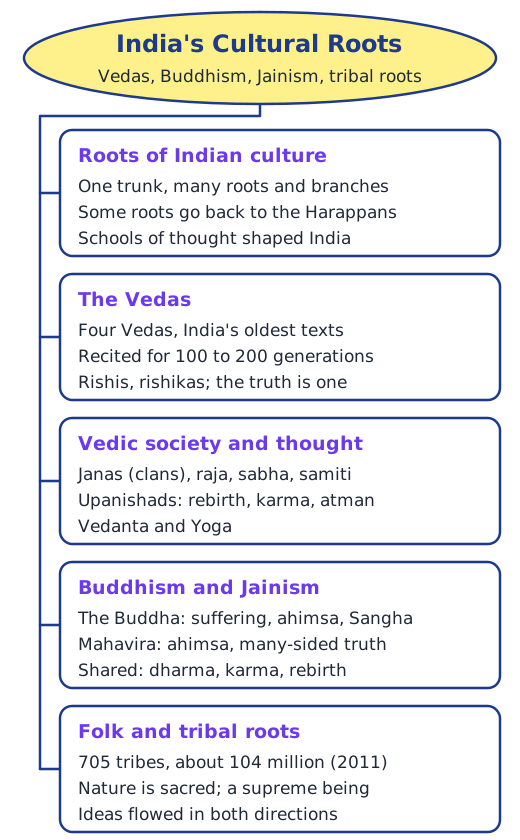
India's Cultural Roots pictures Indian culture as a tree with many roots, a common trunk and many branches. The four Vedas, India's oldest texts, were passed on orally for 100 to 200 generations. The Upaniṣhads brought ideas such as karma, rebirth, brahman and ātman, leading to Vedanta and Yoga. Buddhism and Jainism did not accept the Vedas' authority but shared ideas such as karma and ahimsa. Folk and tribal traditions enriched Indian culture too.
Many roots, one trunk
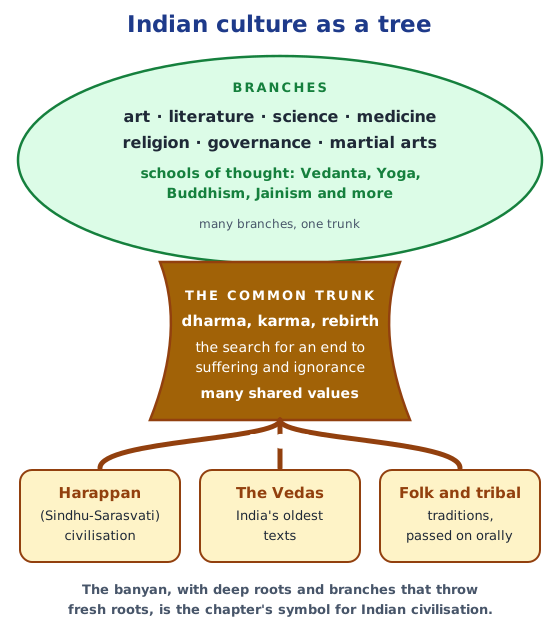
The chapter opens with a saying that true knowledge is the greatest wealth, since it cannot be stolen and grows the more it is used. Indian culture is several millenniums old, and like an ancient tree it has many roots that nurture a common trunk, from which grow many branches: art, literature, science, medicine, religion, governance, martial arts and many schools of thought, groups of thinkers or seekers who share similar ideas. Some roots go all the way back to the Harappan civilisation of Chapter 6.
The Vedas
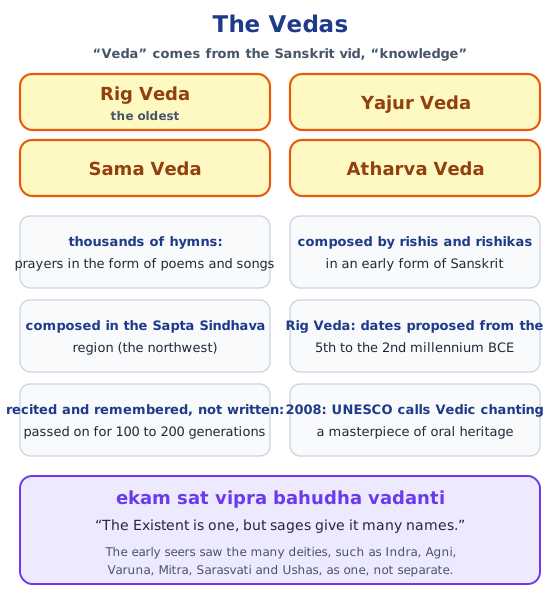
‘Veda’ comes from the Sanskrit vid, ‘knowledge’. The four Vedas, the Ṛig Veda, Yajur Veda, Sāma Veda and Atharva Veda, are India’s most ancient texts and among the oldest in the world. They hold thousands of hymns, prayers in the form of poems and songs, composed in the Sapta Sindhava region by rishis and rishikas, male and female seers, in an early form of Sanskrit. Experts’ dates for the Ṛig Veda range from the 5th to the 2nd millennium BCE. For 100 to 200 generations the hymns were memorised and passed on orally with hardly any change, which is why UNESCO recognised Vedic chanting in 2008.
The hymns address deities such as Indra, Agni, Varuṇa, Mitra, Sarasvatī and Uṣhas, who with the seers sustained ṛitam, truth and order. Yet the seers saw them as one: ekam sat viprā bahudhā vadanti, the Existent is one, but sages give it many names. Truth was a central value, and the last mantras of the Ṛig Veda call on people to come together with one mind and one purpose.
Vedic society
Early Vedic society lived in janas or clans; the Ṛig Veda alone lists over 30, such as the Bharatas, Purus, Kurus, Yadus and Turvaśhas, each linked to a region of the northwest. Little is known of their government, but the words rājā (king or ruler), sabhā and samiti (assemblies) give clues. The texts mention many professions, such as agriculturist, weaver, potter, builder, carpenter, healer, dancer, barber and priest.
Vedic schools of thought
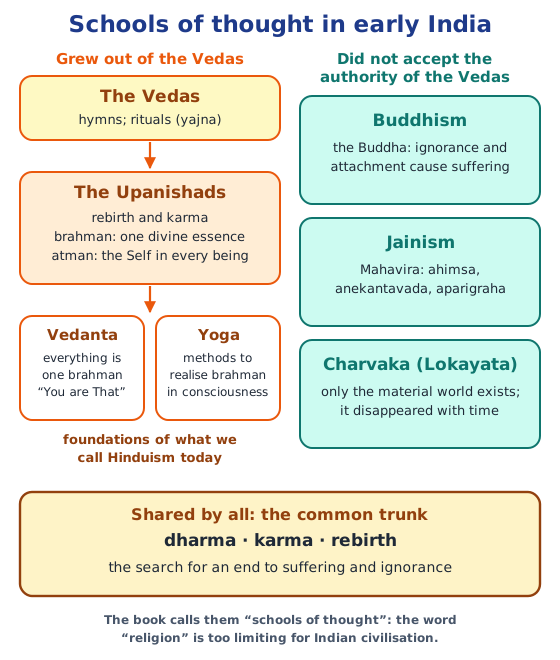
Rituals called yajña were offered to deities, especially Agni, and grew more complex over time. The Upaniṣhads built on the Vedas and introduced rebirth and karma. In the school called Vedanta, everything is one divine essence, brahman, and the ātman, the Self in every being, is one with it: aham brahmāsmi, ‘I am brahman’, and tat tvam asi, ‘You are That’. So everything is connected, which explains the prayer sarve bhavantu sukhinah, ‘May all creatures be happy’. Early in the 1st millennium BCE more schools grew from the Vedas, such as Yoga; together they became the foundations of what we call Hinduism today. Upaniṣhad stories, of Śhvetaketu, Nachiketa, and Gārgī and Yājñavalkya, show the value of asking questions. Read more in what are the Vedas.
Buddhism and Jainism
Some schools did not accept the authority of the Vedas. Siddhārtha Gautama, a prince born in Lumbini (now Nepal), saw old age, sickness and death, left the palace at 29, and after meditating under a pipal tree at Bodh Gaya realised that avidyā (ignorance) and attachment cause suffering. As the Buddha, the ‘awakened’ one, he taught ahimsa, ‘non-hurting’, and sincere inner discipline, and founded the Sangha of monks and, later, nuns.
Vardhamāna, born near Vaiśhālī (Bihar) in the early 6th century BCE, left home at 30 and after 12 years of discipline became Mahāvīra, the ‘great hero’. Jainism, whose roots are said to be much older, teaches ahimsa towards all creatures, anekāntavāda (truth has many sides) and aparigraha (non-possession). The Jātaka tales and Jain stories teach these values simply. Monks and nuns of both schools travelled far, building monasteries and living in rock-cut caves, as at Ellora, where Hindu, Buddhist and Jain caves were cut between the 6th and 10th centuries CE. Read more in Buddhism and Jainism.
There were other schools too, such as the Chārvāka or Lokāyata, which held that only the material world exists; it did not last. The book calls all these schools of thought rather than religions, because they have philosophical, spiritual, religious, ethical and social sides. They differed, but they shared a common trunk: dharma, karma, rebirth and the search for an end to suffering and ignorance.
Folk and tribal roots
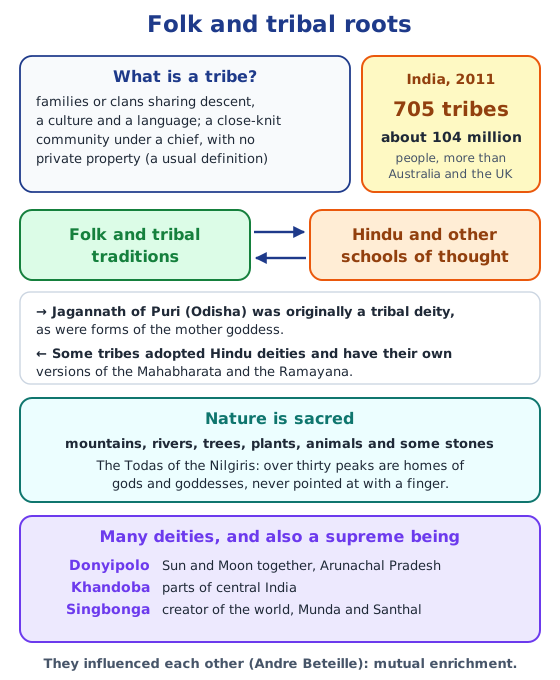
India also has rich oral traditions: folk traditions passed on by common people and tribal traditions passed on by tribes. Ancient India had no word for ‘tribe’; tribes were simply janas living in forests or mountains, and the Constitution says ‘tribes’ or janjāti. In 2011, India had 705 tribes, about 104 million people. Deities, ideas, legends and rituals moved both ways: Jagannath of Puri was originally a tribal deity, while some tribes have their own versions of the Mahābhārata and the Rāmāyaṇa. Folk, tribal and Hindu traditions see nature as sacred, and many tribes worship a supreme being, such as Donyipolo, Khandoba or Singbonga. The sociologist André Béteille noted that they have influenced each other since before history; the result is mutual enrichment.
Answers to every question are in the NCERT solutions for Chapter 7.
Key terms
| Term | Meaning |
|---|---|
| Spiritual | Concerned with the spirit or soul, ātman; spirituality is the search for a deeper or higher dimension beyond our current personality. |
| School of thought | A group of thinkers or spiritual seekers who share similar ideas about human life and the world. |
| Veda | From the Sanskrit vid, ‘knowledge’; the four Vedas, the Ṛig, Yajur, Sāma and Atharva, are India's oldest texts. |
| Rishi and rishika | Male and female seers or sages who composed the Vedic hymns in an early form of Sanskrit. |
| Ṛitam | Truth and order in human life and in the cosmos, which the deities and seers sustained. |
| Jana | A clan or large group of people in early Vedic society, such as the Bharatas, Purus, Kurus and Yadus. |
| Yajña | A Vedic ritual, often read as ‘yagya’, directed towards deities for individual or collective wellbeing. |
| Brahman and ātman | In the Upaniṣhads, brahman is the one divine essence of everything, and ātman is the Self in every being, ultimately one with brahman. |
| Karma and rebirth | Karma means our actions or their results; rebirth means taking birth again and again. |
| Ahimsa | Usually translated ‘non-violence’, but originally ‘non-hurting’ or ‘non-injuring’, in deed and also in thought. |
| Anekāntavāda | The Jain idea of ‘not just one’ aspect: truth has many sides and no single statement can fully describe it. |
| Aparigraha | ‘Non-possession’: detachment from material things, keeping only what is truly necessary. |
| Sangha | The community of Buddhist monks (bhikṣhus) and, later, nuns (bhikṣhuṇīs) founded by the Buddha. |
| Tribe | A group of families or clans sharing descent, culture and language, living as a close-knit community under a chief. |
Topics in this chapter
Practice
-
The word ‘Veda’ comes from the Sanskrit vid, which means:
Show answer
Answer: (b) knowledge
-
Which is the oldest of the four Vedas?
Show answer
Answer: (a) Ṛig Veda
-
Mahāvīra was born near:
Show answer
Answer: (b) Vaiśhālī
-
Which school held that only the material world exists?
Show answer
Answer: (c) Chārvāka
-
According to official figures, how many tribes did India have in 2011?
Show answer
Answer: (c) 705
Questions students ask
What are the main topics of Class 6 SST Chapter 7?
Indian culture as a tree; the Vedas and Vedic society; the Upaniṣhads, Vedanta and Yoga; Buddhism and Jainism and their teachings; other schools such as the Chārvāka; the ideas they shared; and the folk and tribal roots of Indian culture.
Is India's Cultural Roots in the new Exploring Society book?
Yes. It is Chapter 7 of Exploring Society: India and Beyond, the Class 6 Social Science textbook (2026-27 session), and the first chapter of the theme ‘Our Cultural Heritage and Knowledge Traditions’.
How many questions does Chapter 7 have at the end?
The “Questions, activities and projects” section has 7 questions, a true-or-false set of 7 statements and a class activity. Our NCERT solutions page answers all of them, along with the Big Questions and every Let's Explore and Think About It box.
Stuck on a question?
Take a photo and Lagnever AI explains it step by step. Try it for 7 days for ₹2.
Get it on Google Play Open in browser
For parents: after the trial, the plan renews monthly by UPI or card autopay. You can cancel anytime in the app.