
Buddhism and Jainism
Answer in short
Buddhism and Jainism are schools of thought that spread in India in the 6th century BCE without accepting the authority of the Vedas. The Buddha taught that ignorance and attachment cause suffering, and stressed ahimsa and inner discipline. Mahāvīra taught ahimsa towards all creatures, anekāntavāda, that truth has many sides, and aparigraha, or non-possession.
Stuck on a question? Take a photo and Lagnever AI explains it step by step. Try it for 7 days for ₹2. Get it on Google Play
New schools of thought
In the 1st millennium BCE, some schools of thought grew out of the Vedas, while others did not accept the authority of the Vedas and built their own systems. The two most influential were Buddhism and Jainism.
The Buddha
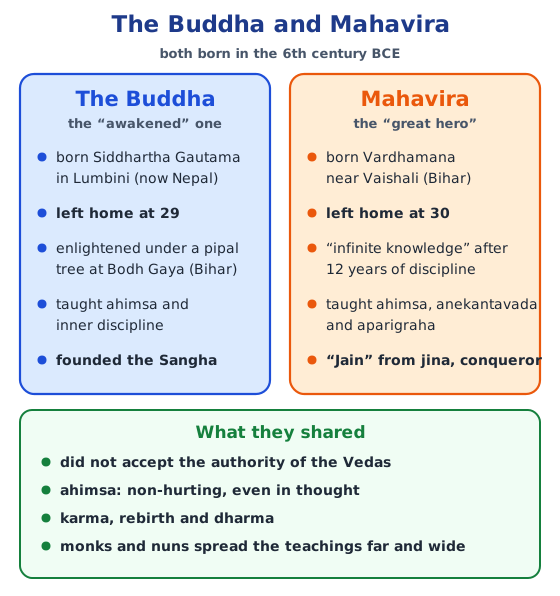
About two and a half millenniums ago, a prince named Siddhārtha Gautama was born in Lumbini, today in Nepal. Scholars disagree on the exact year; Chapter 4 took about 560 BCE. He grew up in a protected palace life. At 29, riding through the city, he saw for the first time an old man, a sick man and a dead body, and also an ascetic who seemed happy and at peace. He gave up palace life and travelled on foot, searching for the root cause of suffering. After meditating for many days under a pipal tree at Bodh Gaya (Bihar), he attained enlightenment: avidyā, ignorance, and attachment are the source of human suffering, and he worked out a way to remove them. He became the Buddha, the ‘awakened’ one.
He taught ahimsa, usually translated ‘non-violence’ but originally ‘non-hurting’, and a sincere inner discipline. In one saying, he explains that bathing in sacred rivers does not make anyone pure; purity lies in truth and dharma, and conquering oneself is greater than conquering thousands in battle. He founded the Sangha, a community of bhikṣhus (monks) and later bhikṣhuṇīs (nuns), and his influence spread across Asia.
The Jātaka tales tell of the Buddha’s former births. In one, a monkey-king makes his own body a bridge so his troop can escape the king’s soldiers; he dies of his injuries, and the watching king learns what a ruler owes his people.
Mahāvīra
Jainism became widespread at the same time, though its roots are said to be much older. Vardhamāna was born into a royal family near Vaiśhālī (Bihar) in the early 6th century BCE. At 30 he left home to seek spiritual knowledge, and after 12 years of ascetic discipline he reached ‘infinite knowledge’. He became Mahāvīra, the ‘great hero’. The word ‘Jain’ comes from jina, ‘conqueror’: not of lands or enemies, but of ignorance and attachments.
Jain teachings include:
- Ahimsa: no living, breathing creature should be killed, hurt, abused or driven away.
- Anekāntavāda: ‘not just one’ view; the truth has many sides and no single statement captures it fully.
- Aparigraha: ‘non-possession’; keep only what is truly necessary.
Jainism also stresses that all creatures, from humans to invisible organisms, depend on one another. In a Jain story, Rohineya, a clever burglar, overhears a few words of Mahāvīra’s sermon, uses them to escape a minister’s trap, then feels remorse, confesses, returns the stolen goods and becomes a monk: right thinking matters, and everyone deserves a second chance.
Ahimsa in thought
In both schools, ahimsa means more than not hurting a person or an animal. It also means avoiding violence in thought, such as ill feelings towards anyone, even towards ourselves. Noticing such thoughts is the first step to turning them into positive ones.
Spreading the teachings
Buddhist and Jain monks, and sometimes nuns, travelled across the land. Some built monasteries far away; others lived in caves cut into rock, where names of monks have been found beside stone beds. At Ellora (Maharashtra), caves cut between the 6th and 10th centuries CE are Hindu, Buddhist and Jain.
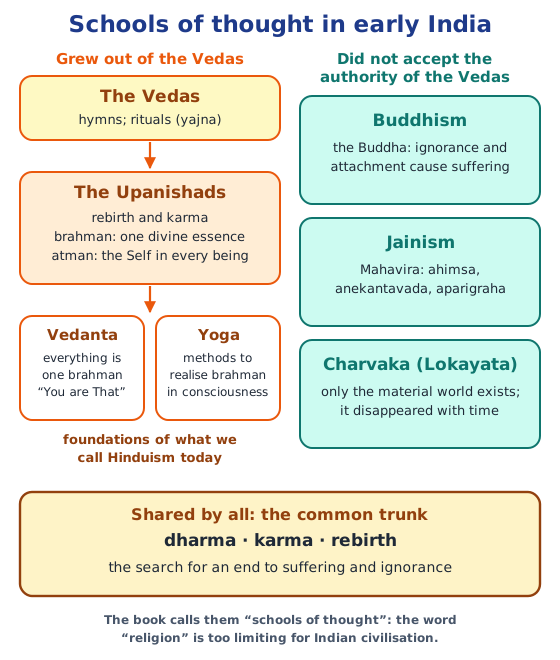
Though different, the Vedic, Buddhist and Jain schools shared ideas such as dharma, karma, rebirth and the search for an end to suffering and ignorance. Read about the Vedic schools in what are the Vedas. Answers to the textbook questions are in the NCERT solutions for Chapter 7; see all of Chapter 7 notes.
Practice
-
Siddhārtha Gautama left the palace at the age of:
Show answer
Answer: (b) 29
-
‘Mahāvīra’ means:
Show answer
Answer: (b) great hero
-
Anekāntavāda means that:
Show answer
Answer: (b) truth has many aspects
-
What did the Buddha realise under the pipal tree at Bodh Gaya?
Show answer
Answer: That avidyā (ignorance) and attachment are the source of human suffering, and he worked out a method to remove these two causes.
-
What does the Jain story of Rohineya teach?
Show answer
Answer: The importance of right action and right thinking, and that everyone deserves a second chance: the burglar confessed, returned what he had stolen and became a monk.
Questions students ask
Who founded Buddhism?
Siddhārtha Gautama, a prince born in Lumbini (now in Nepal), who became the Buddha, the ‘awakened’ or ‘enlightened’ one, after meditating under a pipal tree at Bodh Gaya. He founded the Sangha of monks and, later, nuns.
What are the main teachings of Jainism?
Ahimsa, not harming any living creature; anekāntavāda, that truth has many aspects; aparigraha, non-possession; and the interdependence of all creatures, from humans to invisible organisms.
What did Buddhism and Jainism have in common?
Both did not accept the authority of the Vedas, both taught ahimsa, including in thought, both shared ideas such as dharma, karma and rebirth, and the monks and nuns of both travelled to spread their teachings.
Stuck on a question?
Take a photo and Lagnever AI explains it step by step. Try it for 7 days for ₹2.
Get it on Google Play Open in browser
For parents: after the trial, the plan renews monthly by UPI or card autopay. You can cancel anytime in the app.