
Asking questions like a scientist
Answer in short
Scientists do not only answer questions; they ask good ones. Chapter 1 turns the usual test around in Activity 1.1, Question the Answer: you are given answers and must invent creative questions that could lead to them. One answer can fit many questions, and there are no wrong questions, so the activity trains curiosity and imagination.
Stuck on a question? Take a photo and Lagnever AI explains it step by step. Try it for 7 days for ₹2. Get it on Google Play
Questions come first
At school we are usually handed questions and expected to find the answers. Science works the other way round as well: before anyone can find an answer, someone has to ask a good question. Great scientists are known not only for their answers but for the amazing questions they asked. Grade 6 put it as a play on words: if you want to be wise, keep asking why.
Activity 1.1: Question the Answer
Chapter 1 ends with an unusual activity. You are given four answers, and your task is to invent curious, creative and fun questions, or situations, that could lead to each of them. There are no wrong questions, so let your imagination roam.
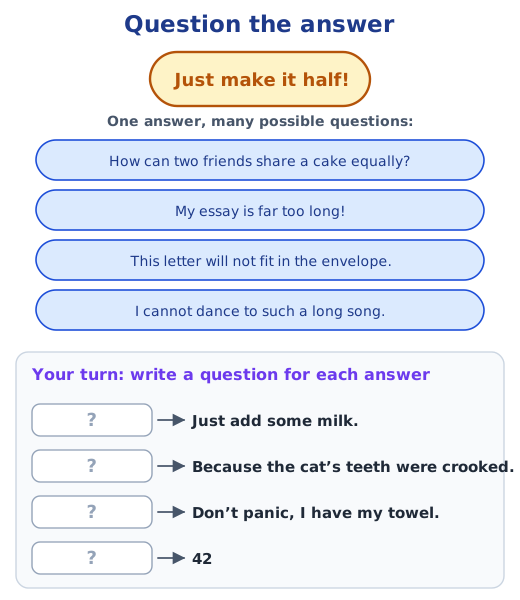
The book gives an example. If the answer is “Just make it half!”, the question could be about sharing a cake equally between friends, an essay that has grown too long, a letter that will not fit in its envelope, or a song too long to dance to. The same answer fits situations that have nothing to do with each other.
Sample questions for the four answers
- “Just add some milk.” My tea is too strong and too hot. What should I do? Or: the halwa is sticking to the pan!
- “Because the cat’s teeth were crooked.” Why did the cat leave such strange bite marks on the ball of wool? Or: why did the cat’s photo show such a funny grin?
- “Don’t panic, I have my towel.” I have just spilled a whole jug of water across the desk! Or: it is pouring and we are still ten minutes from home.
- “42.” How many legs do seven insects have altogether? (Each insect has six legs, and 7 × 6 = 42.) Or: how many days are there in six weeks?
The book asks for interesting questions, not obvious ones such as “What is 32 + 10?”, and it jokes that you should also skip the famous question about life, the universe and everything. That joke, and the towel, are a playful nod to a well-known science-fiction novel.
What makes a question good?
A good scientific question makes you want to find out more. It often begins with how or why, it comes from something you have noticed, and it can be explored by observing or experimenting. “Why does a ripe banana go soft but a pebble stays hard?” leads somewhere; “What colour is my bag?” does not.
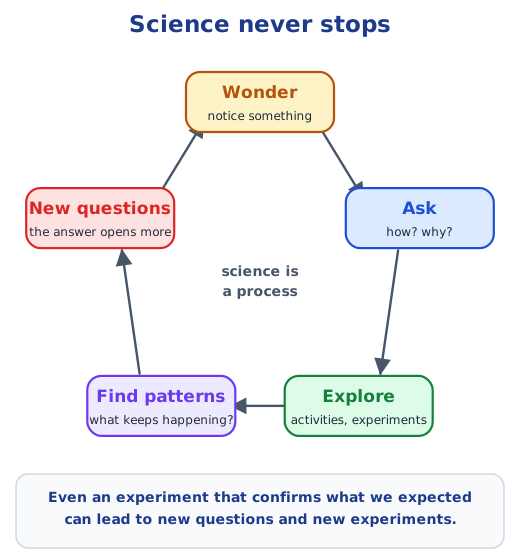
Good questions also lead to more questions. The chapter reminds us that even experiments that confirm what we expected can open new questions that need further experiments. That is why science never stands still.
Try it yourself
Pick an answer of your own, such as “It floats” or “Because of the shadow”, and ask a friend to invent three different questions for it. Then swap. You will be surprised how many ways one answer can be reached, and you will be practising the most important skill a scientist has.
Why it matters
Asking good questions turns every chapter of the year into a set of puzzles to explore. Read more about science as a process in how science keeps changing, and see the year’s journey in the Chapter 1 notes. More sample questions are in the NCERT solutions for Chapter 1.
Practice
-
In Activity 1.1 you are asked to:
Show answer
Answer: (b) invent questions for given answers
-
The book’s example answer for this activity is:
Show answer
Answer: (a) “Just make it half!”
-
Which is the more interesting question for the answer 42?
Show answer
Answer: (b) How many legs do seven insects have altogether?
-
Write a creative question for the answer “Just add some milk.”
Show answer
Answer: For example: “My cup of tea is too strong and too hot. What should I do?” or “The halwa is sticking to the pan!” Either situation could be solved by adding milk.
-
Why is asking questions important in science?
Show answer
Answer: Questions decide what we look for and test. A curious question such as “why does this happen?” leads to observations and experiments, and the answers often raise new questions, which keeps science moving forward.
Questions students ask
What is Activity 1.1, Question the Answer?
It is the only activity in Chapter 1. Instead of answering questions, you are given four answers, “Just add some milk”, “Because the cat’s teeth were crooked”, “Don’t panic, I have my towel” and “42”, and you must write creative questions or situations that could lead to each one.
Can there be more than one right question for an answer?
Yes. The book’s example answer, “Just make it half!”, could reply to a question about sharing a cake, an essay that is too long, a letter that will not fit in an envelope or a song too long to dance to. Many different questions can share one answer.
What does “to be a wise person, you must be a whys person” mean?
It is a play on the words wise and whys, recalled from Grade 6. It means that people become wise by asking “why?” again and again, and by not taking things for granted, which is exactly how scientists work.
Stuck on a question?
Take a photo and Lagnever AI explains it step by step. Try it for 7 days for ₹2.
Get it on Google Play Open in browser
For parents: after the trial, the plan renews monthly by UPI or card autopay. You can cancel anytime in the app.