
How science keeps changing
Answer in short
Science keeps changing because it is a process, not a fixed list of facts. Scientists observe, ask questions, experiment and look for patterns, and every answer opens new questions. Ideas from one field, such as physics, spark questions in others, such as biology. Science also links to society: human actions affect nature, and science can help build a sustainable world.
Stuck on a question? Take a photo and Lagnever AI explains it step by step. Try it for 7 days for ₹2. Get it on Google Play
Science is a way of thinking
In Grade 6 you learnt that science is a process. Grade 7 builds on that idea. Exploring is not only about collecting new facts or learning about different things in nature; it is a way of thinking that welcomes curiosity, keeps asking questions and stays open to what we do not yet know. That is why science is always changing: each new question can lead to new knowledge.
Deeper questions
This year the questions go deeper. How do things work? Why do events happen the way they do? What can we learn from the patterns we see in nature? A pattern is something that happens again and again in a regular way, like the Sun rising every morning or a battery that runs down after use. Noticing a pattern is the first step; asking why it happens is where real science begins.
Learning by doing
To answer such questions, reading is not enough. The book asks us to step out of its pages, and sometimes out of the classroom, to do activities and experiments. These experiences are meant to be stepping stones to a deeper understanding of our surroundings and of our place on the planet, and they show science as a discovery that never stops.
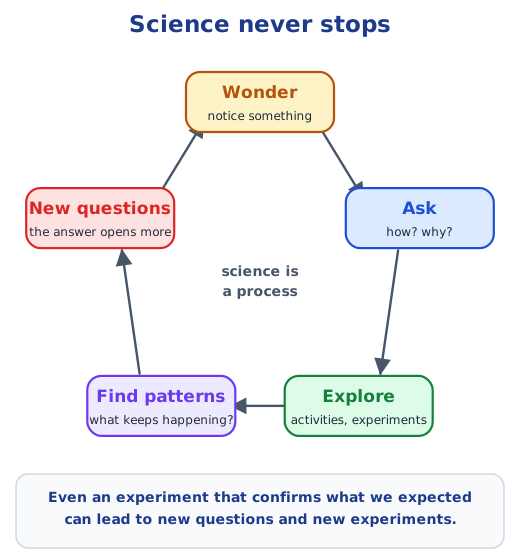
Even an experiment that turns out exactly as we expected can raise fresh questions. Why did it work? Would it work with a different material, a bigger amount or a hotter day? Each new question needs a new experiment, and so the cycle goes on.
Simple observations, big ideas
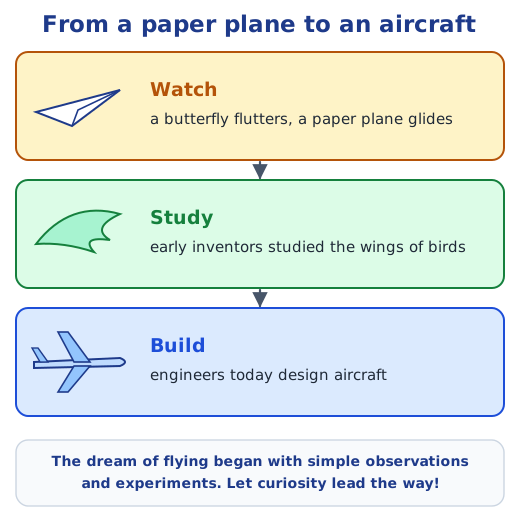
The page numbers in the Grade 7 book follow a butterfly and a paper plane. They hint at a real story: a paper plane is a simple toy, yet watching things fly led early inventors to study bird wings, and that work eventually led modern engineers to design aircraft. The dream of flying started with simple observations and experiments, which is how much of science begins.
All the sciences are connected
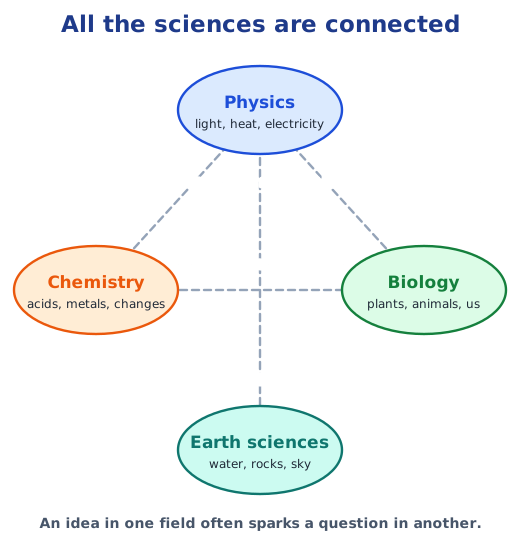
The book has chapters from physics, chemistry, biology and earth sciences. They look separate, but they are linked: a scientific idea from one area can trigger a discovery, or at least a new question, somewhere else. Light from the Sun lets plants make food; the Sun’s heat makes water evaporate and fall as rain; changes in materials happen inside our own bodies when we digest food and breathe.
Science and responsibility
Discovery comes with responsibility. As young explorers you will notice how what people do changes the natural world and is tied up with the society we live in. Science can help us understand environmental challenges, such as melting glaciers or changing rainfall, and find ways to build a more sustainable world.
Why it matters
Seeing science as a living process makes every chapter of the year an adventure rather than a list to learn. Practise asking good questions in asking questions like a scientist, and see where the year will take you in the Chapter 1 notes. Answers to every question in the chapter are in the NCERT solutions for Chapter 1.
Practice
-
Which of these shows that science is a process?
Show answer
Answer: (b) Asking questions, testing and asking again
-
According to the chapter, what did early inventors study on the way to designing aircraft?
Show answer
Answer: (b) Bird wings
-
Which pair shows two linked fields of science?
Show answer
Answer: (a) Sunlight and plants making food
-
Why does the chapter say science is also about responsibility?
Show answer
Answer: Because what people do affects nature and the society around them. As we learn how the world works, we can see the harm some actions cause and use science to face environmental challenges and build a more sustainable world.
-
Give an example of a pattern in nature that can lead to a deeper question.
Show answer
Answer: Day always follows night. Noticing this pattern leads to the deeper question of why it happens, which is answered by the Earth spinning on its axis while the Sun lights only one half of it at a time.
Questions students ask
What does it mean to say science is a process?
It means science is a way of finding out rather than a finished book of answers. We observe, wonder, ask questions, test ideas with activities and experiments, notice patterns and then ask new questions. What we know grows and changes as this cycle goes on.
What deeper questions does Grade 7 Science ask?
Chapter 1 names three: how things work, why events turn out as they do, and what nature’s patterns can teach us. The chapters of the year, from acids and electricity to life processes, light and eclipses, are built around such questions.
Why are the different fields of science connected?
Because nature is one world, and we only divide it into physics, chemistry, biology and earth sciences to study it. Heat from the Sun drives the water cycle, sunlight lets plants make food, and changes in materials happen inside our bodies, so an idea in one field often sparks questions in another.
Stuck on a question?
Take a photo and Lagnever AI explains it step by step. Try it for 7 days for ₹2.
Get it on Google Play Open in browser
For parents: after the trial, the plan renews monthly by UPI or card autopay. You can cancel anytime in the app.