
Class 7 Science Chapter 1: The Ever-Evolving World of Science Notes
This chapter in five lines
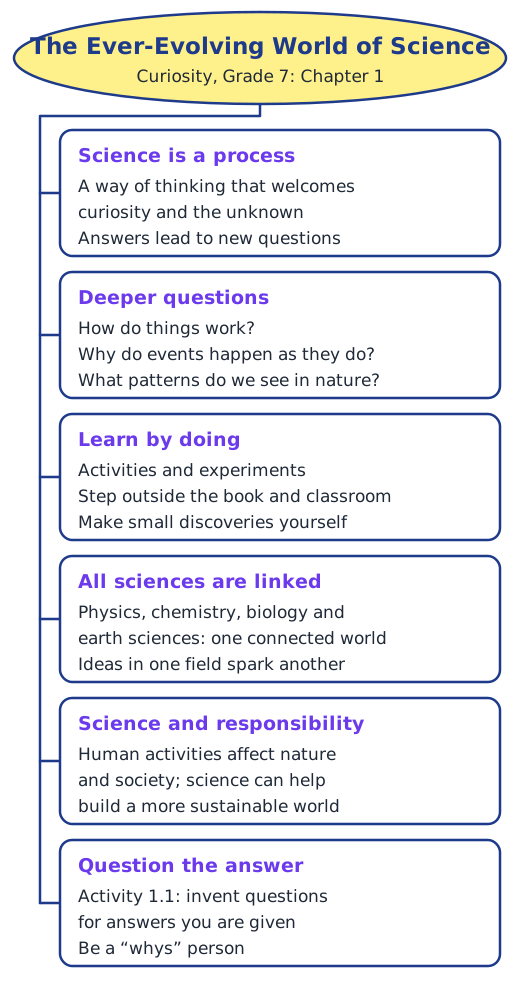
The Ever-Evolving World of Science is the opening chapter of Curiosity, Grade 7. It reminds us that science is a process, a way of thinking that welcomes curiosity and the unknown, and invites us to ask deeper questions: how things work, why events happen and what patterns nature shows. It previews the year’s journey, from materials and electricity to life processes, time, light and the sky, and ends with Activity 1.1, Question the Answer.
What is this chapter about?
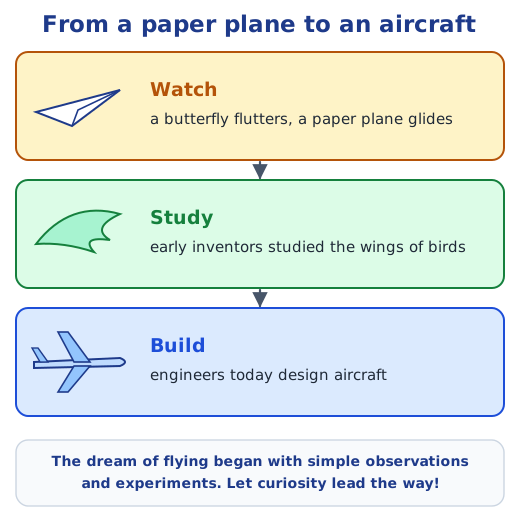
Chapter 1 welcomes you back to Curiosity after Grade 6. The book is not meant to be a store of facts but an invitation to question, to experiment and to explore the world, from tiny cells inside a leaf to the movement of the Sun and stars. Its page numbers follow a fluttering butterfly and a soaring paper plane, a reminder that simple observations of flight once led to real experiments and, in time, to aircraft.
Science is a process
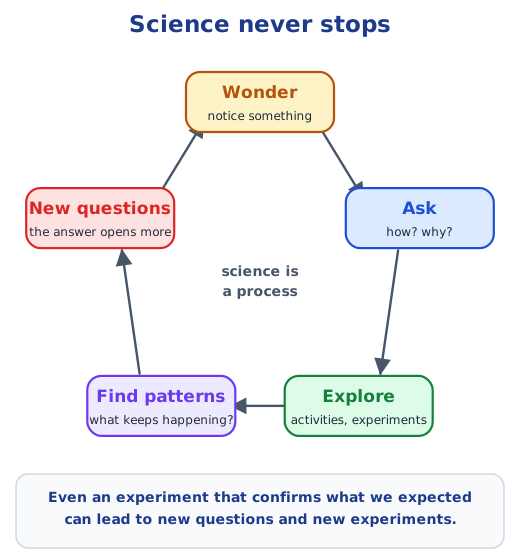
Science is not only about finding new facts. It is a habit of mind that enjoys curiosity, keeps asking and is comfortable with what we do not yet know. In Grade 7 the questions dig deeper, into how things work, why events turn out as they do and what nature’s patterns can teach us. To answer them we step out of the book, and sometimes out of the classroom, to do activities and experiments. Read more in how science keeps changing.
Connected sciences and our responsibility
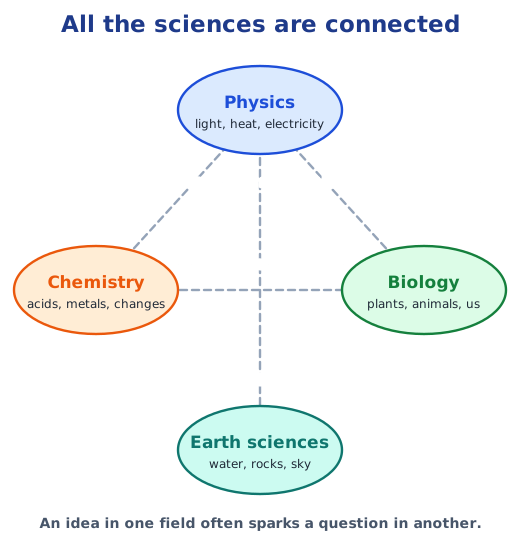
The book has chapters from physics, chemistry, biology and earth sciences, but they are all linked: an idea in one field often inspires a discovery, or at least a question, in another. Science is also about responsibility. What people do affects nature and is tied to the society we live in, and science can help us face environmental challenges and build a more sustainable world.
The journey of the year
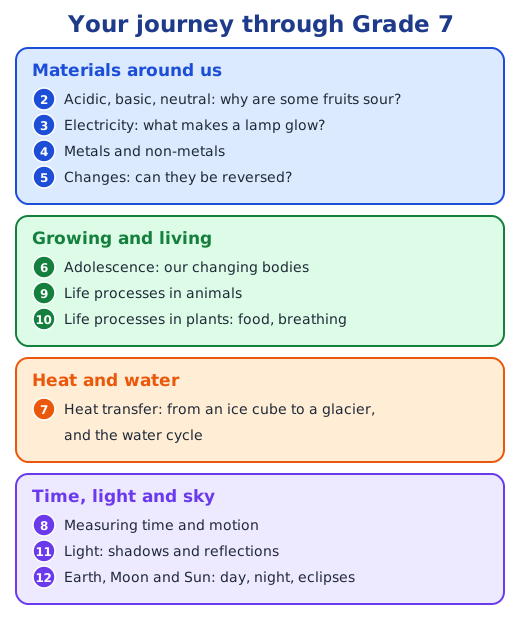
The chapter takes a quick tour of the book. We begin with materials: why are some fruits sour, and what happens when a haldi stain is washed? Batteries, lamps and wires lead to metals and non-metals, and then to changes, some reversible and some not. We follow heat as it melts an ice cube or a glacier, and water as it evaporates, rains and soaks into the ground. Then come our own growing bodies, life processes in animals and plants, the measurement of time, light and shadows, and finally the Earth, Moon and Sun, with day and night and eclipses. You can already read the notes on heat, time and motion, life processes in animals, life processes in plants, light and the Earth, Moon and Sun.
Happy exploring!
Each chapter builds on what you know and asks you to think like a scientist, and even experiments that confirm what we expect may lead to new questions. The chapter ends with Activity 1.1, Question the Answer: instead of answering questions, you invent creative questions for given answers. Try it in asking questions like a scientist, and find sample answers to every question in the NCERT solutions for Chapter 1.
Key terms
| Term | Meaning |
|---|---|
| Science | A way of thinking and finding out about the world by asking questions, observing and experimenting. It is a process that keeps going, not just a list of facts. |
| Curiosity | The wish to know and understand. In science it leads to questions such as how? and why? |
| Observation | Noticing carefully, with our senses or with instruments, what happens around us. |
| Experiment | A planned test done to check an idea or to find out what happens. |
| Pattern | Something that happens again and again in a regular way, such as day following night. Patterns lead to deeper questions. |
| Fields of science | Physics, chemistry, biology and earth sciences study energy, materials, living things and the Earth and sky. They are different chapters but one connected world. |
| Reversible and irreversible changes | Some changes can be undone, like ice melting into water; others cannot, like a fruit ripening or a rock breaking into pebbles. |
| Life processes | Activities such as eating, breathing and moving nutrients around the body that living things need in order to grow and survive. |
| Eclipse | An event in which the Earth or the Moon casts its shadow on the other, blocking sunlight for a while. |
| Sustainable world | A way of living that meets our needs without harming the environment for the future. Science can help us build it. |
Topics in this chapter
Practice
-
According to the chapter, science is mainly:
Show answer
Answer: (b) a process and a way of thinking
-
Which question is a deeper question of the kind Grade 7 asks?
Show answer
Answer: (b) How do things work?
-
In Activity 1.1, students are asked to:
Show answer
Answer: (b) write questions for given answers
-
Which of these changes cannot be reversed?
Show answer
Answer: (b) A fruit ripening
-
The page numbers of the Grade 7 book follow:
Show answer
Answer: (b) a butterfly and a paper plane
Questions students ask
What is Class 7 Science Chapter 1 about?
It is the opening chapter of the Grade 7 Curiosity book. It explains that science is a process of asking and exploring, shows how the fields of science are connected and linked to our responsibility for the environment, previews every chapter of the year and ends with Activity 1.1, where you invent questions for given answers.
Is The Ever-Evolving World of Science in the new NCERT book?
Yes. It is Chapter 1 of Curiosity, the Class 7 Science textbook (Reprint 2026-27), on pages 1 to 6. It continues the idea of the Grade 6 chapter The Wonderful World of Science and leads into Chapter 2 on acidic, basic and neutral substances.
Does Chapter 1 have exercise questions?
No end-of-chapter exercise is given. The chapter asks many questions in its text, about sour fruits, glowing lamps, changes, growing bodies, plants, time and eclipses, and it has one activity, Activity 1.1, Question the Answer. Our NCERT solutions page answers all of them.
Stuck on a question?
Take a photo and Lagnever AI explains it step by step. Try it for 7 days for ₹2.
Get it on Google Play Open in browser
For parents: after the trial, the plan renews monthly by UPI or card autopay. You can cancel anytime in the app.