
NCERT Solutions Class 7 Science Chapter 1: The Ever-Evolving World of Science
Answers to every question in Chapter 1, The Ever-Evolving World of Science, of Curiosity Grade 7 (Reprint 2026-27). The chapter has no end-of-chapter exercise; it asks many questions in its text, as a preview of the year, and it has one activity, Activity 1.1, Question the Answer. Page numbers follow the book (pages 1–6). Short notes: Chapter 1 notes.
Questions about materials (pages 2–3)
Why are some fruits sour? Sour fruits such as lemons, raw mangoes and tamarind contain acids. (Extra: lemons and oranges contain citric acid, tamarind tartaric acid.) Chapter 2 explores acidic, basic and neutral substances.
What happens when we wash a haldi stain on our school uniform? Washing it with soap turns the yellow stain reddish-brown. (Extra: haldi is a natural indicator, and soap solution is basic, so the colour changes; Chapter 2 explains why.)
What kind of materials do we need to make a lamp glow? A cell or battery, connecting wires and a bulb, joined in a complete loop, and materials that let electricity pass through them. Materials that let electricity pass are conductors; Chapter 3 tests many of them, and Chapter 4 sorts materials into metals and non-metals.
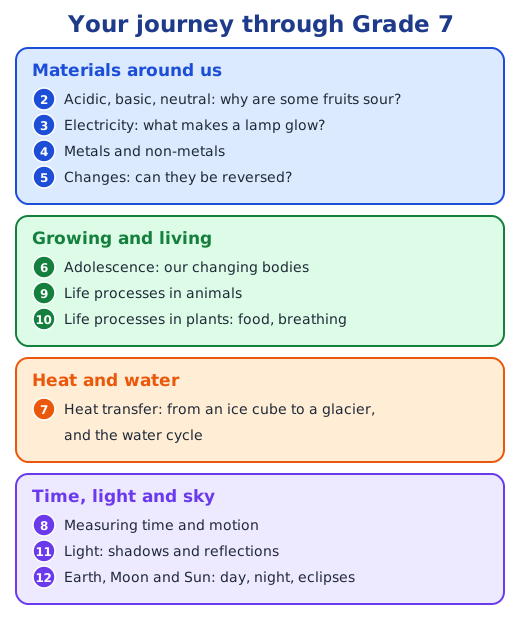
Batteries run out, ice melts into water, fruits ripen, rocks break into pebbles: what kind of changes are these?
- A battery running out: a chemical change, which cannot simply be reversed.
- Ice melting into water: a physical change, which can be reversed by freezing.
- A fruit ripening: a chemical change, which cannot be reversed.
- Rocks breaking into pebbles: a physical change (the material stays the same), which cannot be undone.
Heat starts or speeds up several of these changes. Chapter 5 is about such changes, and Chapter 7 about how heat flows.
Questions about living things (page 4)
Why are our bodies changing so fast in the middle-school years? These are the years of adolescence, when the body grows quickly and changes as it moves from childhood towards adulthood. Chapter 6 explains this stage of growth and change.
To grow, what must animals do? Eat and breathe, and blood must carry nutrients from food all over the body. These life processes are the subject of Chapter 9.
Don’t plants also need food? How do they get it? Do they breathe? How? Yes. Plants make their own food in their green leaves using sunlight, water and carbon dioxide, a process called photosynthesis. They also respire, taking in oxygen through tiny pores in their leaves and other parts. See Chapter 10.
Questions about time, light and the sky (pages 4–5)
How do we measure time, and how fast does something happen? Clocks and watches measure time today; long before them, people used the position of shadows cast by the Sun. How fast something happens is measured by how far it moves, or how much it changes, in a given time. See Chapter 8.
Why is light important beyond shadow puppets and telling the time? Light lets us see, we have found many ways to produce it so that we can read at night, and studying the nature of light has taught us a great deal about the universe. See Chapter 11.
How do shadows lead to eclipses, and what causes day and night? The Earth and the Moon cast shadows in space; when one falls on the other, we see an eclipse. Day and night happen because the Earth spins on its axis, so only the half facing the Sun is lit. The Moon circles the Earth while the Earth circles the Sun; Chapter 12 explains these movements.
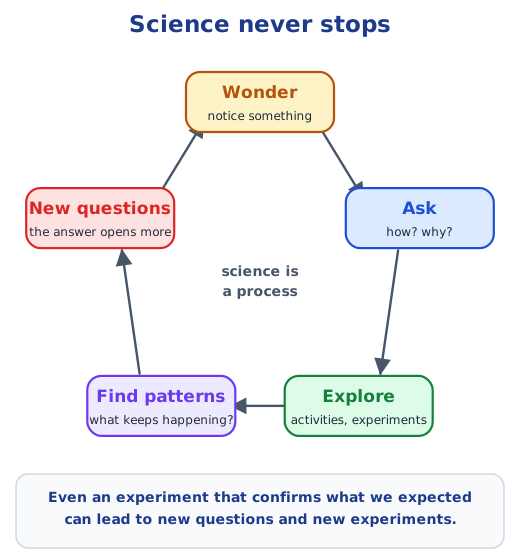
Isn’t it amazing that we humans can wonder about the world we live in? Yes. Our ability to wonder, ask questions and test ideas is what makes science possible.
Activity 1.1: Question the Answer (pages 5–6)
Any creative question that could lead to the answer is right; here are samples.
- Just add some milk. “My cup of tea is too strong and too hot. What should I do?” “The halwa is sticking to the pan!” “How do I make this dough softer?”
- Because the cat’s teeth were crooked. “Why did the cat leave such strange bite marks on the ball of wool?” “Why did the cat’s photo show such a funny grin?” “Why couldn’t the cat hold its toy mouse properly?”
- Don’t panic, I have my towel. “I have just spilled a jug of water across the desk!” “It is pouring and we are still ten minutes from home.” “The baby splashed bath water all over me!”
- 42. “How many legs do seven insects have altogether?” (6 × 7 = 42) “How many days are there in six weeks?” “If I read 6 pages every day, how many pages do I read in a week?”
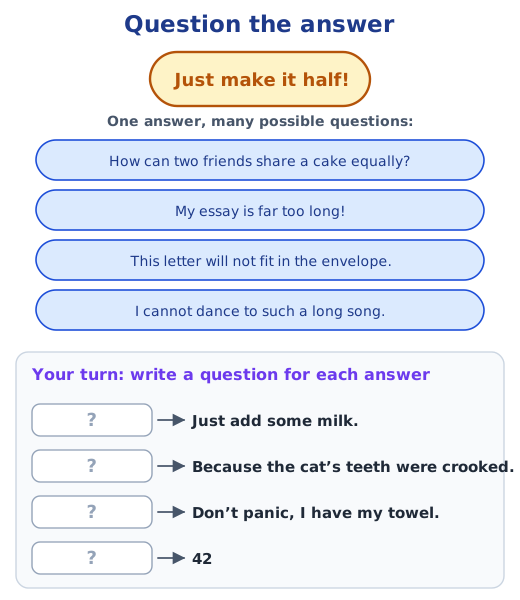
The book’s own example shows why this works: the answer “Just make it half!” could reply to a question about sharing a cake, an essay that is too long, a letter that will not fit in an envelope or a song too long to dance to. Thinking up many questions for one answer is good practice for thinking like a scientist. Read more in asking questions like a scientist.
Practice
-
Which of these is a chemical change that cannot be reversed?
Show answer
Answer: (b) Burning a candle wick
-
What do plants need to make their own food?
Show answer
Answer: (b) Sunlight, water and carbon dioxide
-
Before clocks, how did early humans tell the time during the day?
Show answer
Answer: (b) By the position of shadows in the Sun
-
Write a creative question for the answer “Because it was raining.”
Show answer
Answer: For example: “Why was the cricket match stopped halfway?” or “Why did the ants carry their eggs to higher ground?”
-
Name two fields of science and give one link between them.
Show answer
Answer: Physics and biology: light from the Sun, studied in physics, lets plants make food, which is studied in biology. Another link: the Sun’s heat (physics) drives the water cycle (earth sciences).
Stuck on a question?
Take a photo and Lagnever AI explains it step by step. Try it for 7 days for ₹2.
Get it on Google Play Open in browser
For parents: after the trial, the plan renews monthly by UPI or card autopay. You can cancel anytime in the app.