
Class 7 Social Science Part 2 Chapter 2: India and Her Neighbours Notes
This chapter in five lines
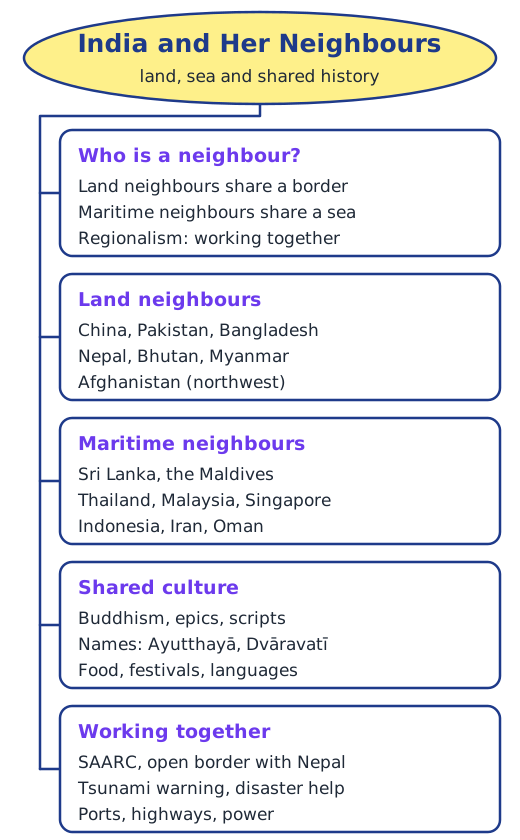
India and Her Neighbours explains that India’s neighbourhood includes countries across both land and sea. Pakistan, Afghanistan, China, Nepal, Bhutan, Bangladesh and Myanmar are land neighbours, while Sri Lanka, the Maldives, Thailand, Malaysia, Singapore, Indonesia, Iran and Oman are maritime neighbours. Trade, Buddhism, epics, languages and food have linked them for thousands of years, and today India works with them on trade, energy, connectivity and disaster relief, despite tensions with some.
What is this chapter about?
The chapter opens with a Nelson Mandela thought: what affects one nation affects the rest. It asks what makes a country a neighbour, how geography and history shape India’s ties with her neighbours, and how they are connected today. It visits each land neighbour and then the nearest maritime neighbours, the countries India shares the seas with.
Who is a neighbour?
The traditional answer is a country with a shared land boundary. India’s land boundary runs for over 15,100 km, crossing deserts and plains, forests and mountains, marshes and river valleys. But India is also a maritime nation, with the sea on three sides: the Arabian Sea, the Bay of Bengal and the Indian Ocean. So Sri Lanka and the Maldives are our neighbours across the water, and Thailand, Malaysia, Singapore and Indonesia to the southeast, with Iran and Oman to the west, form a wider maritime neighbourhood.
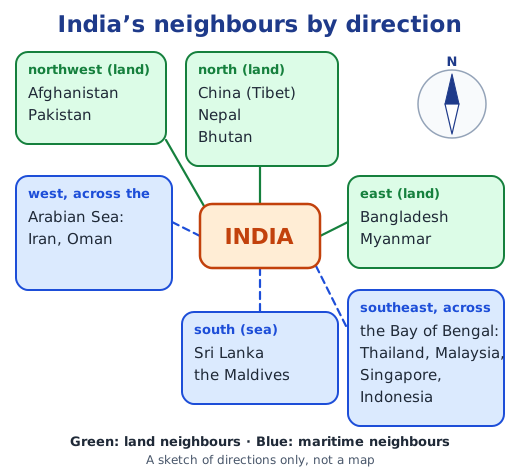
With a coastline of about 11,100 km and a peninsula reaching deep into the Indian Ocean, India sits on busy sea routes linking Southeast Asia, West Asia and Africa. The Indian Ocean carries half of the world’s container ships and two-thirds of its oil. Working together in the region for peace and progress is called regionalism.
The land neighbours
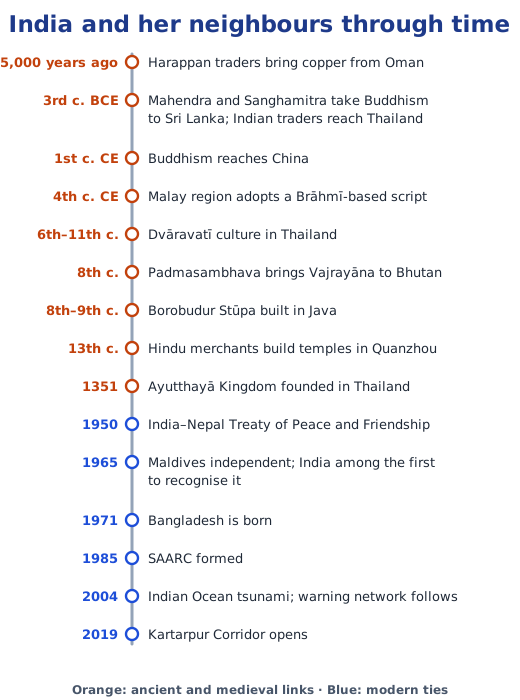
China, the largest neighbour, is separated from India by the Himalayas. Buddhism reached China from India around the 1st century CE; Chinese monks such as Faxian and Xuanzang studied in India, and Indian monks such as Bodhidharma and Kumārajīva taught in China. Trade continues, though China sells India about eight times more than it buys, and border tensions recur. Pakistan was part of India until the 1947 Partition. Wars and Pakistan-backed terrorism have kept relations tense, yet shared places such as the Katas Raj temple and the Kartarpur Corridor, opened in 2019 for Sikh pilgrims, link the two peoples.
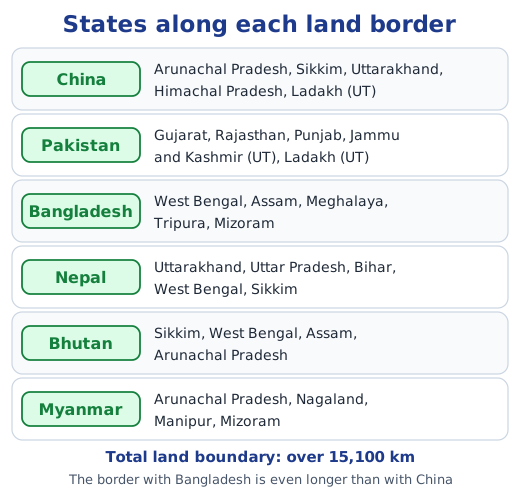
Bangladesh, born in 1971, shares Bangla, the Ganga–Brahmaputra rivers and the Sundarban mangroves with India. Nepal has an open border with India, so people cross without passports or visas. Bhutan, the ‘Land of the Thunder Dragon’, shares Buddhism and hydroelectric power, and measures its progress with Gross National Happiness. Myanmar is India’s gateway to Southeast Asia, and Afghanistan, linked to India by the ancient Uttarāpatha route, has received Indian help with its Parliament building and the Zaranj–Delaram highway. Read more in India’s land neighbours.
Buddhism and shared culture
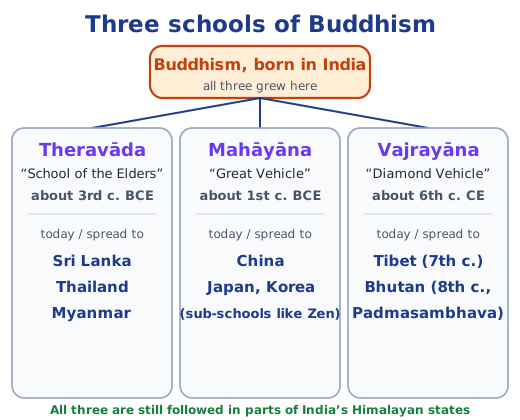
Three schools of Buddhism grew in ancient India. Theravāda spread to Sri Lanka, Thailand and Myanmar; Mahāyāna to China, Japan and Korea; and Vajrayāna to Tibet and to Bhutan, where Guru Padmasambhava took it in the 8th century. Epics, festivals, languages, scripts and food also travelled across borders.
The maritime neighbours
Sri Lanka, only about 32 km away across the Palk Strait, received Buddhism from Aśhoka’s children Mahendra and Sanghamitrā. The Maldives, over 1,100 islets about 130 km from Minicoy, shares food, dance and words with south India; India helped it in the 2004 tsunami and the 2014 Malé water crisis. Thailand’s Dvāravatī and Ayutthayā are named after Dvārakā and Ayodhyā, Malaysia once used a Brāhmī-based script, Singapore has Tamil as an official language, and Indonesia shows Garuḍa on its currency. To the west, Iran shares ancient links between the Avesta and the Ṛigveda, and Oman traded copper with the Harappans 5,000 years ago. See India’s maritime neighbours.
Working together
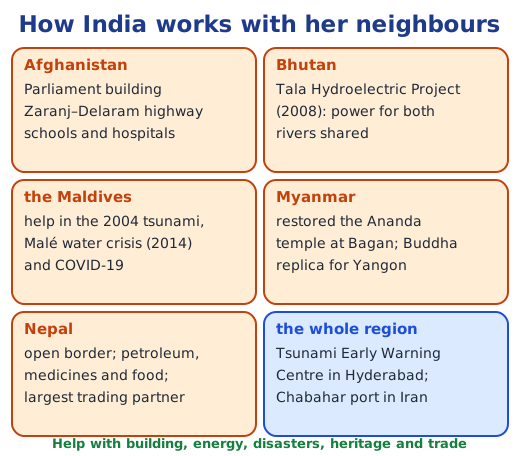
In 1985 India and seven neighbours formed SAARC to cooperate, though tensions have often disrupted it. After the 2004 tsunami, India joined Indonesia, Sri Lanka, Thailand and others to build a warning network, with the Indian Tsunami Early Warning Centre in Hyderabad. Ancient routes such as the Uttarāpatha, the Silk Route and the spice routes once linked the region; new highways, ports and power projects now aim to revive those links. Answers to every question are in the NCERT solutions for Part 2 Chapter 2.
Key terms
| Term | Meaning |
|---|---|
| Neighbour | A country next to another. Traditionally a neighbour shares a land boundary, but countries across a shared sea are neighbours too. |
| Maritime neighbour | A country that faces another across a shared sea or ocean, even with no land border between them, such as Sri Lanka and the Maldives for India. |
| Regionalism | Countries of a region working together for peace, stability and shared progress, for example through trade and disaster relief. |
| Open border | A border that people of the two countries can cross without a passport or visa, like the India–Nepal border. |
| Landlocked | Having no coastline, with land on all sides, like Afghanistan, Nepal and Bhutan. |
| Archipelago | A large group of islands. Indonesia is made of a few large islands and more than 17,000 small ones. |
| SAARC | The South Asian Association for Regional Cooperation, formed in 1985 by India with Pakistan, Nepal, Bhutan, Bangladesh, Sri Lanka, the Maldives and Afghanistan. |
| Theravāda, Mahāyāna, Vajrayāna | The three main schools of Buddhism, which grew in ancient India and spread to her neighbours. |
| Gross National Happiness | Bhutan’s index for measuring progress through sustainability, good governance and culture, not only income. |
| Suvarṇabhūmi | The ‘golden land’, the name ancient Indian traders gave to the lands of Southeast Asia such as Java, Sumatra and Malaya. |
| Ingot | A block of metal cast in a shape that is easy to carry and rework, like the copper ingots from ancient Oman. |
Topics in this chapter
Practice
-
Which of these is a maritime neighbour of India?
Show answer
Answer: (c) Sri Lanka
-
India and Nepal have an open border under the treaty of:
Show answer
Answer: (b) 1950
-
The narrow sea between India and Sri Lanka is the:
Show answer
Answer: (a) Palk Strait
-
Bhutan measures its progress with:
Show answer
Answer: (b) Gross National Happiness
-
SAARC was formed in:
Show answer
Answer: (c) 1985
-
India’s land border with which country is longer than her border with China?
Show answer
Answer: (b) Bangladesh
Questions students ask
What are the main topics of Class 7 SST Part 2 Chapter 2?
What a neighbour is; India’s land neighbours China, Pakistan, Bangladesh, Nepal, Bhutan, Myanmar and Afghanistan; her maritime neighbours Sri Lanka, the Maldives, Thailand, Malaysia, Singapore, Indonesia, Iran and Oman; shared culture such as Buddhism; and how India works with her neighbours.
Is India and Her Neighbours in the new NCERT book?
Yes. It is Chapter 2 of Exploring Society: India and Beyond, the Class 7 Social Science textbook Part 2 (2026-27), on pages 29 to 60.
How many neighbours does India have?
The chapter names seven land neighbours, Pakistan, Afghanistan, China, Nepal, Bhutan, Bangladesh and Myanmar, and eight nearby maritime neighbours, Sri Lanka, the Maldives, Thailand, Malaysia, Singapore, Indonesia, Iran and Oman.
Stuck on a question?
Take a photo and Lagnever AI explains it step by step. Try it for 7 days for ₹2.
Get it on Google Play Open in browser
For parents: after the trial, the plan renews monthly by UPI or card autopay. You can cancel anytime in the app.