
NCERT Solutions Class 8 Social Science Chapter 7: Factors of Production
Answers to the Big Questions, every Let’s Explore and Think About It box, and all ten Questions and activities in Chapter 7, Factors of Production, of Exploring Society: India and Beyond, Grade 8 Part 1. Page numbers follow the book (pages 163–183). Short notes: Chapter 7 notes.
The Big Questions (page 163)
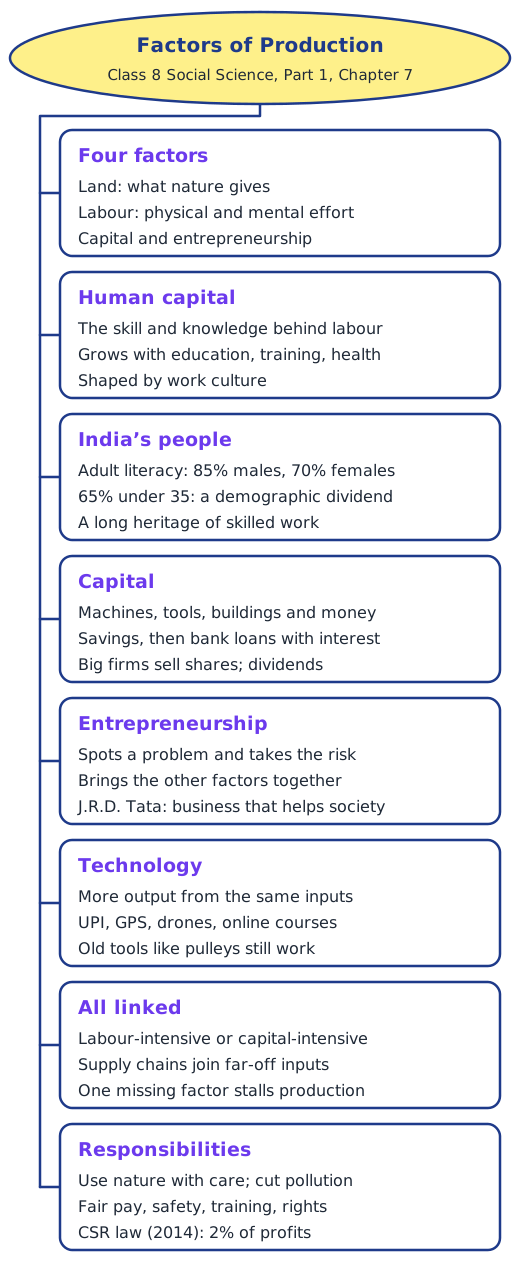
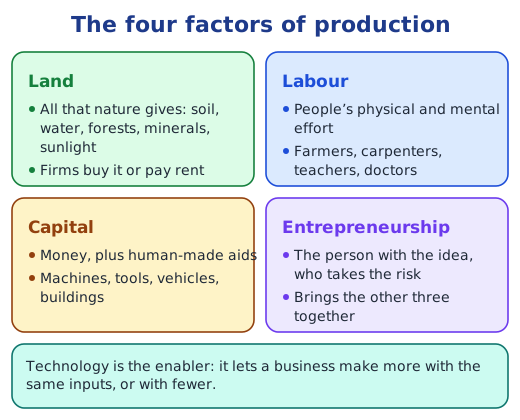
1. What are the factors of production? They are the inputs, or resources, used to make goods and services. Economists group them into four: land, meaning every natural resource (soil, water, forests, air, sunlight, minerals, oil and natural gas); labour, the physical and mental effort of people; capital, money plus human-made aids such as machines, tools and buildings; and entrepreneurship, the person who has the idea, takes the risk and combines the rest. Technology is the enabler that helps all four produce more.
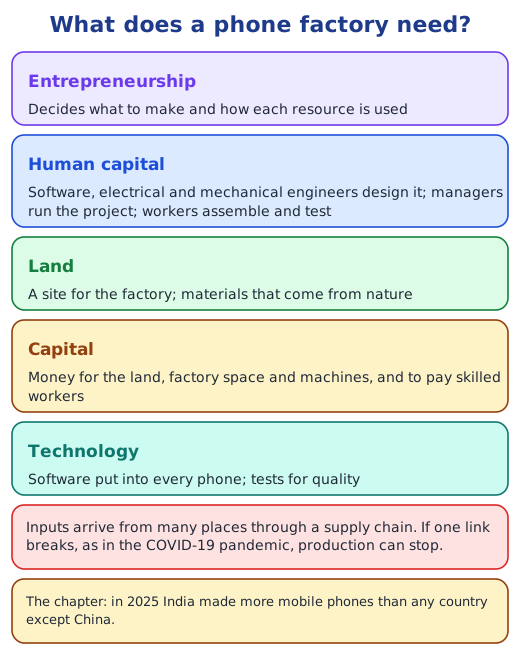
2. How are the factors linked to one another? They complement each other: a business needs all of them, and if one is missing or misused, production becomes wasteful or stops. The mix depends on the product. Farming, construction and handicrafts use more labour; semiconductor chips and satellites use more capital. New methods can change the mix, as when farm machines reduce the need for workers. Inputs also come from different places, joined by supply chains, so a break far away, as in the COVID-19 pandemic, can halt production. A mobile phone factory shows all of them at work together.
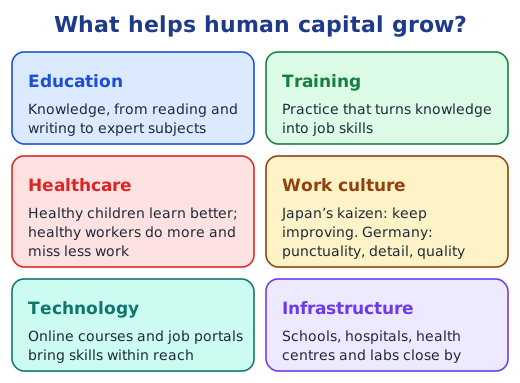
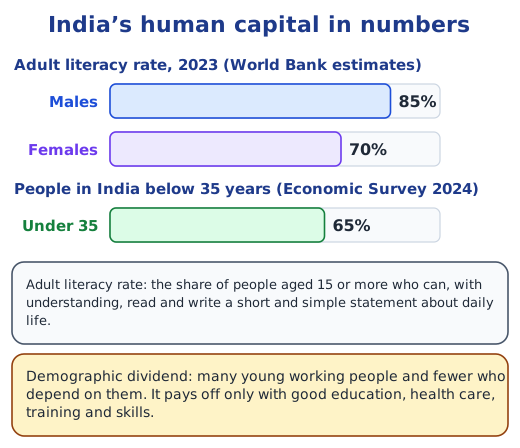
3. What does human capital do in production, and what helps it grow? Human capital, the skill, knowledge and expertise of people, decides how well and how efficiently labour is used, so it raises productivity and helps create new ideas and better products. It grows through education and training, good health, and social and cultural influences such as a culture of hard work and continuous improvement; the chapter’s summary also adds the use of technology.
Let’s Explore and Think About It (pages 165–180)
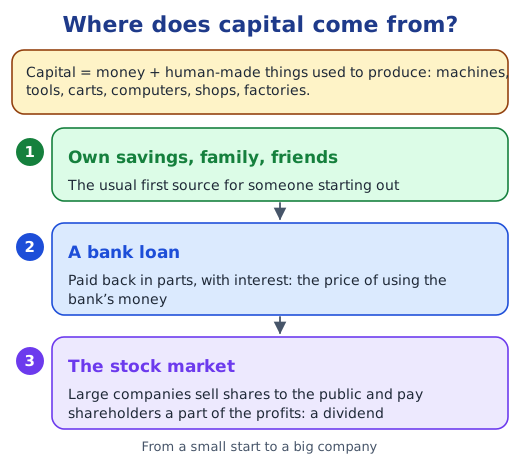
A survey of economic activities near you (page 165). A sample report from our own street. Tailors (3): stitch and alter clothes; inputs: sewing machines, thread, cloth, space in a shop, skill. Bakery (1): bread, buns, cakes; inputs: flour, sugar, an oven, electricity, bakers. Cycle repair stall (2): repairs; inputs: tools, spare tyres and tubes, a pump, skill. Tea stalls (4): tea and snacks; inputs: milk, tea leaves, a stove and gas, cups, a cart. Where does the money come from? Usually the owner’s savings, help from family and friends, and sometimes a bank loan. Where did the hairdresser train? Often by working under an experienced hairdresser for some years, or in a short beauty and hair course. Who taught the food vendors to cook? Often parents or relatives, then practice on the job; some learn from a cook they worked for. What motivated the owners? To earn a living, to be their own boss, a skill or interest they enjoy, a family business to carry on, or a need they saw in the area.
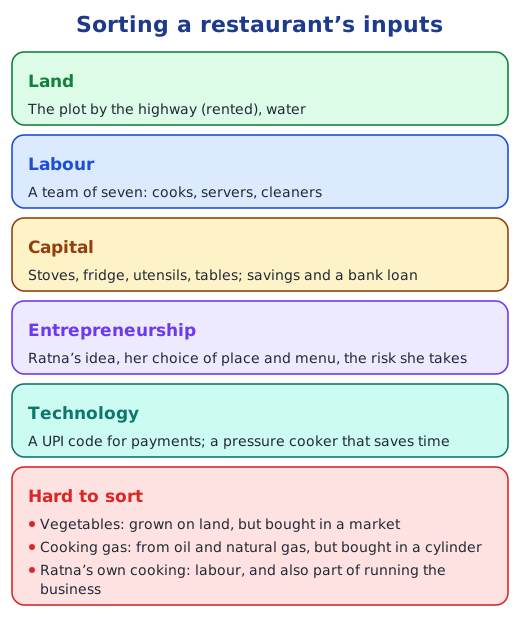
Which items are ‘land’? (page 166). Items that come straight from nature: water (for the salon or the tea stall), the space or plot where a shop or stall stands, and, with a little thought, fresh vegetables and fruit (grown on soil) and cooking gas (from oil and natural gas). These last two are tricky, because they reach the shop only after someone has grown, extracted or processed them. Tools, carts, ovens and scales are capital, not land.
How do infrastructure and healthcare build human capital? (page 168). Hospitals, primary health centres, doctors, pharmacies and diagnostic labs catch and treat illness early, so children do not miss school and adults do not miss work. Vaccines and check-ups keep children healthy, so their minds develop well and they learn better. Healthy workers are stronger, more alert and more creative, and they produce more in the same time. Roads and transport also help, by bringing people to schools, clinics and jobs.
The culture at people’s workplaces (page 169). Ask ten working adults the same few questions: What do people at your workplace value most? How do they treat mistakes? Do they help each other? Are they on time? Note the words they use. A sample result: ‘hardworking’, ‘punctual’, ‘friendly’ and ‘busy’ came up most often, with ‘team spirit’ and ‘strict’ a few times. Share and compare: workplaces where people keep learning and help each other often seem to get more done.
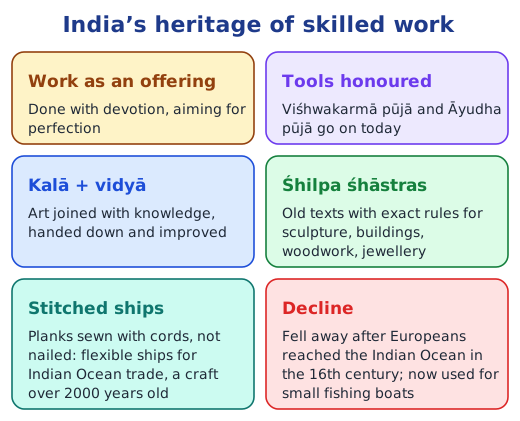
What helped the creators of India’s art and architecture excel? (page 169). (1) Skill learned over many years from masters, often within families of craftspeople. (2) Written knowledge, such as the śhilpa śhāstras, with exact rules for proportions and design. (3) Support from rulers, temples and merchants, who paid for the work (capital). (4) Good local stone, wood and metals (land). (5) Devotion: work was seen as worship, so they aimed for perfection. (6) Time and patience, sometimes across generations. You can see examples in Part 2 Chapter 3, A Journey Through Indian Architecture.
Harsh, who had to leave school (page 170). The box names the student Harsh and then Shivay; it is the same boy. Effects: without two years of schooling he may struggle to read, write and calculate well, find it harder to get further training, and end up in low-paid work with few chances to move up. His confidence may suffer too. He can still return to studies later, and it is worth helping him do so. Problems for businesses that cannot find skilled workers: work is slower and has more mistakes, quality and orders suffer, new machines cannot be used well, and the business has to spend on training, pay more to hire skilled people from elsewhere, or turn down work.
Are some jobs more important than others? (page 170). Every job matters, because society needs all of them together. If nobody cleaned the streets or collected the trash, garbage would pile up and disease would spread. If farmers stopped growing crops, there would be no food, and without doctors, sick people would go untreated. Some jobs need longer training, but all honest work deserves respect, much as India’s old tradition treated work as worship.
Why have indigenous techniques declined? (page 172). Possible reasons: cheaper factory-made goods and, for ships, faster European ships with nails and later steel; under colonial rule, as Chapter 4 showed, British goods were favoured over Indian ones; fewer young people learn the old crafts, because the pay is low; much of the knowledge was passed on by word of mouth and not written down; and raw materials became harder to get. Techniques from your region (Extra, as examples): Channapatna wooden toys from Karnataka, Pochampally ikat weaving from Telangana, bamboo and cane products from the northeast, or the blue pottery of Jaipur. Draw the product and write how it is made.
Capital in a factory near you (page 173). Pick a factory, such as a rice mill, a brick kiln or a garment unit, and list what money was spent on: the land, the building, the machines, vehicles, and the money kept aside to buy materials and pay wages. Ask the owner or manager for rough costs, or make your own estimate, and add them up. Equipment, for a rice mill: machines to clean, husk, polish and sort rice, weighing scales, bag-sealing machines and trucks.
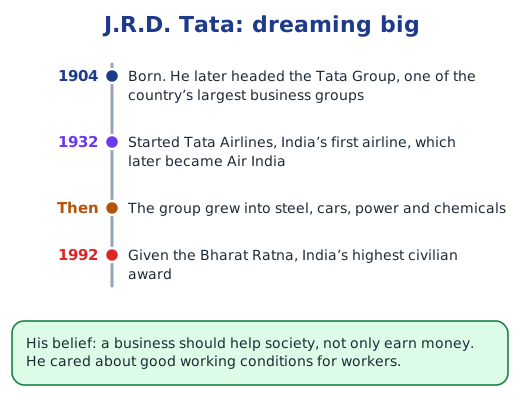
J.R.D. Tata (page 175). Lessons for young entrepreneurs: dream big and try what nobody has done before, as with India’s first airline; work hard and stay honest; care for your workers; and see business as a way to serve society, not only to earn. Existing knowledge or other sources? What the entrepreneur already knows is a start, but most new problems need more: experts, research, training, other people’s experience and the team’s ideas. Is profit the only motivation? No. Profit keeps a business running, but entrepreneurs also want to solve a problem, serve people, create jobs, prove themselves and see a dream come true, as the chapter says. Other traits: courage to take risks, patience, creativity, honesty, leadership, the ability to learn from failure, and good communication.
Technology around you, and your own invention (page 178). Changes elders may mention: mobile phones and video calls, paying shops through UPI, tractors and now drones on farms, gas stoves in place of wood fires, online classes and forms, and solar panels on roofs. A sample invention: name, ‘Rain Alert’; what it does, warns you when it starts raining so clothes drying outside can be brought in; how it works, a small sensor outside senses water and sounds a buzzer indoors; then a sketch of the sensor, the wire and the buzzer.
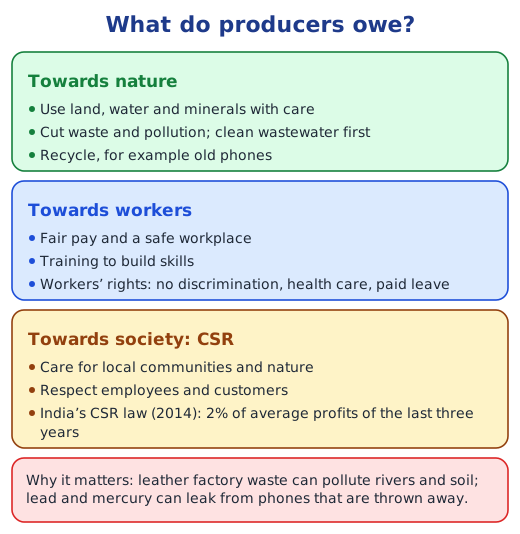
How are communities and nature affected? (page 180). When factory waste reaches rivers and soil, fish die, crops suffer and people who drink or bathe in the water fall ill. Fishers and farmers lose their livelihoods. Plants and animals lose their homes, and some may disappear from the area. Places near you: look for a lake that has shrunk or turned dirty, a stretch of river below a factory or drain, or land where the soil has worn away; ask elders how it looked earlier, and discuss what could help, such as treating waste before release.
Questions and activities (pages 182–183)
Q1. “How are the factors of production different from each other? What are the difficulties you faced in classifying the factors of production in the exercise given in-text?” Differences: land is what nature gives and nobody makes it; labour is human effort; capital is made by people (machines, tools, buildings) or is money used to buy them; entrepreneurship is the person who has the idea, takes the risk and puts the others together. Difficulties: some inputs fit two boxes. Vegetables come from the land but are bought in a market; cooking gas comes from nature but is processed and bottled; electricity may come from water or sunlight but needs power plants. A shop owner who also works at the counter gives both labour and entrepreneurship, and a mobile repairer’s ‘knowledge and skills’ are human capital rather than a thing.
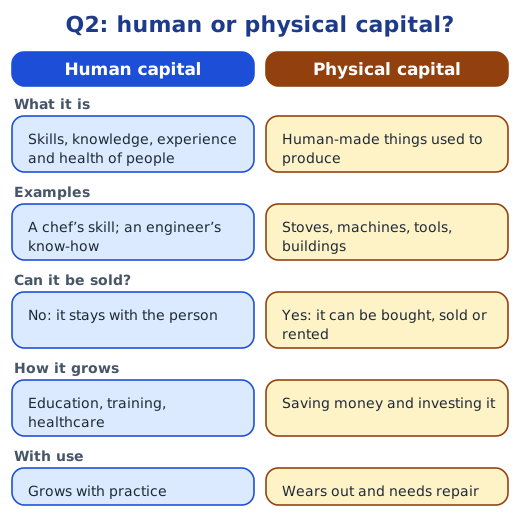
Q2. “How does human capital differ from physical capital?” Human capital is the skill, knowledge, experience and health of people; physical capital is the human-made things used to produce, such as machines, tools and buildings. Human capital stays with the person and cannot be sold separately, while physical capital can be bought, sold or rented. Human capital grows through education, training and healthcare, and gets better with practice; physical capital grows when money is saved and invested, and it wears out with use.
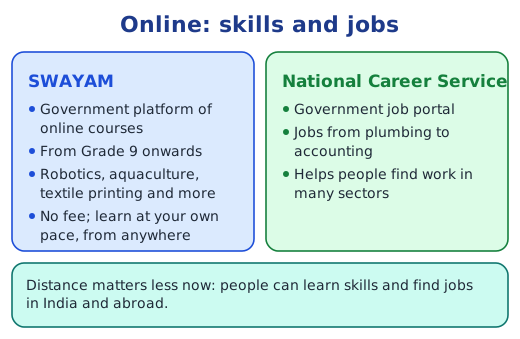
Q3. “How do you think technology is changing the way people develop their skills and knowledge?” (1) Online courses, such as those on SWAYAM, let students from Grade 9 onwards learn subjects like robotics or aquaculture at no fee, at their own pace and from anywhere. (2) Videos and apps let people learn a craft or a language by watching and practising. (3) Job portals such as the National Career Service show which skills employers want. (4) Distance matters less, so a learner in a village can reach the same course as one in a city. People still need guidance, practice and a good internet connection, and must check that what they read online is reliable.
Q4. “A skill is something you learn and practice to get better. It helps you do things well, like playing a sport, creative writing, solving math problems, cooking, or even communicating well with people. If you could learn one skill today, what would it be and why?” Your own answer. A sample: I would learn to code, because it would let me build small apps and games, solve problems step by step, and use it later in almost any job. I would start with an online course and practise a little every day.
Q5. “Do you think entrepreneurship is the ‘driving force’ of production? Why or why not?” Yes, in many ways: without the entrepreneur, land, labour and capital would not come together. The entrepreneur sees a need, takes the risk, decides what to make and how, and keeps improving it. New businesses create jobs and new products. But not alone: an entrepreneur cannot produce anything without land, workers, capital and technology, and the chapter says the factors complement each other. So entrepreneurship is the factor that starts and steers production, while all the factors together keep it going.
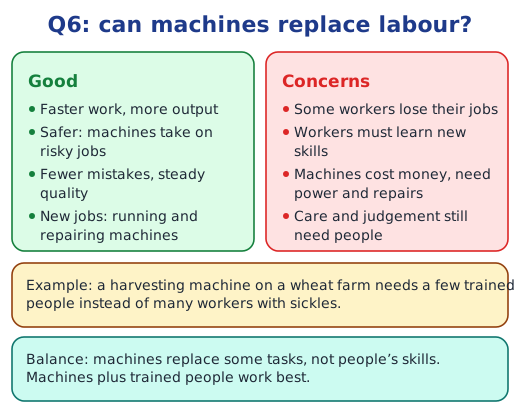
Q6. “Can technology replace other factors like labour? Is this good or bad? Support your answer with the help of an example.” Technology can replace some labour, but not all. Example: on a wheat farm, a harvesting machine run by a few trained people can do the work that once needed many workers with sickles. Good: work is faster and cheaper per unit, risky jobs become safer, and quality is steadier. Bad: some workers lose their jobs, those who stay need new skills, and machines cost money and need power and repairs. It is good when people are trained for the new jobs that technology creates, such as running and repairing machines, and when care, judgement and creativity, which machines cannot replace, are valued.
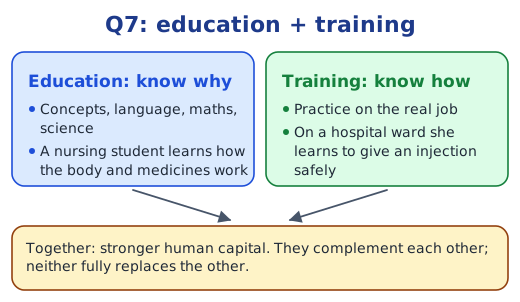
Q7. “How do education and skill training affect human capital? Can they be substitute for each other, or do they complement each other?” Education builds knowledge and understanding, such as reading, maths, science and the reasons behind things. Skill training builds the ability to do a particular job well through practice. Both raise human capital and productivity. They complement each other: a nursing student learns how the body and medicines work in class, then learns on a hospital ward to give an injection safely. Without education, training stays narrow and hard to adapt; without training, education stays on paper.
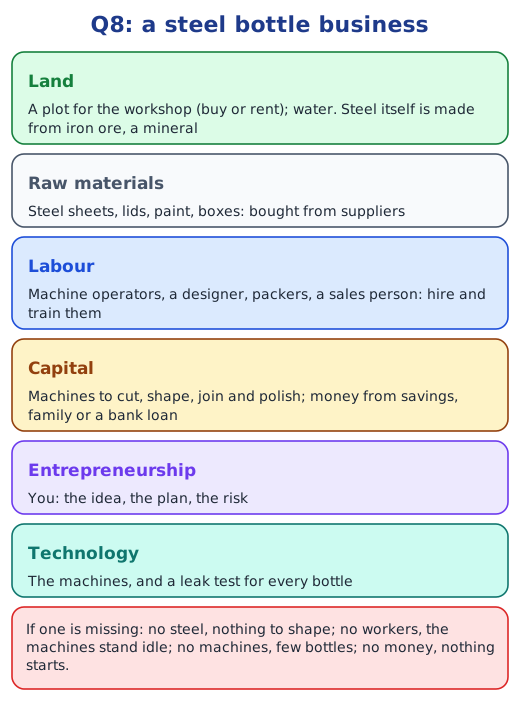
Q8. “Imagine you want to start a business that produces steel water bottles. What kind of inputs are needed? How would you obtain them? Suppose one of the factors is missing; what happens to your business operations?” Inputs and how to get them: land, a plot or shed for the workshop (buy or rent it) and water; raw materials, steel sheets, lids, paint and boxes from suppliers; labour, machine operators, a designer, packers and someone to sell (hire them and train them); capital, machines to cut, shape, join and polish the steel, and money from savings, family or a bank loan; entrepreneurship, your own idea, plan and risk; technology, the machines and a leak test for every bottle. If one is missing: without steel there is nothing to shape; without workers the machines stand idle; without machines very few bottles can be made; without money nothing can start. Production slows down or stops.
Q9. “Interview an entrepreneur or founder of business to understand their motivation to start a business and the opportunities and challenges they saw. You can work in pairs to create a questionnaire to collect the information and share what you have learned in a report.” A sample questionnaire: (1) What does your business make or sell? (2) Why did you start it? (3) Where did the first money come from? (4) Which skills did you need, and how did you learn them? (5) What opportunity did you see? (6) What was the hardest problem in the first year, and how did you solve it? (7) How many people work with you? (8) What advice would you give a student? Ask for an appointment first, go with an adult, note the answers, and write a one-page report with headings: motivation, opportunities, challenges, and what we learned.
Q10. “Think like an economist. Let’s explore what happens when things change. If you were Ratna, what would you do in the following situations? Discuss with your classmates.”
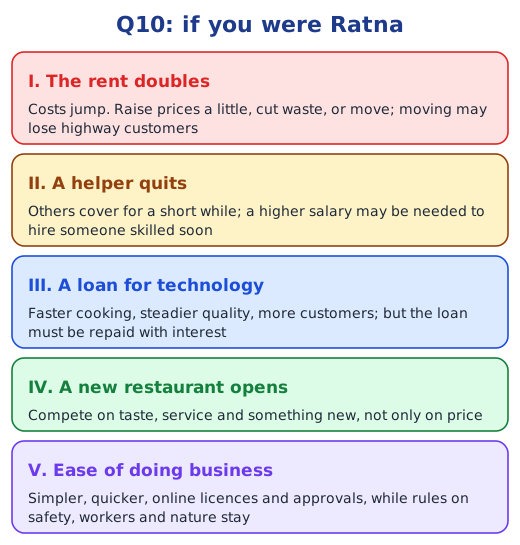
I. “Suppose the rent for your space suddenly doubles. Will you raise the price of the food served to cover the costs? Will you look for a cheaper location? How does this affect your business?” Costs go up at once. I might raise prices a little and cut waste, but a big rise could drive customers away. A cheaper place is possible, but I could lose the highway travellers who stop here. My profit falls for a while either way.
II. “Imagine one of your helpers quits suddenly. Can the remaining workers manage the same amount of work? Will you need to offer a higher salary to attract a new worker?” For a few days the others can cover, but they will be tired and service may slow. To find a skilled cook or server quickly, I may have to offer a better salary.
III. “You receive a small loan to invest in better technology for your restaurant. Will this increase the production or improve quality? Will it help you reach more customers?” Better equipment can cook faster and keep quality steady, and online ordering or digital payments can bring in more customers. I must plan to repay the loan with interest from the extra earnings.
IV. “Suppose another restaurant opens in the neighbourhood. How will you attract and keep your customers? Will you improve your service, reduce prices, or offer something new?” I would compete on taste, cleanliness, quick and friendly service and a new dish or two. Cutting prices a lot could hurt my profit, so I would keep that for small offers.
V. “What government laws or rules should be amended to improve the ease of doing business?” Ideas often discussed include fewer forms, one office or website for all licences, clear time limits for approvals, and online renewals. Rules that protect people, such as food safety, fire safety, fair wages and pollution control, should stay; the aim is to make them simpler and quicker to follow, not to remove them.
Practice
-
Which of these is NOT a factor of production in the chapter’s list of four?
Show answer
Answer: (c) Profit
-
What do shareholders of a company receive out of its profits?
Show answer
Answer: (c) A dividend
-
Which ancient texts gave detailed design rules for sculpture and buildings?
Show answer
Answer: (a) The śhilpa śhāstras
-
Why did many factories stop during the COVID-19 pandemic, according to the chapter?
Show answer
Answer: Their supply chains broke. They depended on inputs from faraway places instead of local ones, so when those inputs could not arrive, production had to halt.
-
Give one example each of a labour-intensive and a capital-intensive product.
Show answer
Answer: Labour-intensive: handicrafts (or farming, or construction). Capital-intensive: semiconductor chips (or satellites).
Stuck on a question?
Take a photo and Lagnever AI explains it step by step. Try it for 7 days for ₹2.
Get it on Google Play Open in browser
For parents: after the trial, the plan renews monthly by UPI or card autopay. You can cancel anytime in the app.