
Class 8 Social Science Chapter 7: Factors of Production Notes
This chapter in five lines
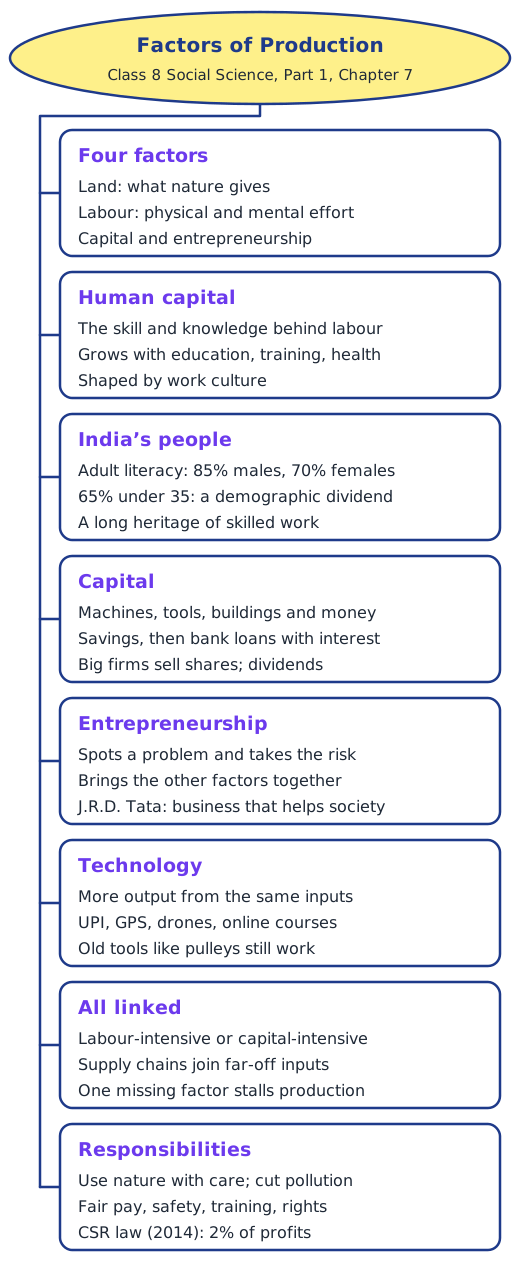
Factors of Production explains the four inputs every business combines to make goods and services: land, labour, capital and entrepreneurship, with technology as the enabler. It shows how skills, health and work culture make labour more productive, where capital comes from, what entrepreneurs do, how the factors depend on each other, and what producers owe to nature and workers.
What is this chapter about?
This chapter belongs to the theme Economic Life Around Us. It opens with a thought from the economist Bibek Debroy, who chaired the Economic Advisory Council to the Prime Minister from 2017 to 2024: India’s biggest gains in growth will probably come from using land, labour and capital more efficiently. Then we meet Ratna, who opened a small restaurant called Pause Point on the edge of a city five years ago. Travellers on the highway like its food, and she now runs it with a team of seven. To begin, she had to pick a place, arrange money for rent and equipment, hire people and buy ingredients. Three Big Questions follow: what the factors of production are, how they are linked, and what human capital does and what helps it grow.
What are the four factors of production?
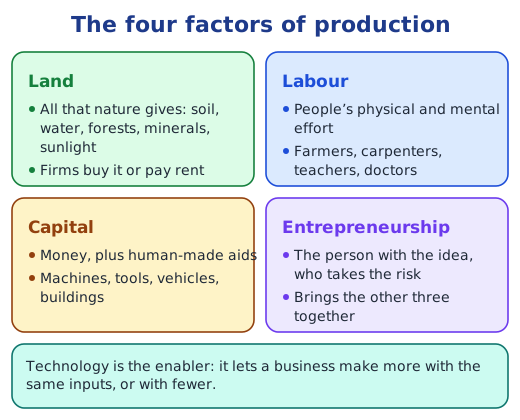
Everything you use, from shoes to a phone, goes through a production process that uses resources, or inputs. These are the factors of production. Land means all that nature provides: soil, water, forests, air, sunlight, minerals, oil and natural gas, as you saw in Chapter 1, Natural Resources and Their Use. Labour is people’s physical and mental effort. Capital is money plus human-made aids such as machines and buildings. Entrepreneurship is the drive to start something new and bring the rest together. Technology is the enabler. Read What are land, labour, capital and entrepreneurship?
What is human capital?
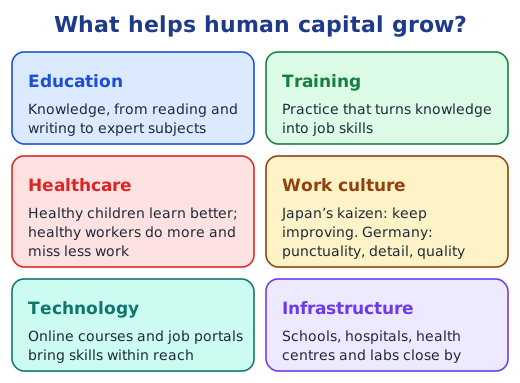
Labour tells us how much effort goes into work. Human capital is the skill, knowledge and expertise behind that effort, so it tells us how well the work is done. A police officer, a scientist and a chef each need their own kind of knowledge and skill. Education and training, good health, and a culture of steady improvement all make human capital stronger. Read What is human capital?
How is India doing on human capital?
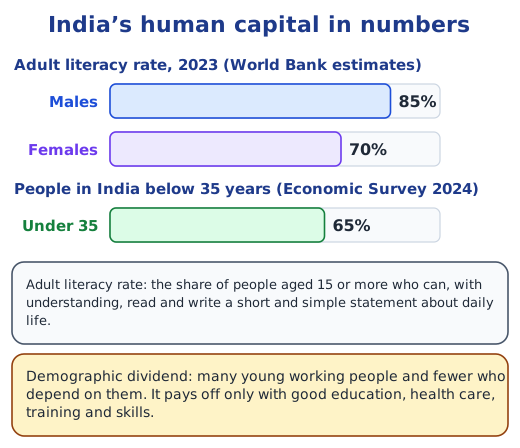
India has made much progress since independence, but challenges remain. World Bank estimates for 2023 put adult literacy at 85 per cent among males and 70 per cent among females. The Economic Survey 2024 says 65 per cent of Indians are below 35, so the country could gain a demographic dividend, but only if young people get good education, health care and skills. India also has a long heritage of skilled work, from temple sculptors to the stitched ships of the Indian Ocean.
Where does capital come from?
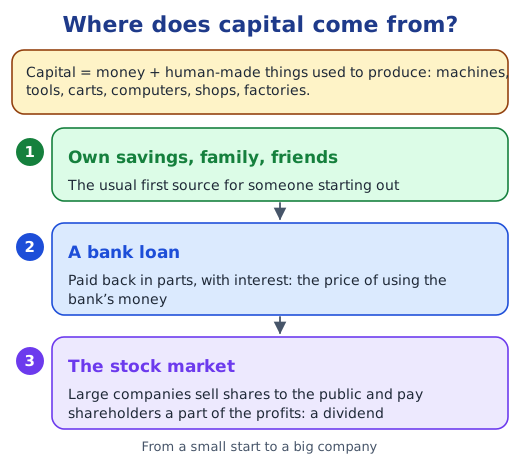
Every enterprise needs capital: money, and durable things such as machines, tools, vehicles, vending carts, computers, shops and factories. People starting out usually rely first on their own savings, family and friends. Ratna’s savings were not enough, so she borrowed from a bank and has been repaying the loan in parts, with interest. Large companies raise money from the public on the stock market by selling shares, and pay shareholders a part of the profits as a dividend.
What does an entrepreneur do?
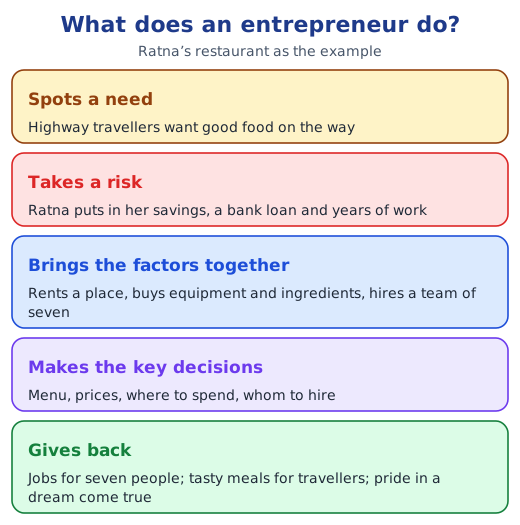
An entrepreneur has an idea to solve a problem, takes the risk of putting in money and time, brings the other factors together and makes the key decisions. New products and services help society, and new businesses create jobs. The chapter’s example is J.R.D. Tata, who started India’s first airline in 1932 and received the Bharat Ratna in 1992. Read What do entrepreneurs and technology do in production?
How does technology help?
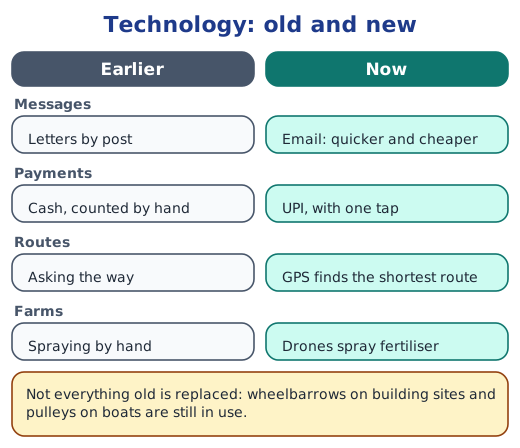
Technology means using scientific knowledge in practice, and every kind of production uses some. Today we pay through UPI, farmers get weather updates in advance, and GPS finds the shortest route for a truck. Email has largely taken the place of posted letters, yet simple tools such as pulleys and wheelbarrows are still useful. Online platforms such as SWAYAM and the National Career Service help people learn skills and find work.
How are the factors connected?
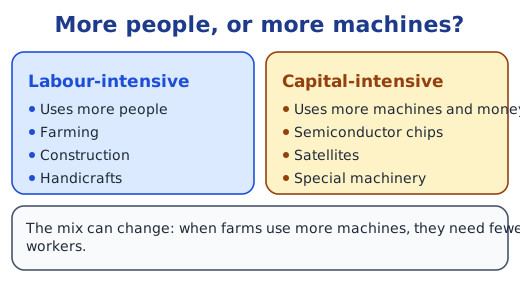
All the factors work together, but the mix depends on the product. Farming, construction and handicrafts depend more on labour (labour-intensive), while semiconductor chips and satellites need more machines and money (capital-intensive). The mix can shift: more machines on farms means fewer workers are needed. Inputs often come from far away through a supply chain, and if it breaks, as during the COVID-19 pandemic, production can stop.
What do producers owe to nature and to workers?
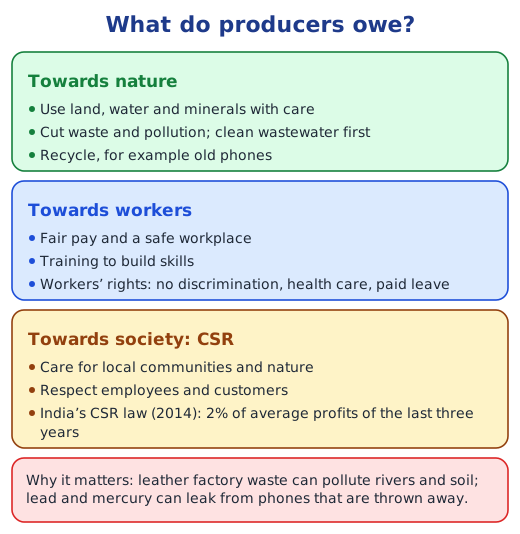
Natural resources are limited and can be damaged. Waste from leather factories in Tamil Nadu can pollute rivers and soil, and old phones that are not recycled can leak lead and mercury. So producers should cut waste and pollution and use resources in a way that leaves enough for future generations. They also owe workers fair pay, safe workplaces, training and their rights. Through Corporate Social Responsibility, businesses look after communities and the environment too. Answers to every question are in the NCERT solutions for Chapter 7.
Key terms
| Term | Meaning |
|---|---|
| Factors of production | The inputs, or resources, used to make goods and services: land, labour, capital and entrepreneurship. |
| Enterprise | A business, such as a firm, a shop or a factory, that makes or sells goods or provides a service. |
| Land | In economics, everything nature provides: the ground itself, soil, water, air, forests, sunlight, minerals, oil and natural gas. |
| Labour | The physical and mental effort people put into producing goods and services. |
| Human capital | The skills, knowledge, abilities and expertise that decide how well and how efficiently people work. |
| Productivity | How much a person or a business can produce in a given time. |
| Demographic dividend | The gain a country can make when many of its people are young and working, and fewer people depend on them. |
| Capital | Any asset, physical or financial, used in production: money, and human-made things such as machines, tools and buildings. |
| Interest | The money a borrower pays the lender for the use of a loan over a period of time. |
| Dividend | The part of a company’s profits that it pays its shareholders, usually at regular intervals. |
| Entrepreneur | A person who has an idea, takes the risk, brings the other factors together and works to make the business succeed. |
| Startup | A new business with limited resources that uses technology and aims to grow fast. |
| Technology | Putting scientific knowledge to practical use. It lets businesses produce more with the same or fewer inputs. |
| Supply chain | The whole network of people, firms, resources, activities and technology involved in making goods and selling them. |
| Corporate Social Responsibility (CSR) | A business’s duty to look after society and the environment, not only to earn profits. |
Topics in this chapter
Practice
-
Which of these counts as ‘land’ in economics?
Show answer
Answer: (c) Groundwater
-
What is the money a borrower pays a lender for using a loan called?
Show answer
Answer: (b) Interest
-
Which of these is capital-intensive, according to the chapter?
Show answer
Answer: (b) Satellites
-
What does the Japanese word kaizen mean?
Show answer
Answer: (b) Continuous improvement
-
Which of these helps human capital grow?
Show answer
Answer: (a) Healthcare
-
In which year did J.R.D. Tata start Tata Airlines?
Show answer
Answer: (b) 1932
Questions students ask
What are the main topics of Class 8 Social Science Chapter 7?
The four factors of production (land, labour, capital and entrepreneurship); human capital and what helps it grow; India’s literacy figures, young population and heritage of skilled work; where capital comes from; what entrepreneurs do, with J.R.D. Tata as the example; technology as the enabler; how the factors are linked; and producers’ responsibilities, including CSR.
Is Factors of Production in the new NCERT Class 8 book?
Yes. It is Chapter 7, the last chapter of Exploring Society: India and Beyond, Grade 8 Part 1 (Reprint 2026-27), on pages 163 to 183, in the theme Economic Life Around Us. It comes after Chapter 6, The Parliamentary System: Legislature and Executive.
What are the four factors of production?
Land (all natural resources), labour (people’s physical and mental effort), capital (money plus human-made things such as machines and buildings) and entrepreneurship (the person who has the idea, takes the risk and brings the other three together).
Is technology a factor of production?
The chapter names four factors and calls technology an enabler: it lets a business produce more with the same or fewer inputs. When it explains how goods are made, it lists technology alongside the four, because almost every kind of production uses some technology.
Stuck on a question?
Take a photo and Lagnever AI explains it step by step. Try it for 7 days for ₹2.
Get it on Google Play Open in browser
For parents: after the trial, the plan renews monthly by UPI or card autopay. You can cancel anytime in the app.