
What do entrepreneurs and technology do in production?
Answer in short
An entrepreneur spots a problem, takes the risk of investing money and time, brings land, labour and capital together and makes the key decisions, creating useful products and jobs. Technology, the practical use of scientific knowledge, is the enabler: it helps businesses produce more with the same or fewer inputs, and helps people learn skills and find work.
Stuck on a question? Take a photo and Lagnever AI explains it step by step. Try it for 7 days for ₹2. Get it on Google Play
Who is an entrepreneur?
Entrepreneurship is setting up an enterprise of your own, or making something new that solves a problem. An entrepreneur is the person who has the idea, takes the risk, brings together the other factors and puts in the hard work that makes the venture a success. A new, small business that uses technology and aims to grow fast is called a startup.
What does an entrepreneur do?
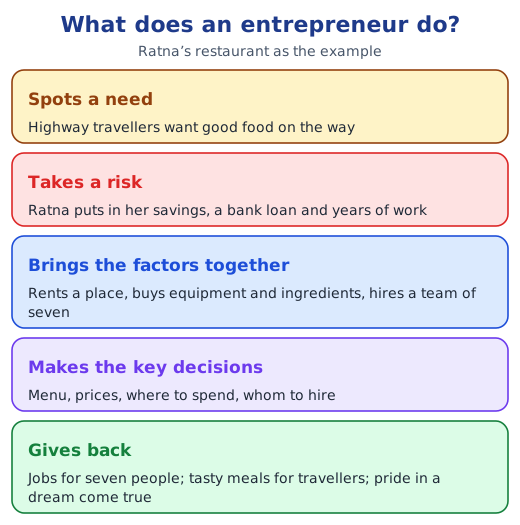
The chapter lists five things an entrepreneur does. Ratna’s restaurant shows each of them.
- Spots a problem and sticks to solving it with a new idea. Travellers on the highway wanted good food on the way.
- Takes risks by putting in money and time. Ratna used her savings and a bank loan, and gave years of hard work.
- Combines the factors of production. She rents a place, buys stoves and ingredients, and hires a team of seven.
- Makes the key decisions about how the business runs: the menu, the prices, what to spend on.
- Serves society through the business: travellers get tasty meals, and seven people have jobs.
An entrepreneur’s vision brings new products and services to the market that help society and the nation, and creates work for others. In return, entrepreneurs feel deep satisfaction when their dream becomes real and they serve people well.
Who was J.R.D. Tata?
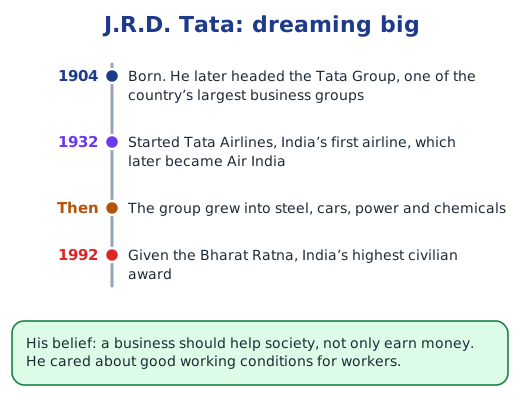
Jehangir Ratanji Dadabhoy (J.R.D.) Tata, born in 1904, was an entrepreneur, an industrialist and a philanthropist. He headed the Tata Group, one of the country’s largest business groups, and helped build modern India. In 1932 he started Tata Airlines, India’s first airline, which later became Air India. Under him the group grew into steel, cars, power and chemicals. He believed a business should help society as well as make money, and he cared about good working conditions. He was awarded the Bharat Ratna, India’s highest civilian award, in 1992.
What is technology, and how does it help production?
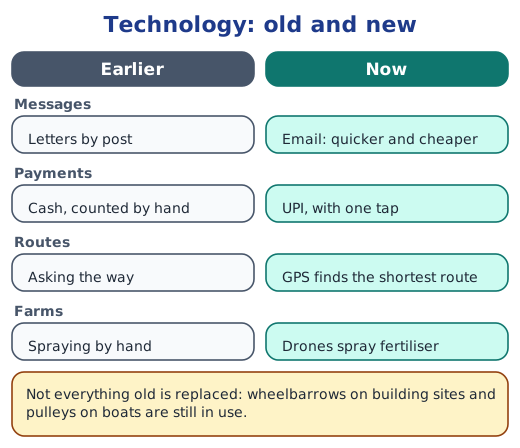
Technology means putting scientific knowledge to use. A digital camera, for example, changes light into electrical signals and builds a picture from them. Every kind of production uses some technology, and some forms, from ancient times, are still in use. Technology is the enabler of production: it lets enterprises make more goods with the same inputs, or with fewer.
Newer technology makes life easier. We can pay with one click through UPI (Unified Payments Interface), farmers get weather updates in advance, and GPS (Global Positioning System) finds the shortest route for moving goods. Drones spray fertiliser over crops, and robots assist doctors in surgery. Often a new tool replaces an old one: email is quicker and cheaper than a letter by post. But not always: pulleys and wheelbarrows are still everywhere.
How does technology help people learn and find work?
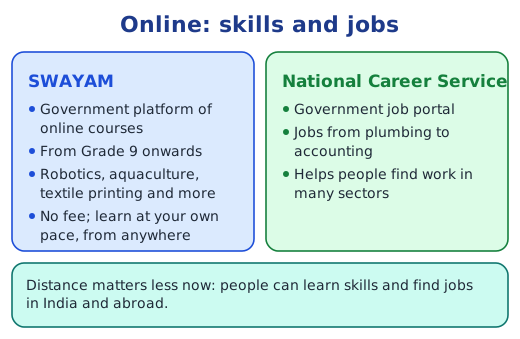
The government’s SWAYAM platform (Study Webs of Active Learning for Young Aspiring Minds) offers online courses for learners from Grade 9 onwards, in the form of Massive Open Online Courses (MOOCs). Subjects range from robotics and aquaculture to textile printing, and the courses charge no fee. Learners study at their own pace, from anywhere, even while working or doing other courses. The government’s National Career Service portal helps people find jobs in many fields, from plumbing to accounting. In this way technology has removed many barriers of distance.
What responsibilities come with producing goods?
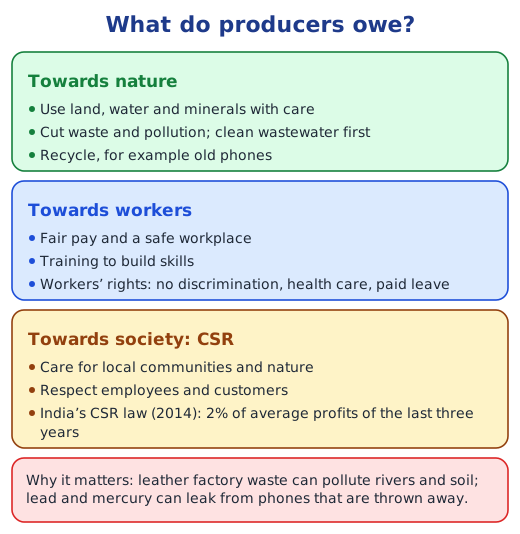
Production uses land, water and minerals, which are limited and can be damaged. Leather factories in Tamil Nadu give many people work, but their waste can pollute rivers and soil. Old smartphones that are not recycled properly can leak lead and mercury into soil and water. So producers should cut waste, avoid pollution, treat wastewater and use recycled inputs, meeting today’s needs while leaving future generations able to meet their own. Businesses also owe their workers fair pay, a safe workplace, training, and the rights that the law gives them.
Through Corporate Social Responsibility (CSR), businesses try to reduce pollution, look after local communities and treat employees and customers with respect. The chapter notes that India was the first country to bring in a CSR law, in 2014: it requires companies to put 2 per cent of their average profit over the previous three years into CSR work.
Read on: What are land, labour, capital and entrepreneurship?, What is human capital?, the chapter notes and the NCERT solutions.
Practice
-
Which of these is a task of an entrepreneur?
Show answer
Answer: (b) Combining the factors of production
-
Which airline did J.R.D. Tata start in 1932?
Show answer
Answer: (b) Tata Airlines
-
What is SWAYAM?
Show answer
Answer: (b) A government platform of online courses
-
Give two examples from the chapter of technology making work easier today.
Show answer
Answer: Any two of these: payments with one click through UPI, weather updates for farmers in advance, GPS finding the shortest route for goods, drones spraying fertiliser, robots assisting in surgery.
-
Name two responsibilities a business has towards its workers.
Show answer
Answer: Any two of these: fair pay and a safe workplace; training so workers keep their skills up to date; following the laws on workers’ rights, such as fair treatment, no discrimination, health care and paid leave.
Questions students ask
What is the role of an entrepreneur in production?
The entrepreneur has the idea, takes the risk of investing money and time, gathers land, labour and capital, and makes the key decisions about running the business. New products and services help society, and the business creates jobs.
What is a startup?
A startup is a new business with limited resources that uses technology and aims to grow and expand fast.
Why is technology called an enabler of production?
Because it does not replace the four factors but helps them work better. With better tools and methods, a business can turn the same inputs, or fewer, into more goods.
What is CSR?
Corporate Social Responsibility: a business’s efforts to care for society and the environment, such as cutting pollution and helping local communities. The chapter says India was the first country to make a CSR law, in 2014. Extra: the rule covers only companies above a certain size, judged by net worth, turnover or profit.
Stuck on a question?
Take a photo and Lagnever AI explains it step by step. Try it for 7 days for ₹2.
Get it on Google Play Open in browser
For parents: after the trial, the plan renews monthly by UPI or card autopay. You can cancel anytime in the app.