
What are land, labour, capital and entrepreneurship?
Answer in short
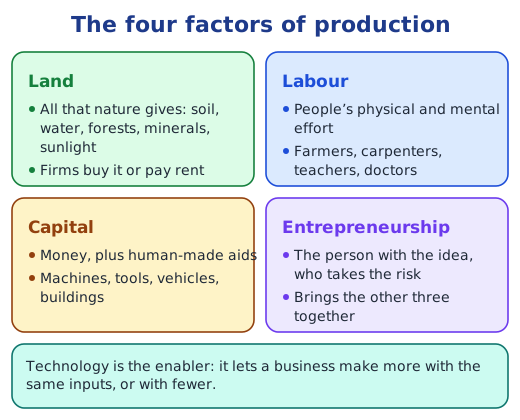
They are the four factors of production, the inputs every business combines to make goods and services. Land is every natural resource, labour is people’s physical and mental effort, capital is money plus human-made aids such as machines, and entrepreneurship is the drive to start a business and bring the rest together. Technology helps all four.
Stuck on a question? Take a photo and Lagnever AI explains it step by step. Try it for 7 days for ₹2. Get it on Google Play
What are factors of production?
Think of your school bag. Someone had to cut the cloth, stitch it, fix the zip and pack it before it reached a shop. Every product you use goes through such a production process, and every process uses resources, or inputs. These inputs are called factors of production. Economists sort them into four kinds: land, labour, capital and entrepreneurship. Technology is not one of the four, but it helps all of them, letting a business make more with the same inputs, or with fewer.
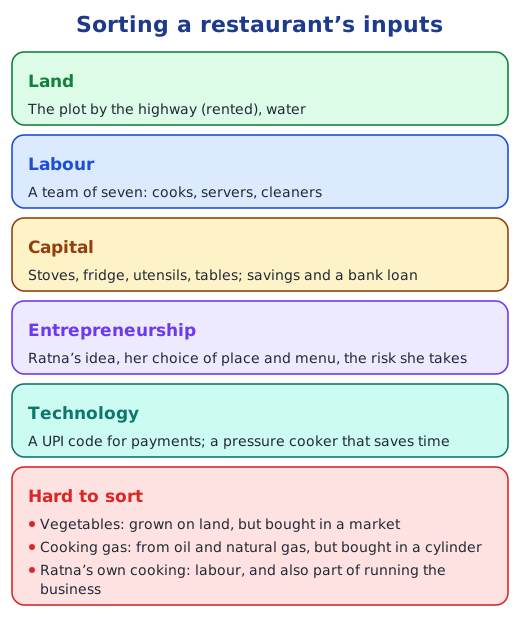
Ratna’s restaurant, Pause Point, shows all four. She rents a place by the highway, hires a team, buys stoves and utensils, and plans the whole business herself. By combining these inputs, enterprises such as hers make goods and services, and they also give people work.
What does ‘land’ mean in economics?
In everyday talk, land is the ground. In economics, land means everything nature gives us: the ground and its soil, water, air, sunlight, forests, minerals, oil and natural gas. A farmer needs fertile soil and rain; a factory needs a plot and water. A business either buys the land it needs or pays rent to use it for some time.
What is labour?
Labour is the physical and mental effort that people put into production. A construction worker lifts and carries; a teacher plans and explains; a doctor examines and decides. Each uses strength, knowledge and skill in a different mix, and each helps meet society’s needs. The skill and knowledge behind the effort is called human capital, which has a page of its own.
What is capital, and where does it come from?
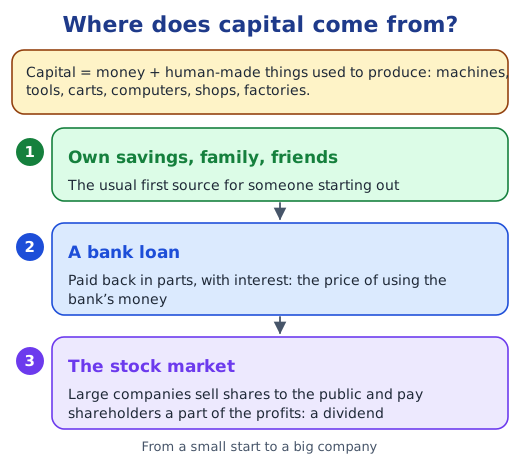
Capital is money, together with the human-made things a business produces with: machines, tools, vehicles, computers, vending carts, equipment, shops, offices and factories. A manufacturer needs it, and so does a service business such as a salon. Ratna needed money to lease the land and to buy furniture and kitchen equipment.
Where does the money come from? Most people starting a business first use their own savings or help from family and friends. Ratna’s savings fell short, so she took a bank loan. She repays a part of the loan over time, together with interest, the price a borrower pays for using someone else’s money. Large companies need far more, so they raise it from the public through the stock market, where shares are bought and sold. People who buy shares get a part of the company’s profits, called a dividend. You met loans and interest in Grade 7, in Banks and the Magic of Finance.
What is entrepreneurship?
Entrepreneurship is setting up an enterprise of your own, or making something new that solves a problem. The entrepreneur is the person who comes up with the idea, takes the risk, gathers the other factors and works hard to make it succeed. Without this person, land, labour and capital would not come together. There is more in What do entrepreneurs and technology do in production?
How do the factors work together?
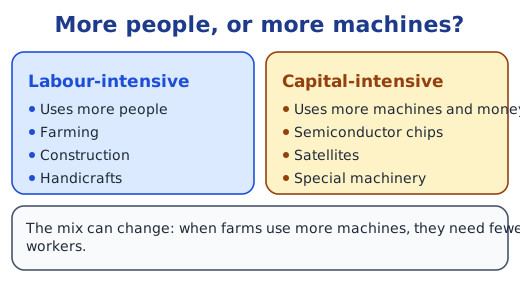
Every product uses all the factors, but in different amounts. Farming, construction and handicrafts depend more on people, so they are labour-intensive. Semiconductor chips and satellites need special machines and huge sums of money, so they are capital-intensive. New methods can change the mix: when farms use more machines, they need fewer workers, and the chapter suggests that 3-D printing could help fading textile crafts make handloom-style goods in large numbers.
Inputs are found in different places, so firms bring them together from far and wide. The supply chain is the whole network of people, firms, resources, activities and technology that takes part in making and selling goods. Relying on faraway sources has a risk: during the COVID-19 pandemic, supply chains broke and many factories had to stop.
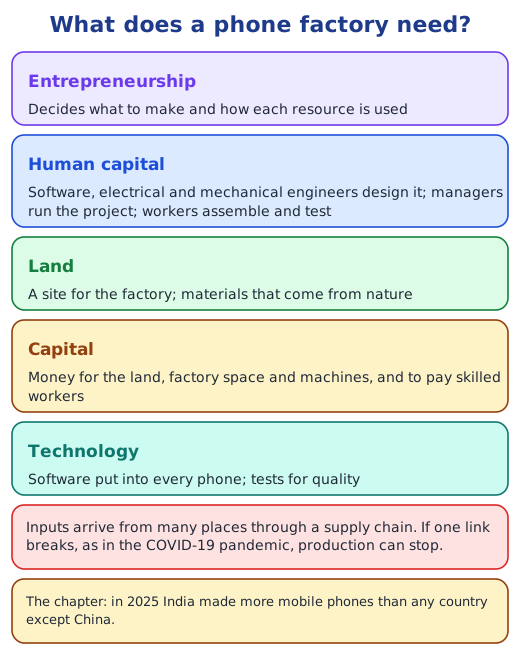
A mobile phone shows the factors working like pieces of a puzzle. The chapter notes that in 2025 India was the world’s second-largest maker of mobile phones, after China. Engineers and managers design the phone, the entrepreneur decides how resources are used, capital pays for land, factory space, machines and skilled workers, and technology goes into every unit. If one piece is missing or misused, production becomes wasteful or stops.
Read on: What is human capital?, What do entrepreneurs and technology do in production?, the chapter notes and the NCERT solutions.
Practice
-
Which of these is an example of capital in a bakery?
Show answer
Answer: (b) An oven
-
Where do people starting a small business usually get money first?
Show answer
Answer: (c) Their own savings, family and friends
-
Which product does the chapter call capital-intensive?
Show answer
Answer: (c) Semiconductor chips
-
What is a supply chain?
Show answer
Answer: The whole network of people, firms, resources, activities and technology that takes part in making goods and selling them.
-
How do large companies raise money from the public?
Show answer
Answer: They sell shares on the stock market, and in return pay shareholders a part of the profits, called a dividend.
Questions students ask
What are the 4 factors of production in Class 8?
Land, labour, capital and entrepreneurship. Land covers all natural resources, labour is people’s effort, capital is money plus human-made aids, and entrepreneurship is the person who has the idea and combines the others. Technology is treated as the enabler.
Is money land or capital?
Money is capital. So are durable things made by people and used in production, such as machines, vending carts, computers and factory buildings. Land is only what nature provides.
What happens if one factor of production is missing?
Production slows down or stops, because the factors complement each other. Without workers, machines stand idle; without capital, nothing can be bought; without materials from a supply chain, a factory cannot make anything.
What is the difference between labour-intensive and capital-intensive?
Labour-intensive production uses more people, as in farming, construction and handicrafts. Capital-intensive production uses more machines and money, as in making semiconductor chips or satellites.
Stuck on a question?
Take a photo and Lagnever AI explains it step by step. Try it for 7 days for ₹2.
Get it on Google Play Open in browser
For parents: after the trial, the plan renews monthly by UPI or card autopay. You can cancel anytime in the app.