
What is human capital?
Answer in short
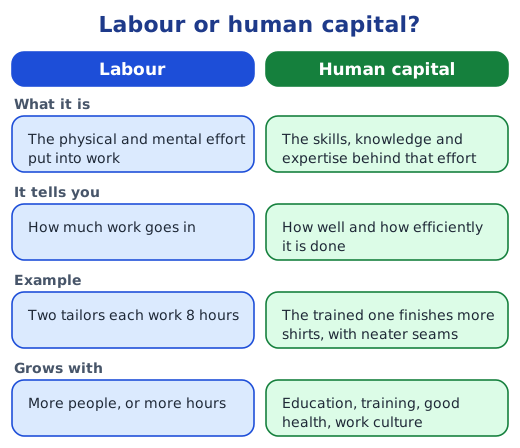
Human capital is the skill, knowledge, ability and expertise that people bring to their work. Labour is the effort itself; human capital decides how well and how efficiently that effort is used. It grows through education, training and good health, and a work culture of steady improvement adds to it.
Stuck on a question? Take a photo and Lagnever AI explains it step by step. Try it for 7 days for ₹2. Get it on Google Play
Why are people a resource?
Machines and money do nothing on their own. People decide what to make, use their knowledge and skills, and turn inputs into goods and services. A police officer keeps the peace, a scientist comes up with new technologies and a chef creates new dishes. Each job needs its own set of knowledge and skills, and each needs dedication too, because good work takes care as well as ability.
How is human capital different from labour?
Labour is the physical and mental effort put into production. Human capital is the specialised skill, knowledge, ability and expertise needed to do that work well. So human capital is about the quality and efficiency of labour, not just the effort. Two tailors may work the same hours, but the trained one finishes more shirts with neater seams. That difference is human capital, and it raises productivity, the amount someone can produce in a given time.
What helps human capital grow?
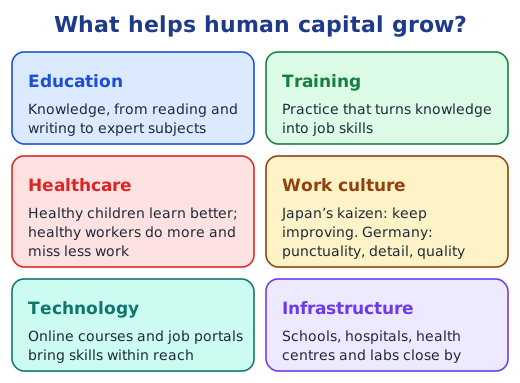
The chapter calls these the facilitators of human capital.
- Education builds knowledge, from basic reading and writing up to expert subjects. What you learn at school helps you solve real problems later.
- Training is learning the skills a particular job needs by doing it. An electrical engineering student learns how circuits work in class, then learns to wire a real building safely under an expert’s eye. With both, people are ready to do well in their careers.
- Healthcare. Good health helps children’s minds develop, so they attend school regularly and learn better. Healthy workers can work at full strength, get more done in less time, think creatively and do not lose days to illness. Hospitals, health centres, pharmacies and labs nearby make this possible.
- Social and cultural influences. When people value hard work and keep trying to do better, the whole nation moves ahead. Japan has applied kaizen, meaning ‘continuous improvement’, since the mid-1940s, and it helped raise living standards there. Germany’s work ethic values punctuality, attention to detail and quality, and helped the country become a world leader in technology and manufacturing.
What challenges does India face?
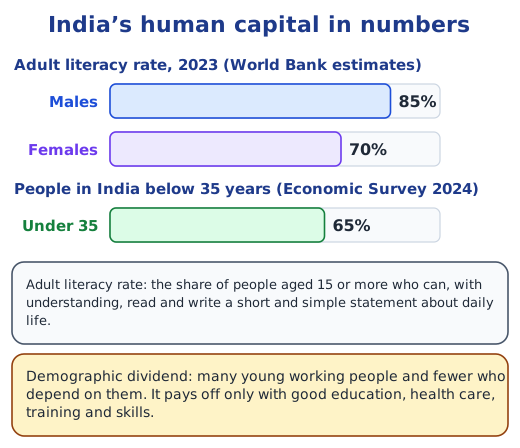
India has come a long way since independence, but building human capital is still a challenge. Literacy helps people gain skills and work more productively. The adult literacy rate is the share of people aged 15 or more who can, with understanding, read and write a short and simple statement about their daily life. World Bank estimates for 2023 put it at 85 per cent among males and 70 per cent among females in India.
When a child leaves school early, for example because a parent has lost a job, the lost years can mean fewer skills and lower earnings later. Businesses that cannot find workers with the right skills may have to slow down, spend on training or look elsewhere.
There is also a big opportunity. The Economic Survey of India 2024 reports that 65 per cent of India’s people are under the age of 35. This young population could bring a demographic dividend: when more people work and earn and fewer depend on them, a country can grow businesses and raise living standards. To use it, young people need good education, health care, training and skills. Part 2 of this book explains it further in India’s demographic dividend.
What was India’s heritage of skilled work?
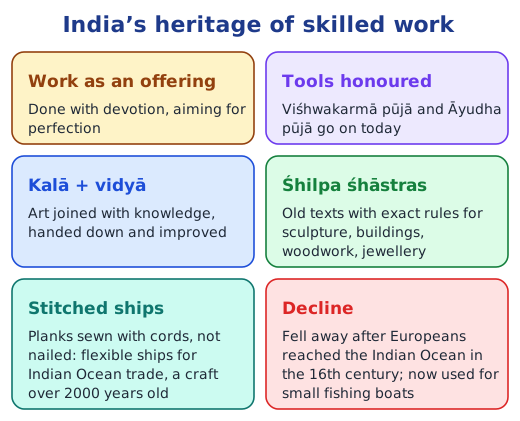
In ancient India, work was a way to express one’s nature and to strive for perfection, offered with devotion to a deity or to the person receiving it. Tools, a form of technology, were worshipped, a custom that lives on in Viśhwakarmā pūjā and Āyudha pūjā. Making things joined kalā (art) with vidyā (knowledge), and that knowledge was handed down and improved. The śhilpa śhāstras laid down detailed design rules for sculpture, painting, buildings, woodwork and jewellery. Families of sculptors built temples over generations, often without living to see them finished.
Indian shipbuilders also stitched wooden planks together with cords instead of nails. These flexible ships carried trade and culture across the Indian Ocean for over 2000 years. The craft declined sharply once Europeans arrived in these waters in the 16th century and is now used mainly for small fishing boats.
Read on: What are land, labour, capital and entrepreneurship?, What do entrepreneurs and technology do in production?, the chapter notes and the NCERT solutions.
Practice
-
Which of these is part of human capital?
Show answer
Answer: (b) A chef’s knowledge of recipes
-
Which country does the chapter link with the idea of kaizen?
Show answer
Answer: (b) Japan
-
According to the Economic Survey 2024, what share of people in India are below 35?
Show answer
Answer: (c) 65 per cent
-
How does good health add to human capital?
Show answer
Answer: Healthy children can attend school regularly and learn better, and healthy workers can do more in less time, think creatively and do not lose days of work to illness.
-
What were the śhilpa śhāstras?
Show answer
Answer: Ancient texts with detailed design rules for sculptures, paintings, buildings, wooden items and jewellery, including exact postures, colours, measurements and proportions for figures.
Questions students ask
What is the difference between labour and human capital?
Labour is the physical and mental effort that goes into production. Human capital is the skill, knowledge and expertise behind it, so it decides the quality and efficiency of that labour, not only its amount.
What are the facilitators of human capital?
The chapter names education and training, healthcare, and social and cultural influences, for example a habit of hard work and steady improvement. Its summary also lists the use of technology.
What is a demographic dividend?
It is the benefit a country can gain when a large share of its people are young and working, and fewer depend on them. India can gain it only if young people get good education, health care, training and skills.
What is stitched shipbuilding?
An old Indian method, over 2000 years old, of joining a ship’s wooden planks with cords instead of nails. The ships were flexible and handled the Indian Ocean well. The craft declined after Europeans arrived in the 16th century and now survives in small fishing boats.
Stuck on a question?
Take a photo and Lagnever AI explains it step by step. Try it for 7 days for ₹2.
Get it on Google Play Open in browser
For parents: after the trial, the plan renews monthly by UPI or card autopay. You can cancel anytime in the app.