
India’s demographic dividend: a limited window
Answer in short
A demographic dividend is the chance of faster economic growth that a country gets when a large share of its people are young and of working age. India, with a median age of 28 and about 65 per cent of its people aged 15–59, has this chance now, but the window narrows after about 2050 as the population ages.
Stuck on a question? Take a photo and Lagnever AI explains it step by step. Try it for 7 days for ₹2. Get it on Google Play
A young country
India’s population pyramid for 2020 has a very broad lower half: a large part of the population is made up of children and young adults. A big group of young people, aged roughly 16 to 30, is called a youth bulge, and it is typical of countries in Stage 2 of the demographic transition, when deaths have fallen but births are still high. About 27 per cent of Indians are under 15, and nearly 65 per cent are of working age (15–59 years).
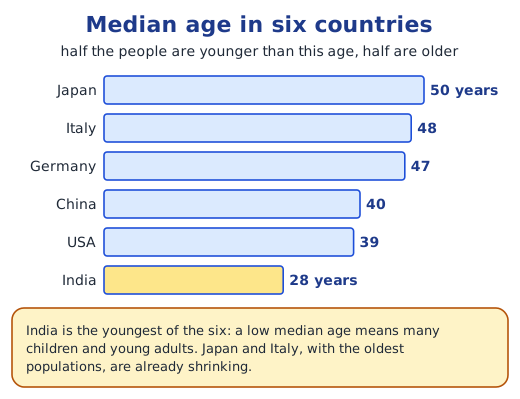
One simple way to compare countries is the median age: half the people are younger than it and half are older. The chapter gives India’s median age as 28 years, far younger than the USA (39), China (40), Germany (47), Italy (48) and Japan (50).
What is a demographic dividend?
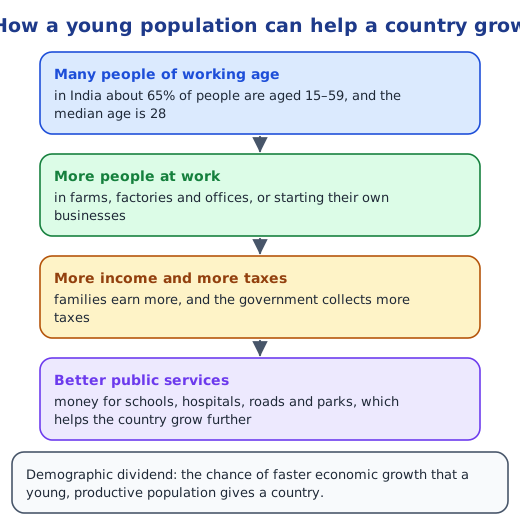
Young adults can work on farms, in factories and offices, or start their own businesses. The more people who work, the more goods and services a country produces, and the faster its economy can grow. Working people also earn incomes and pay taxes, which the government spends on schools, hospitals, roads and parks. This growth potential, which comes from having a young and productive population, is called the demographic dividend. A dividend is a share of profit; here, the profit is the extra growth that a young population makes possible.
Why is the window limited?
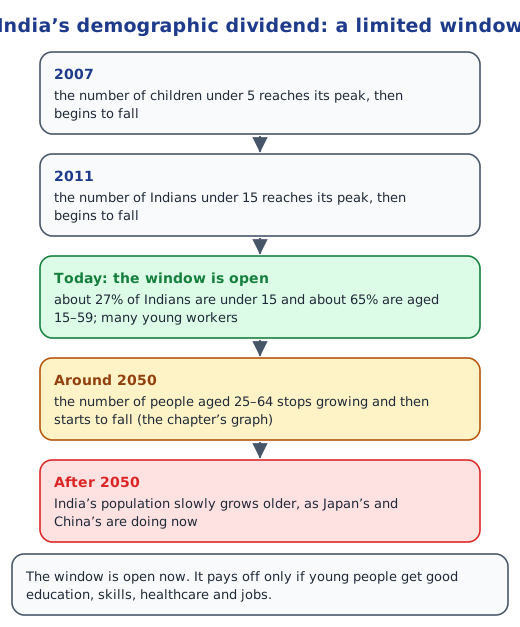
India will not stay young for ever. The number of Indian children under 5 reached its highest point in 2007 and has been falling since; the number under 15 peaked a little later, in 2011, and is falling too. The chapter’s graph of age groups shows the 25–64 group growing until about 2050 and then shrinking. After 2050, India’s population will begin to turn older.
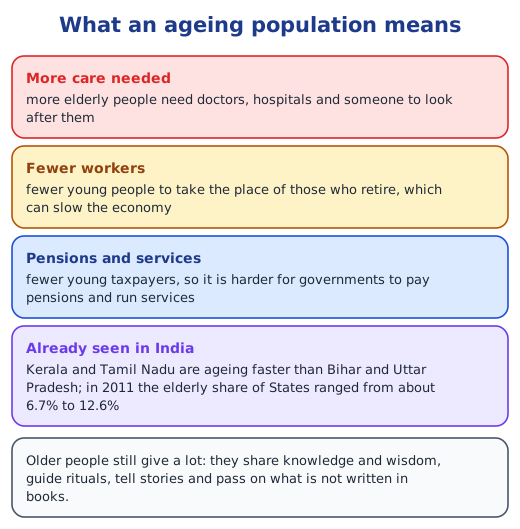
Some States are already ahead on this path. Kerala and Tamil Nadu are ageing faster than Bihar and Uttar Pradesh. The chapter’s map for 2011 shows the share of elderly people in different States ranging from about 6.7 to 12.6 per cent.
What does an ageing population bring?
An ageing population has a growing number of older people to look after and a shrinking number of young people at work to support them. Hospitals and health services come under pressure, because older people need more medical care. As workers retire, there are not enough younger people to fill their places, and the economy can slow down. With fewer young taxpayers, governments also find it harder to pay pensions, the regular payments made to people above the retirement age, and to keep services running.
Older people are not only a cost, though. Indian tradition speaks of ashrama dharma, which divides life into four stages: brahmacharya, grihastashrama, vanaprastha and sanyasa. Even as elders step back from earning, they share their knowledge and wisdom, guide rituals, tell stories and pass on things no book contains.
Making the most of the dividend
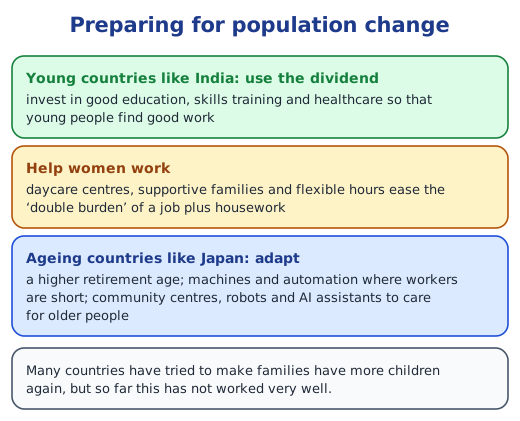
Every country has to prepare for these changes. Rich countries with ageing populations try to stay productive and inventive. Japan, for example, has raised its retirement age, uses technology and automation where workers are short, and runs large community centres, with robots and AI helpers that assist in caring for the elderly. Many countries have tried to persuade families to have more children again, without much success so far.
For a developing country like India, the task is to turn its young population into a real gain by investing in good education, skills training and healthcare. Women need special support. As more women take formal jobs, many face a double burden: their job plus most of the housework. Without childcare, help from the family or flexible working hours, many stop working. Daycare centres and supportive families can help India turn its demographic dividend into lasting progress.
Read on: birth rate, death rate and migration, demographic transition and population pyramids, the chapter notes and the NCERT solutions.
Practice
-
The median age of India’s population, as given in the chapter, is:
Show answer
Answer: (a) 28
-
A large share of people aged about 16 to 30 is called:
Show answer
Answer: (b) a youth bulge
-
Which country has raised its retirement age and uses robots to help care for older people?
Show answer
Answer: (c) Japan
-
How does a large working-age population help the government?
Show answer
Answer: More working people earn incomes and pay taxes, so the government has more money to spend on schools, hospitals, roads and parks.
-
What is the ‘double burden’ faced by many working women?
Show answer
Answer: Doing a job and also handling most of the housework. Daycare centres, flexible work hours and supportive families can ease it.
Questions students ask
What is a demographic dividend?
It is the boost to economic growth a country can get when a large part of its population is young and of working age. More workers can mean more production, more income and more taxes.
Why won’t India’s demographic dividend last for ever?
India’s population is slowly growing older. The number of children under 5 peaked in 2007 and of those under 15 in 2011, and after about 2050 the working-age group stops growing, so the chance has to be used now.
What problems does an ageing population bring?
More elderly people need healthcare and looking after, while fewer young people are working. The economy can slow down, and with fewer young taxpayers it is harder for governments to pay pensions and run services.
How can India make the most of its demographic dividend?
By investing in good education, skills training and healthcare, by creating jobs, and by helping women to work through daycare centres, flexible hours and supportive families.
Stuck on a question?
Take a photo and Lagnever AI explains it step by step. Try it for 7 days for ₹2.
Get it on Google Play Open in browser
For parents: after the trial, the plan renews monthly by UPI or card autopay. You can cancel anytime in the app.