
Birth rate, death rate and migration
Answer in short
Three things change a population. The birth rate counts live births in a year per 1,000 people, and the death rate counts deaths per 1,000 people. The fertility rate is how many children a woman has on average, with 2.1 as the replacement level. Migration, people moving in or out, adds to or reduces a population.
Stuck on a question? Take a photo and Lagnever AI explains it step by step. Try it for 7 days for ₹2. Get it on Google Play
Three things that change a population
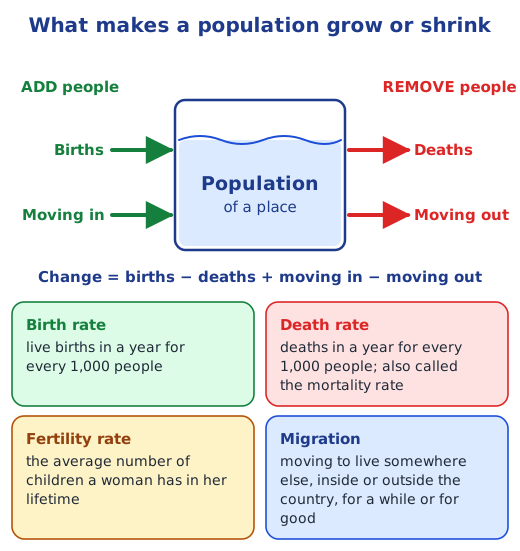
Think of a country’s population as water in a tank. Births and people arriving from elsewhere pour water in; deaths and people leaving let water out. How full the tank is today depends on how these flows have worked over many years. Demographers track the flows with four measures, called indicators: the birth rate, the fertility rate, the death rate (or mortality rate) and migration.
Birth rate and fertility rate
The birth rate is the number of live babies born in a year for every 1,000 people. A high birth rate makes a population grow quickly; a low one slows growth and can, in time, make it shrink.
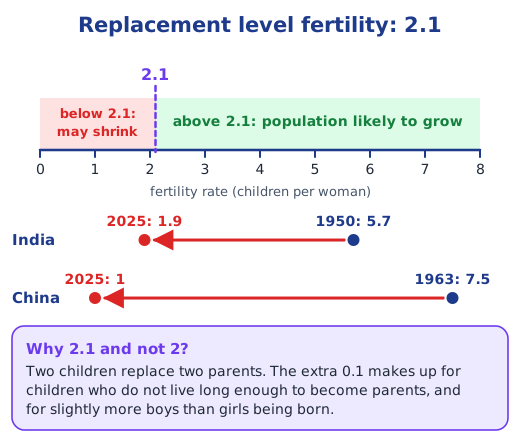
The fertility rate looks at mothers instead: it tells us how many children, on average, a woman has during her life. A rate of 2.1 is called the replacement level, because at that rate each generation of children just takes the place of its parents. Why not exactly 2? Some children do not live long enough to become parents themselves, and a few more boys than girls are born, so slightly more than two children per woman are needed. Above 2.1, a population usually grows; below it, it may slowly get smaller. When women have fewer children, the birth rate drops as well.
Why are families getting smaller?
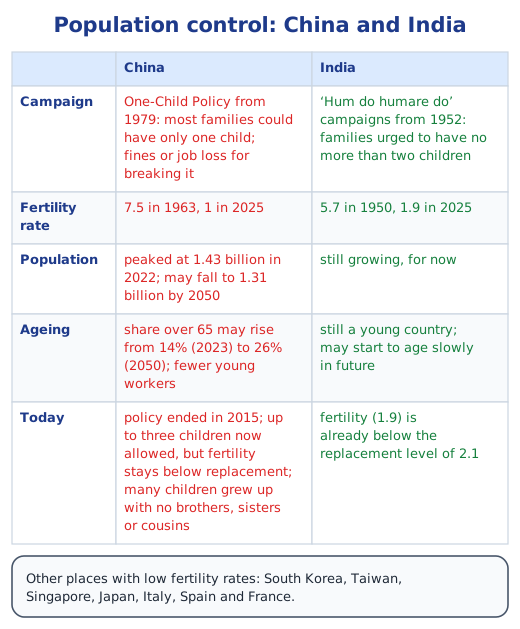
In the 1970s China feared that its fast-growing population would run short of food, jobs and homes. In 1979 it brought in the One-Child Policy: most families could have just one child, and rule-breakers faced fines or lost their jobs. China’s fertility rate, 7.5 in 1963, was down to 1 by 2025, and its population, after peaking at 1.43 billion in 2022, has begun to fall. A whole generation grew up without brothers, sisters or cousins. The policy ended in 2015 and up to three children are now allowed, yet fertility has stayed below replacement.
India took a gentler path, with campaigns such as ‘Hum do humare do’ from 1952 that urged families to stop at two children. India’s fertility rate was 5.7 in 1950; by 2025 it had fallen to 1.9. Many other countries, among them South Korea, Japan, Italy, Spain and France, also have low fertility today.
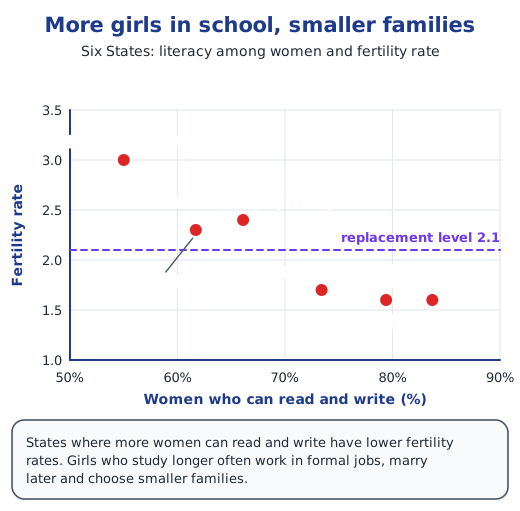
Campaigns are only part of the story. When girls stay in school longer and women take formal jobs, they tend to marry later and have fewer children. Life in cities is also costly, so many couples choose small families. The chapter’s figures for six States show the link: Bihar, where 55 per cent of women can read and write, has a fertility rate of 3.0, while Delhi, at 83.7 per cent, has 1.6.
Death rate and life expectancy
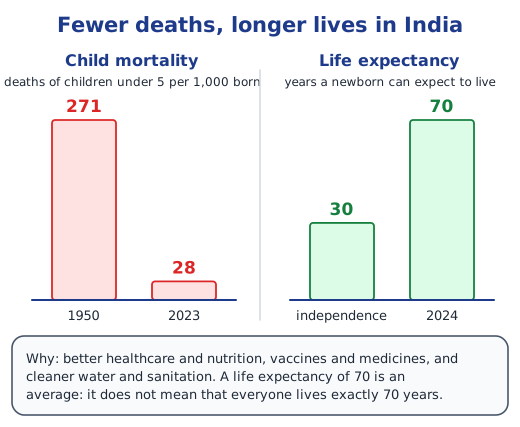
The death rate, or mortality rate, is the number of people who die in a year for every 1,000 people. A low death rate is a sign of good healthcare and nutrition. India has made big gains here. Child mortality, the deaths of children under 5 for every 1,000 live births, fell from 271 in 1950 to 28 in 2023.
Life expectancy is the number of years a newborn can expect to live on average, if today’s conditions stay the same. In India it was only about 30 years when the country became independent, and it reached 70 years in 2024. That does not mean everyone lives exactly 70 years; it is an average.
Migration
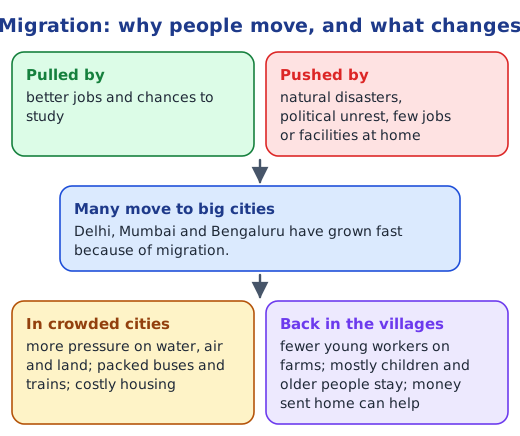
Migration means moving to live in another place, within the country or abroad, for a short time or for good. Better jobs and chances to study pull people towards a place; natural disasters or political unrest can push them out. Places that receive many migrants grow: Delhi, Mumbai and Bengaluru have swelled this way. But crowding many people into a small area strains water, air and land, as well as transport and housing.
Why it matters
These four indicators explain why some populations grow and others shrink, and they help governments plan schools, hospitals, homes and jobs. They also set the stage for the bigger patterns in this chapter: the stages of demographic transition and India’s young population.
Read on: demographic transition and population pyramids, India’s demographic dividend, the chapter notes and the NCERT solutions.
Practice
-
A fertility rate below 2.1 means that a population:
Show answer
Answer: (b) may shrink over time
-
Child mortality counts the deaths of children under the age of:
Show answer
Answer: (b) 5
-
Which policy did China bring in in 1979?
Show answer
Answer: (b) the One-Child Policy
-
Give two reasons why families in India have become smaller.
Show answer
Answer: More girls are educated and more women work in formal jobs, so they marry later and have fewer children; and life in cities is costly, so parents prefer small families.
-
Why do cities like Delhi, Mumbai and Bengaluru keep growing?
Show answer
Answer: Many people migrate to them for jobs and education. The inflow adds to their population, which also puts pressure on water, air, land, transport and housing.
Questions students ask
What is the difference between birth rate and death rate?
The birth rate is the number of live births in a year for every 1,000 people; the death rate counts deaths in a year for every 1,000 people. When births are more than deaths, the population grows, unless many people move away.
Why is the replacement level 2.1 and not 2?
Two children would replace two parents only if every child grew up to become a parent. Some children die young, and slightly more boys than girls are born, so on average a little more than two children per woman are needed.
What is life expectancy?
The average number of years a newborn baby can expect to live if today’s health, safety and living conditions continue. In India it was about 30 years at independence and 70 years in 2024.
What is migration?
People moving from one place to another, inside their country or abroad, to stay for a while or for good. Jobs and education pull people towards a place, while disasters and unrest can push them out.
Stuck on a question?
Take a photo and Lagnever AI explains it step by step. Try it for 7 days for ₹2.
Get it on Google Play Open in browser
For parents: after the trial, the plan renews monthly by UPI or card autopay. You can cancel anytime in the app.