
Continents and oceans: a quick world tour
Answer in short
The Earth has seven continents, Asia, Africa, North America, South America, Antarctica, Europe and Australia, and five oceans, the Pacific, Atlantic, Indian, Southern and Arctic. Oceans cover about 71% of the surface and hold about 97% of the Earth’s water. Each continent has its own mountains, plateaus, plains and deserts, which shape climate and life.
Stuck on a question? Take a photo and Lagnever AI explains it step by step. Try it for 7 days for ₹2. Get it on Google Play
Seven continents, five oceans
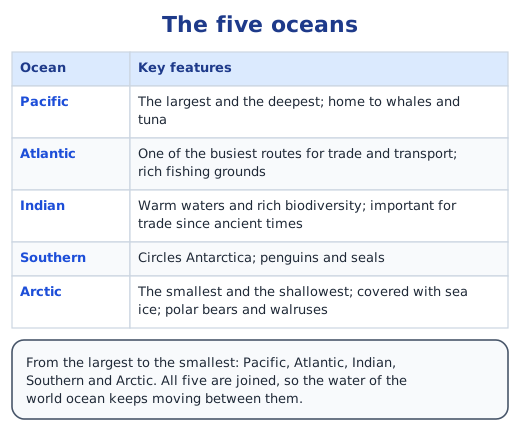
A continent is a large, continuous stretch of land. The usual count gives seven: Asia, Africa, North America, South America, Antarctica, Europe and Australia. Around them lie five connected oceans: the Pacific, the Atlantic, the Indian, the Southern and the Arctic. The Pacific is the largest and deepest, with whales and tuna; the Atlantic is one of the busiest routes for ships and a rich fishing ground; the Indian Ocean is warm, full of life and has carried trade for thousands of years; the Southern Ocean circles Antarctica, with its penguins and seals; and the Arctic, the smallest and shallowest, is covered with sea ice and home to polar bears and walruses.
Why the oceans matter
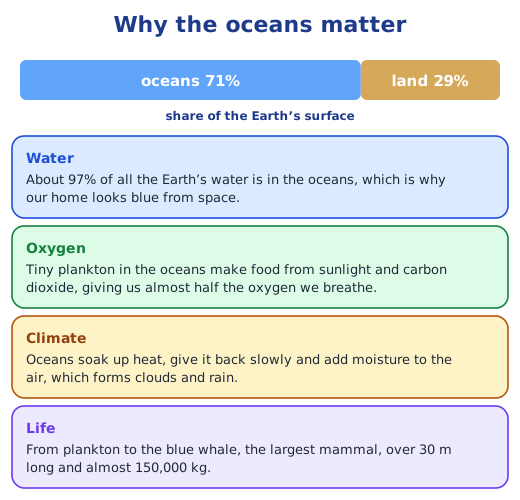
Salt water covers about 71% of the Earth’s surface, which is why astronauts called it the blue planet, and the oceans hold about 97% of all its water. Microscopic plankton, which make food from sunlight and carbon dioxide, supply nearly half of the oxygen in the air we breathe. The oceans also steady the climate: they absorb heat, release it slowly and add moisture to the air, which becomes clouds and rain. Life in them ranges from plankton to the blue whale, the largest mammal, over 30 m long. The ocean floor is not flat either; it has mountains, valleys and plains, just like the land.
Currents, trenches and reefs
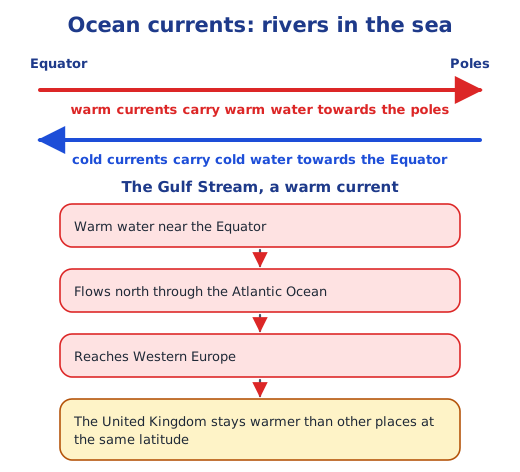
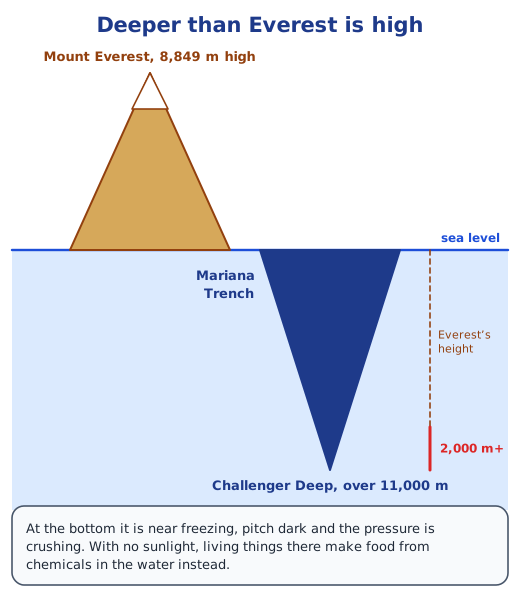
Ocean water is always moving. Currents flow like giant rivers: warm ones carry water from the Equator towards the poles, and cold ones carry water from the poles towards the Equator. The warm Gulf Stream crosses the Atlantic to Western Europe and keeps places like the United Kingdom milder than other lands lying at a similar latitude. The deepest parts of the seafloor are V-shaped trenches. In the Mariana Trench, the Challenger Deep goes more than 11,000 m down, in freezing, dark, crushing water where living things make food from chemicals. Reefs, ridges near the surface often built by corals, are among the richest ecosystems on Earth. The Great Barrier Reef off Australia stretches over 2,000 km.
Seas, gulfs, bays, straits and canals
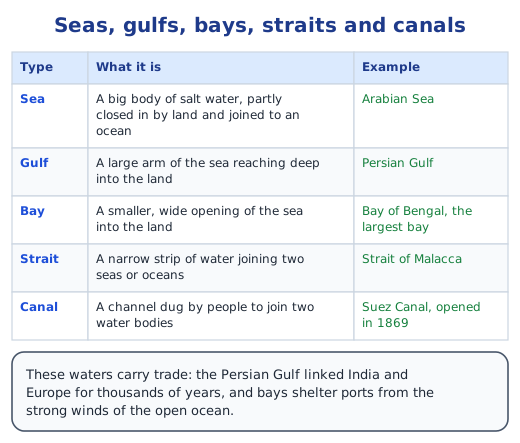
Geographers name smaller water bodies by their shape. A sea, like the Arabian Sea, is partly enclosed by land but joined to an ocean. A gulf, like the Persian Gulf, reaches deep into the land, while a bay, like the Bay of Bengal, the largest bay in the world, is smaller and wider. A strait, like the Strait of Malacca, is a narrow channel joining two seas or oceans, and a canal is dug by people: the Suez Canal, opened in 1869, links the Red Sea and the Mediterranean.
Landforms on every continent
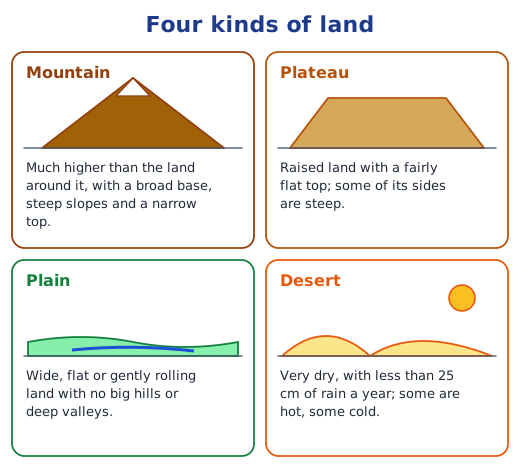
On land, the main landforms are mountains, plateaus and plains, along with deserts, which get less than 25 cm of rain a year and can be hot or cold. Every continent has its own famous examples: the Tibetan Plateau and the Gobi Desert in Asia, the European Plain and the Alps in Europe, the Sahara and the Nile in Africa, the Andes and the Amazon in South America, the Rocky Mountains and the Great Lakes in North America, and the Great Australian Desert. The largest desert of all is icy Antarctica. The full tour is in the Chapter 1 notes; for maps see mapping the Earth, and every question is answered in the NCERT solutions.
Practice
-
Which is the smallest and shallowest ocean?
Show answer
Answer: (c) Arctic
-
The deepest point in the oceans, the Challenger Deep, is in the:
Show answer
Answer: (a) Mariana Trench
-
Which is a channel dug by people?
Show answer
Answer: (c) Suez Canal
-
How do ocean currents affect the climate of coastal places?
Show answer
Answer: They carry water of a different temperature. The warm Gulf Stream brings water from near the Equator across the Atlantic to Western Europe, so the United Kingdom stays milder than other lands lying at a similar latitude.
-
Why do bays matter for trade?
Show answer
Answer: A bay is sheltered from the strong winds and waves of the open ocean, so it is a safe place for ports and dockyards where ships can load and unload.
Questions students ask
What are the seven continents and five oceans?
The continents are Asia, Africa, North America, South America, Antarctica, Europe and Australia. The oceans are the Pacific, the Atlantic, the Indian, the Southern and the Arctic. Seven is the most common count of continents; some people count them differently.
Why are oceans important for life on Earth?
They hold most of the Earth’s water, give us almost half our oxygen through plankton, feed a huge variety of living things, and keep the climate steady by soaking up heat, releasing it slowly and adding moisture that forms clouds and rain.
What is the difference between a sea and an ocean?
An ocean is one of the five huge, open bodies of salt water. A sea is smaller and partly enclosed by land, but it is connected to an ocean, as the Arabian Sea is connected to the Indian Ocean.
Stuck on a question?
Take a photo and Lagnever AI explains it step by step. Try it for 7 days for ₹2.
Get it on Google Play Open in browser
For parents: after the trial, the plan renews monthly by UPI or card autopay. You can cancel anytime in the app.