
Class 6 Social Science Chapter 4: Timeline and Sources of History Notes
This chapter in five lines
History is the study of the human past. To place events in time, we use the Gregorian calendar: years after the conventional year of Jesus' birth are marked CE (Common Era) and years before it BCE (Before Common Era), with no year zero. Decades, centuries and millenniums measure longer periods, and timelines show events in order. Historians rebuild the past from archaeological, literary, oral and artistic sources, like fitting jigsaw pieces together. The chapter ends with how early humans lived and began farming.
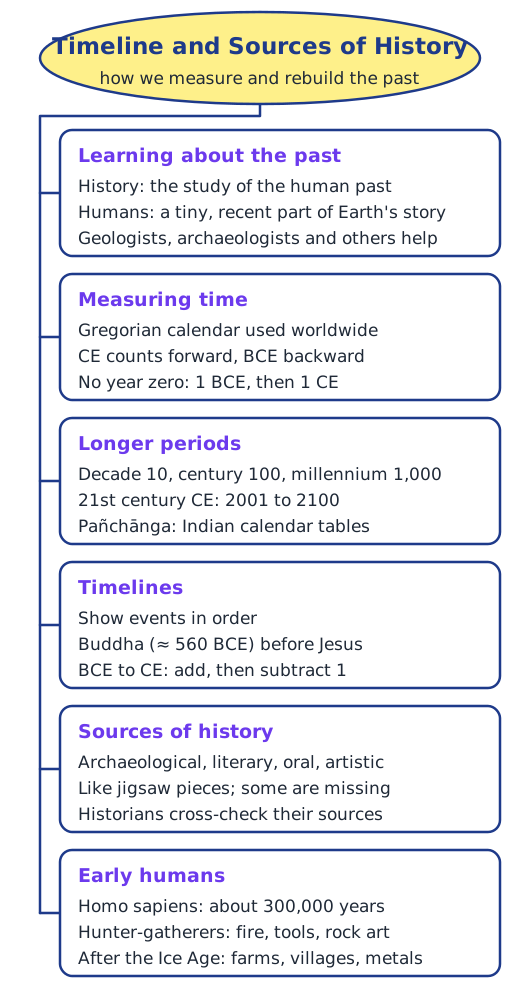
How do we learn about the past?
The chapter opens with the historian E.H. Carr, who called history “an unending dialogue between the present and the past”. History is the study of the human past. Your earliest memories, five or six years back, are part of your own past; the past of human societies goes back thousands of years.
The Earth is far older still, about 4.54 billion years old, and we humans occupy only a tiny, very recent part of its history. (Extra: if the Earth’s whole history were squeezed into one day, modern humans would appear only in the last 6 seconds before midnight.)
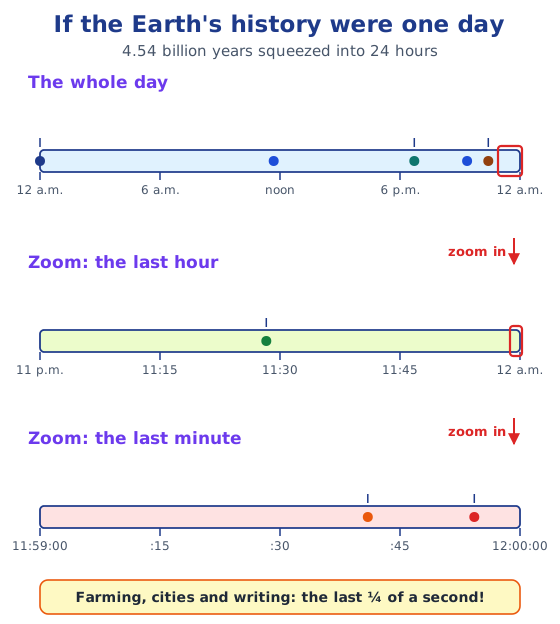
Many experts help us learn about the distant past. Geologists study the physical features of the Earth, such as soil, stones, hills, rivers and oceans. Palaeontologists study fossils, the remains of plants, animals and humans from millions of years ago. Anthropologists study human societies and cultures from the oldest times to the present, and archaeologists dig up what people, plants and animals left behind: tools, pots, beads, toys, bones, burnt grains and bricks.
How is time measured in history?
Every society has had its own way of measuring time, and a major event, such as the birth of an important person or the start of a ruler’s reign, often marked the beginning of a new era. Today the Gregorian calendar is used all over the world, while Hindu, Muslim, Jewish, Chinese and other calendars are used side by side for festivals and other auspicious events.
The Gregorian calendar counts from the conventional year of Jesus Christ’s birth. Years after it are marked CE (Common Era; earlier AD), so India gained independence in 1947 CE. Years before it are counted backward and marked BCE (Before Common Era; earlier BC): the Buddha was born in about 560 BCE. There is no year zero, because 1 CE follows straight after 1 BCE. So, to find the years between a BCE date and a CE date, add the two numbers and subtract 1. In 2026 CE, the Buddha’s birth was 560 + 2026 − 1 = 2,585 years ago. Read more in BCE and CE explained.
Decades, centuries and millenniums
A decade is 10 years, a century 100 years and a millennium 1,000 years. Centuries CE are counted from 1 CE, so the 21st century runs from 2001 to 2100. Centuries BCE are counted back from 1 BCE, so the 3rd century BCE runs from 300 BCE to 201 BCE. We live in the 3rd millennium CE, which began in 2001.
India also has traditional calendars based on the positions of the sun and the moon. A pañchānga is a book of tables listing the days of each month with astronomical data. It predicts solar and lunar eclipses and sunrise and sunset times, and gives the dates of festivals and often weather predictions for the year.
Timelines
A timeline shows the dates and events of a period in order. Even without reading the dates, a timeline shows at once that the Buddha was born before Jesus. A timeline of human history usually skips long periods; otherwise it would have to be metres long.
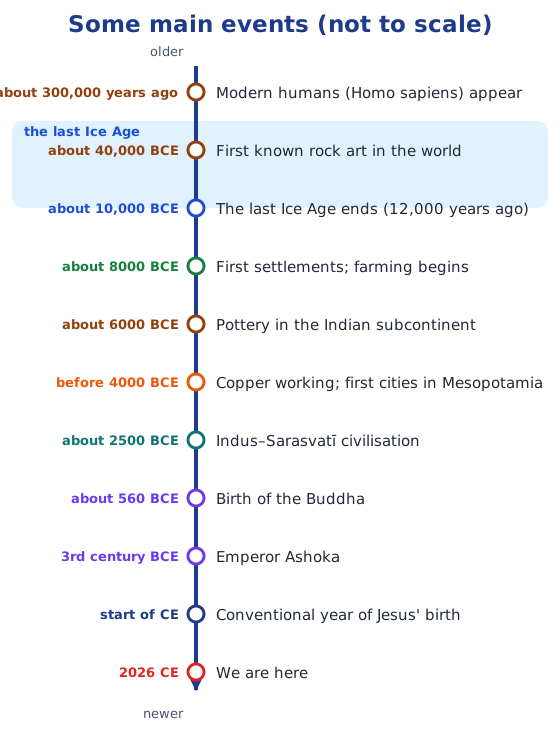
Sources of history
A source of history is a place, person, text or object that gives us information about some past event or period. Every object tells a story and is like a piece of a jigsaw puzzle, and in history some pieces are always missing. Sources can be archaeological (monuments, mounds and excavated remains, inscriptions and coins), literary (Indian texts and foreign accounts), oral (folklore and family genealogies) or artistic (paintings, sculptures and carved panels).
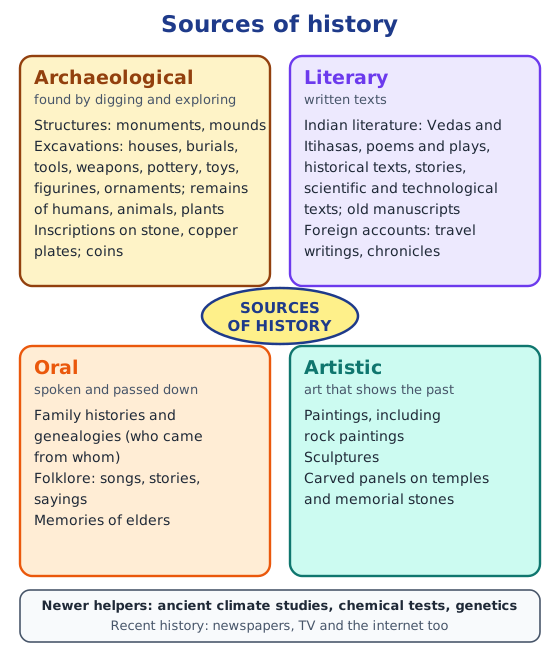
Historians gather as many sources as they can. When sources agree, the pieces match; when they contradict each other, historians decide which to trust more. Archaeologists, epigraphists (who study ancient inscriptions), anthropologists and experts in literature and languages all contribute. In the last 50 years or so, studies of ancient climates, chemical studies of excavated materials and the genetics of ancient people have added fresh insights, and for recent history, newspapers and electronic media are sources too. Read more in sources of history.
The beginnings of human history
Modern humans (Homo sapiens) have walked the planet for about 300,000 years. Early humans lived in bands, in temporary camps, rock shelters or caves, as hunter-gatherers who hunted and collected edible plants and fruits. They used fire, made better stone axes, blades and arrowheads, painted animals and people on rock walls, made beads and pendants, and had beliefs about nature and possibly an afterlife.
During an Ice Age, much of the Earth was covered with ice. The last one lasted from over 100,000 years ago to around 12,000 years ago. Afterwards, people in many places began growing cereals, domesticated animals such as cattle and goats, and settled near rivers, where water was close and the soil fertile. Chieftains looked after the community, and land was sown and harvested together. Hamlets grew into villages that exchanged food, clothing and tools; some became small towns, and pottery and metals, copper first and iron later, came into use.
Answers to every question are in the NCERT solutions for Chapter 4.
Key terms
| Term | Meaning |
|---|---|
| History | The study of the human past. |
| Era | A distinct period of time, often counted from a major event such as the birth of an important person or the start of a ruler's reign. |
| Gregorian calendar | The calendar used the world over: 12 months adding up to 365 days, with a leap year every four years; century years are leap years only if they are multiples of 400. |
| CE (Common Era) | Years counted forward from the conventional year of Jesus' birth, earlier marked AD; India gained independence in 1947 CE. |
| BCE (Before Common Era) | Years counted backward from the same point, earlier marked BC; the Buddha was born in about 560 BCE. |
| Timeline | A line that shows the dates and events of a period in the order in which they happened. |
| Century | Any period of 100 years; the 21st century CE runs from 2001 to 2100. |
| Millennium | Any period of 1,000 years; we are in the 3rd millennium CE, which began in 2001. Its plural is millenniums or millennia. |
| Pañchānga | An Indian book of tables listing the days of each month with astronomical data, such as eclipses and sunrise times, and festival dates. |
| Source of history | A place, person, text or object from which we gather information about some past event or period. |
| Fossils | Impressions of footprints, or parts of plants or animals, found preserved within layers of soil or rock. |
| Hunter-gatherers | People who live by hunting animals and collecting edible plants and fruits, as early humans did. |
| Ice Age | A long period when the Earth was very cold and much of it was covered with ice; the last one ended around 12,000 years ago. |
Topics in this chapter
Practice
-
BCE stands for:
Show answer
Answer: (a) Before Common Era
-
Which year comes just before 1 CE?
Show answer
Answer: (b) 1 BCE
-
The 21st century CE runs from:
Show answer
Answer: (b) 2001 to 2100
-
A person who studies ancient inscriptions is called:
Show answer
Answer: (b) an epigraphist
-
Folklore and family genealogies are examples of:
Show answer
Answer: (a) oral sources
Questions students ask
What are the main topics of Class 6 SST Chapter 4?
How we learn about the past; how time is measured in history, with the Gregorian calendar, BCE and CE, decades, centuries and millenniums; timelines; the sources of history; and the beginnings of human history, from early hunter-gatherers to the first farming villages.
Is Timeline and Sources of History in the new Exploring Society book?
Yes. Timeline and Sources of History is Chapter 4 of Exploring Society: India and Beyond, the Class 6 Social Science textbook (2026-27 session). It opens the book's history theme, Tapestry of the Past.
How many questions does Chapter 4 have at the end?
The “Questions, activities and projects” section has 5 questions, including a set of exercises with dates. Our NCERT solutions page answers all of them, along with the Big Questions, every Let's Explore and the Think About It boxes.
Stuck on a question?
Take a photo and Lagnever AI explains it step by step. Try it for 7 days for ₹2.
Get it on Google Play Open in browser
For parents: after the trial, the plan renews monthly by UPI or card autopay. You can cancel anytime in the app.