
NCERT Solutions Class 6 Social Science Chapter 4: Timeline and Sources of History
Answers to the Big Questions, every Let’s Explore and Think About It box, the in-text questions and all 5 “Questions, activities and projects” in Chapter 4, Timeline and Sources of History, of Exploring Society: India and Beyond (2026-27 session). The page numbers match the book. Calculations take 2026 CE as the present year; the book’s own example uses 2024. Activities about your own family and surroundings have sample answers; yours will differ. Short notes: Chapter 4 notes.
The Big Questions (page 59)
1. How do we measure historical time?
We measure historical time with calendars, counting years from a fixed starting point. The Gregorian calendar, used worldwide, counts years forward from the conventional year of Jesus’ birth as CE (Common Era) and backward as BCE (Before Common Era), with no year zero. Longer stretches are measured in decades (10 years), centuries (100 years) and millenniums (1,000 years), and a timeline shows events in the order they happened. Other calendars, such as the Hindu, Muslim, Jewish and Chinese ones and India’s pañchāngas, are used side by side, especially for festivals.
2. How can various sources help us understand history?
Each source gives one piece of information, like a piece of a jigsaw puzzle. Archaeological sources (monuments, excavated tools, pots and bones, inscriptions and coins) show how people lived and built; literary sources (Indian texts and foreign accounts) tell us what people thought, believed and recorded; oral sources (folklore and genealogies) keep memories alive; and artistic sources (paintings, sculptures and panels) show scenes, dress and beliefs. By comparing many sources, historians see which pieces match and which do not, and re-create the past as closely as they can, even though some pieces stay missing.
3. How did early humans live?
Early humans lived in bands, in temporary camps, rock shelters or caves. They were hunter-gatherers, who hunted animals and collected edible plants and fruits. They used fire, made stone axes, blades and arrowheads, painted on rock walls, made beads and pendants and sometimes exchanged them with other groups, and had beliefs about nature and possibly an afterlife. After the last Ice Age ended, around 12,000 years ago, many began farming, kept animals such as cattle and goats, and settled near rivers. Villages grew and exchanged goods, some became towns, and pottery and metals came into use.
Think About It: your own past (page 60)
- Sample answer: “My earliest memory is of my first day at school, when I was about four years old.” Most people remember little from before the age of three or four, so these memories, a few years back, are your own past.
- Understanding the past helps us understand the present because today’s world grew out of it. Our languages, festivals, food, towns and even today’s problems have roots in earlier times. Knowing how and why things changed helps us make sense of the present and learn from earlier successes and mistakes; this is what the historian E.H. Carr meant by a dialogue between the present and the past.
The experts who study the past (page 61)
The four pictures show people learning about the Earth’s past and ours:
- Geologists examine rocks, soil and landforms such as hills, rivers and seas to learn how the Earth formed and changed.
- Palaeontologists dig out and study fossils, the remains of plants, animals and humans from millions of years ago.
- Anthropologists study human societies and cultures, from the oldest times to the present.
- Archaeologists carefully dig up and record remains such as tools, pots, beads, figurines, toys, bones, burnt grains and bricks.
How long ago was the Buddha born? (pages 62–63)
The Buddha was born in about 560 BCE. Counting to 2026 CE: 560 + 2026 − 1 = 2,585 years ago. (With 2024 as the present year, as in the book’s example: 560 + 2024 − 1 = 2,583.)
Let’s Explore: no year zero. A timeline marking every year from 2 BCE to 2 CE shows 2 BCE, 1 BCE, 1 CE and 2 CE: only three steps, so 3 years pass, not 4. So between a BCE date and a CE date, add the two numbers and subtract 1: 2 + 2 − 1 = 3.
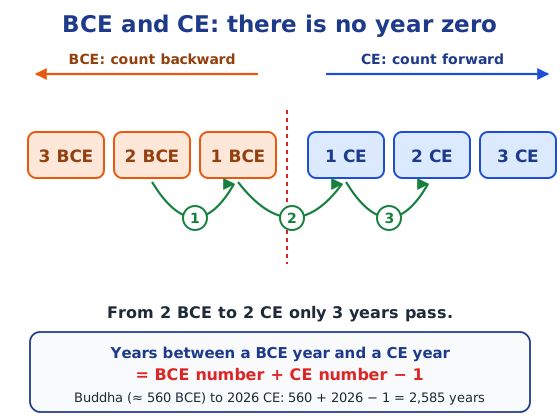
More practice: from 50 BCE to 50 CE, 50 + 50 − 1 = 99 years; from 1 BCE to 1 CE, 1 + 1 − 1 = 1 year; from 100 BCE to 2026 CE, 100 + 2026 − 1 = 2,125 years.
The 8th millennium BCE (page 65)
Millenniums BCE are counted back from 1 BCE: the 1st millennium BCE is 1000 to 1 BCE, the 2nd is 2000 to 1001 BCE, and so on. So the 8th millennium BCE runs from 8000 BCE to 7001 BCE, and it begins in 8000 BCE: the mark labelled 8000 BCE on the timeline in Fig. 4.3, where the book shows the first settlements and the beginning of agriculture.
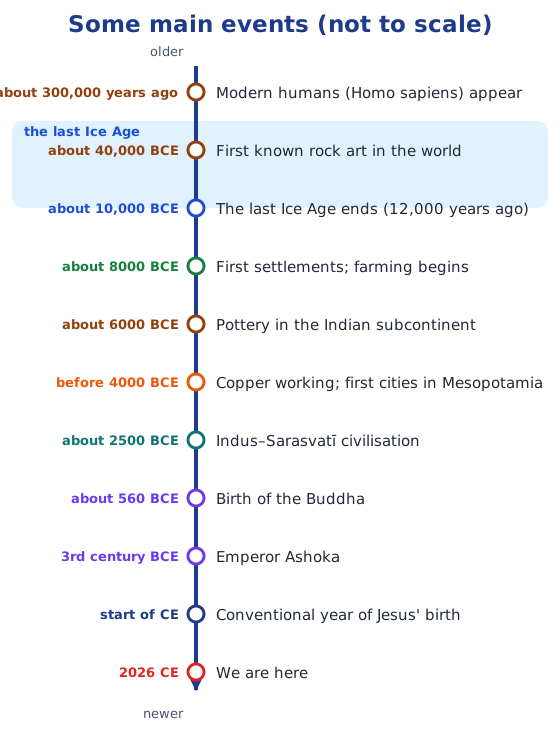
Let’s Explore: a family timeline from 1900 CE (page 65)
Sample timeline: 1900 (start) · 1901, the 20th century CE begins · 1956, grandfather born · 1959, grandmother born · 1984, father born · 1987, mother born · 2000, the 20th century CE ends · 2001, the 21st century CE begins · 2011, elder sister born · 2014, I am born · 2026, today.
The 20th century CE begins with 1901 and ends with 2000.
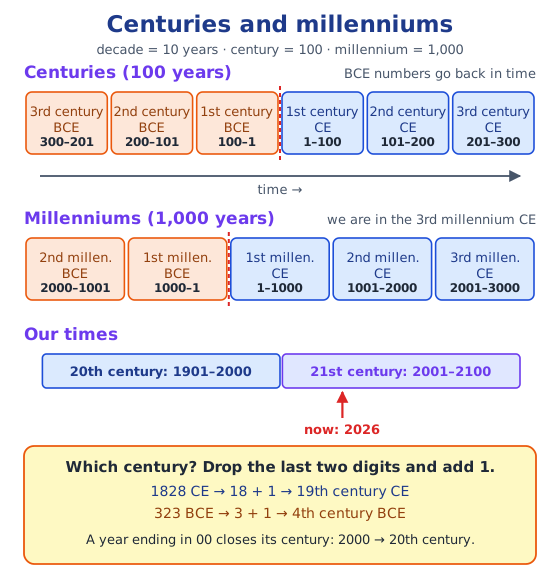
Let’s Explore: three generations of your family (page 66)
A sample of the table; fill it in with your own family’s details:
| Relation | Sample details and source |
|---|---|
| Grandparents (father’s side) | Ramesh, farmer, born in a village near Sitapur; Kamla, tailor, born in Barabanki. Source: their own memories |
| Grandparents (mother’s side) | Mohan, railway clerk, and Sushila, teacher, both born in Lucknow. Source: Nani’s photo album and certificates |
| Great-grandparents (father’s side) | Shivnath and Rampyari, farmers, born near Sitapur. Source: Dadi’s stories |
| Great-grandparents (mother’s side) | Gopal, shopkeeper, and Savitri, born in Lucknow. Source: an old shop register that Nana kept |
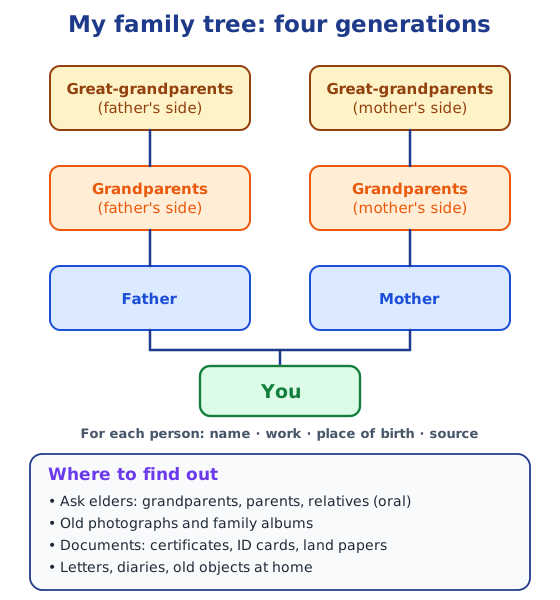
How did you find details about your family’s past? Sample answer: by asking parents and grandparents (oral sources), looking at old photographs and a wedding card, reading names and dates on ID cards, ration cards and certificates, and reading an old diary kept by a grandparent. Some details, such as the work of great-grandparents, came only from memories, so they may be less exact.
Think About It: old objects at home (page 67)
Old objects and buildings are sources of family and local history:
- Coins tell us which government or ruler issued them, roughly when, the metal used and what money was worth.
- Books show the language, the script and the ideas people read about.
- Clothes show the fabrics, styles and crafts of their time, and what people wore on special days.
- Jewellery shows the metals, skills and customs of a family or region.
- Utensils of brass, copper or clay tell us how food was cooked, stored and served.
- Old houses and buildings show the building materials, the size of families, how people suited homes to the climate, with thick walls or courtyards, and how wealthy the owners were.
Let’s Explore: what do these sources show? (pages 68–69)
The book gives no captions, so these answers describe what the pictures show and what they most likely are:
- The gold coin shows a king with a halo, seated on a high-backed couch and playing a veena (a stringed instrument) on his lap, with writing around the edge. It looks like a gold coin of the Gupta king Samudragupta (4th century CE), of the kind called the lyrist or veena-player type. It tells us that the king wished to be seen as a musician, that gold coins were in use, a sign of wealth and trade, and it shows the script, dress and musical instruments of the time.
- The carved stone panel has two rows of figures under a domed top. The lower row shows a fight around a boat full of armed men; the upper row shows richly dressed figures under parasols. It looks like a hero stone, a memorial set up for a warrior who died in battle. (Extra: hero stones showing sea battles have been found on India’s west coast, for example near Mumbai and in Goa.) It tells us that boats were used in war, what weapons and clothes looked like, and how warriors were honoured, perhaps with a belief in a life after death.
- The stone lions are the Lion Capital of Ashoka from Sarnath, near Varanasi (3rd century BCE): four lions stand back to back on a round base carved with a wheel and animals, above a bell-shaped lotus. It tells us about the emperor Ashoka, who set up such pillars, about the skill of stone carvers who polished the sandstone, and about the spread of the Buddha’s teaching, shown by the wheel. (Extra: today it is India’s national emblem.)
Let’s Explore: life in a rock shelter (page 70)
- Keeping a fire going: a man feeds the fire with a long stick while others sit around it to keep warm, and a mother holds her baby close to it. Fire also gave light, cooked food and kept wild animals away.
- Painting the rock wall: a person paints animals such as deer and bulls, and human figures, on the wall of the shelter, while a child watches.
- Preparing an animal skin: two men work on a large hide spread on the ground, perhaps scraping it to make clothing or a covering.
- Making tools: a man strikes one stone with another to shape a tool.
- Sorting food: a man and a woman pick things out of a large container, perhaps fruits or nuts they had gathered.
- Children sit together, eating and playing.
People wear animal skins and necklaces of teeth or beads, which shows that they made clothes and ornaments.
Let’s Explore: an early farming village (pages 71–72)
- Harvesting: people cut the ripe crop, and others carry bundles of it on their heads.
- Carrying tools: a man walks with a stone tool fixed to a wooden handle on his shoulder, perhaps to dig or clear land.
- Chopping wood: a man splits logs with an axe near the huts.
- Cooking: a woman grinds grain on a grinding stone, with vegetables and fruit beside her, while food cooks in a clay pot over a fire.
- Herding: sheep graze, cattle stand near the water, and a dog walks with the people.
- Children play near the houses.
- Houses: huts with mud walls and thatched roofs show that people now stayed in one place, close to a river or lake.
Think About It: roles of men and women (page 72)
Points for the class discussion: the pictures are artists’ ideas, not photographs, and we have only limited evidence about who did what. Work may often have been shared according to need: women may have prepared colours and painted, made tools or gathered and hunted, while men may have cooked, gathered food or cared for children. Roles probably varied from group to group and changed over time. So we should not assume that early people divided work the way some people do today; historians look for evidence, such as tools found in the graves of men and women, before drawing conclusions.
Questions, activities and projects (page 74)
1. Write the history of your family or village (project). A plan:
- Choose a question, for example: where did my family live and work over the last 100 years?
- Collect sources: talk to elders (oral sources), and look at photographs, letters, certificates, land papers and old objects. For a village, also visit old temples, wells, ponds or houses, and ask elders and the panchayat.
- Note the source of every fact, and check facts against each other.
- Put the main events on a timeline.
- Write the history in parts (where the family or village came from, work, moves, important events, changes), add photos or drawings, and list your sources at the end.
2. Can we compare historians to detectives? Yes, in many ways:
- Both start with a question about what happened, and why.
- Both collect clues: a detective from witnesses and objects, a historian from sources such as objects, texts and memories.
- Both check whether the clues agree, and decide which to trust when they clash.
- Both fill gaps carefully, using evidence and reasoning, and change their conclusions when new evidence appears.
One difference: a detective can often question living witnesses, while a historian of the distant past mostly has objects and texts, and some pieces of the puzzle are lost for ever.
3. A few exercises with dates
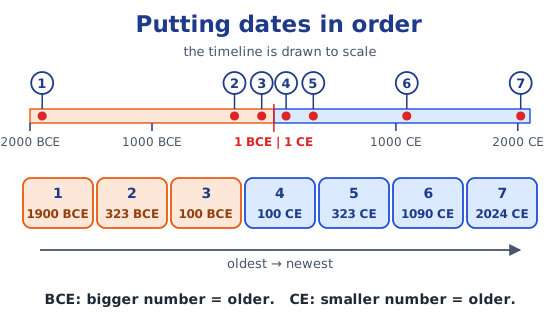
- In order: 1900 BCE → 323 BCE → 100 BCE → 100 CE → 323 CE → 1090 CE → 2024 CE.
- King Chandragupta, born in 320 CE: he belonged to the 4th century CE (301 to 400 CE). That was 560 + 320 − 1 = 879 years after the Buddha’s birth.
- The Rani of Jhansi, born in 1828: she belonged to the 19th century CE (1801 to 1900). That was 1947 − 1828 = 119 years before India’s Independence.
- ‘12,000 years ago’ as a date: taking 2026 CE as the present year, 12,000 − 2026 + 1 = 9,975 BCE, which is about 10,000 BCE. (With 2024 as the present year: 9,977 BCE.) This is around the time the last Ice Age ended.
4. A visit to a nearby museum. Before the visit, find out what kind of exhibits the museum holds (for example the National Museum in New Delhi, or your state or district museum) from its website or a guidebook, and prepare a few questions. During the visit, note the name, date and place of a few objects, read the labels and sketch one object. Sample report: “Our class visited the district museum. We saw stone tools, pottery, terracotta toys, coins of different rulers and sculptures. Unexpected: how small and detailed some ancient toys were. Interesting: coins of different rulers used different scripts and pictures. Fun: matching each object to its place on a timeline of our region.”
5. Inviting an archaeologist or a historian. With your teacher’s help, write a polite invitation, fix a date and prepare questions, for example:
- What are the oldest sites or monuments in our region?
- How do you find out how old an object is?
- How has our region changed over the centuries?
- Why is it important to know the history of our region?
After the talk, write a short summary and send a thank-you note. (Knowing local history helps us value our heritage, protect old sites and understand how our region came to be as it is.)
For more practice, read BCE and CE explained and sources of history.
Practice
-
Which of these is an oral source?
Show answer
Answer: (b) Folklore
-
If King Chandragupta was born in 320 CE, he belonged to the:
Show answer
Answer: (b) 4th century CE
-
The 20th century CE begins with the year:
Show answer
Answer: (b) 1901
-
Turn ‘2,000 years ago’ into a date, taking 2026 CE as the present year.
Show answer
Answer: Both dates are CE, so subtract: 2026 − 2000 = 26, so it was 26 CE.
-
How many years passed from 323 BCE to 323 CE?
Show answer
Answer: Add and subtract 1, because there is no year zero: 323 + 323 − 1 = 645 years.
Stuck on a question?
Take a photo and Lagnever AI explains it step by step. Try it for 7 days for ₹2.
Get it on Google Play Open in browser
For parents: after the trial, the plan renews monthly by UPI or card autopay. You can cancel anytime in the app.