
Sources of history
Answer in short
A source of history is a place, person, text or object that gives us information about a past event or period. Sources are archaeological (monuments, excavated remains, inscriptions, coins), literary (written texts and foreign accounts), oral (folklore and family genealogies) and artistic (paintings, sculptures and panels). Historians compare them, like fitting jigsaw pieces together.
Stuck on a question? Take a photo and Lagnever AI explains it step by step. Try it for 7 days for ₹2. Get it on Google Play
What is a source of history?
A source of history is a place, person, text or object from which we gather information about some past event or period. Look around your home: an old photograph, a grandparent’s diary, a brass utensil or an old coin each says something about your family’s past. In the same way, historians put together the story of a past period from many kinds of sources.
Every object or structure is like a piece of a jigsaw puzzle. Fit enough pieces together and a picture appears, but in history quite a few pieces are always missing, so the picture is never complete.
Four kinds of sources
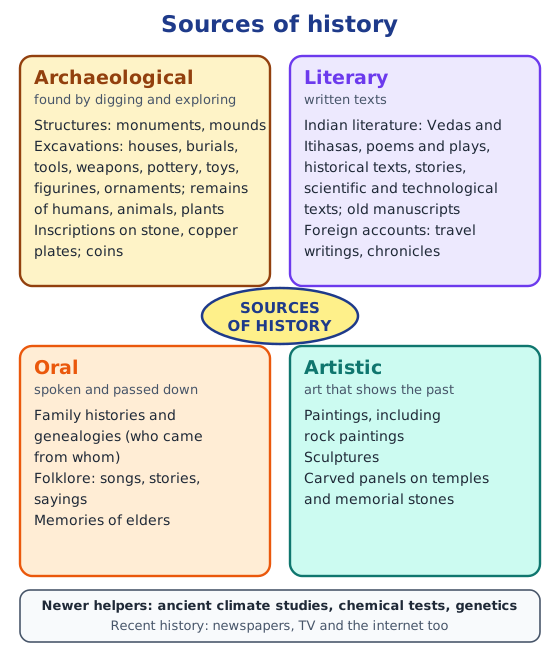
- Archaeological sources are found by exploring and digging. They include structures such as monuments and mounds; excavations, which reveal houses and burials, tools and weapons, pottery and toys, figurines and ornaments, and the remains of humans, animals and plants; and inscriptions on stone and copper plates, along with coins.
- Literary sources are written texts. Indian literature includes the Vedas and Itihasas, poems and plays, historical texts, collections of stories, and scientific and technological texts, many of them kept in old manuscripts. Foreign accounts, such as travelogues and chronicles written by visitors, are literary sources too.
- Oral sources are spoken and passed down from one generation to the next: genealogies, which record who descended from whom, and folklore, such as songs, stories and sayings.
- Artistic sources include paintings, such as rock paintings, sculptures and carved panels.
Reading an object
Take the Lion Capital of Ashoka from Sarnath, near Varanasi, which appears among the chapter’s pictures of sources. Four lions stand back to back on a round base carved with a wheel and four animals, an elephant, a bull, a horse and a lion. (Extra: it once topped a polished sandstone pillar set up by the emperor Ashoka in the 3rd century BCE, and it is now India’s national emblem.) From one such object we learn about a ruler and his empire, the skill of stone carvers, and the spread of the Buddha’s teaching, shown by the wheel.
Who works with sources?
Historians study and write about the past. When they study, say, a king or queen of 1,500 years ago, an ancient monument, a war or some items of trade, they consult as many sources as they can find. Others contribute too:
- archaeologists, who dig up and study remains;
- epigraphists, who study ancient inscriptions;
- anthropologists, who study human societies and their cultures;
- experts in literature and languages.
In the last 50 years or so, science has added fresh insights: studies of ancient climates, chemical studies of excavated materials, and studies of the genetics of ancient people, which show how features pass from one generation to the next. For recent history, usually the last two or three centuries, newspapers are another source, and for the last few decades, electronic media such as television and the internet can also be consulted.
When sources agree, and when they clash
Sometimes sources confirm each other: the jigsaw pieces match. At other times they give contradictory information, and historians must decide which source to trust more, for example by asking who made it, when and why. This careful checking is how they re-create the history of the period they study, much as a detective weighs clues.
Start with your own family
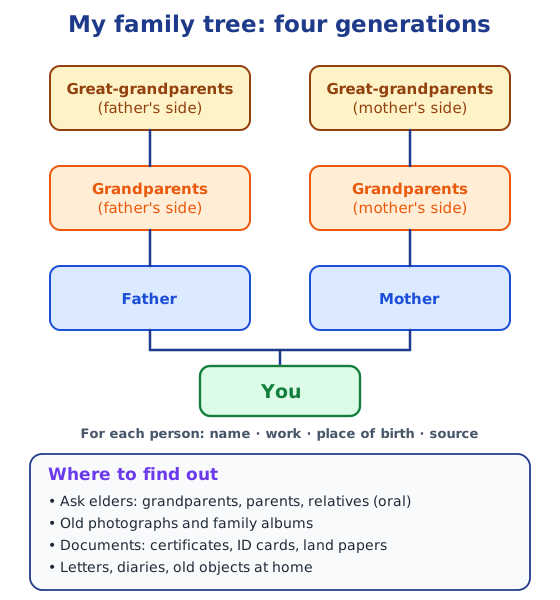
You can practise being a historian at home. Ask your parents and grandparents about three generations of your family: their names, work and places of birth. Their memories are oral sources; photographs, letters, diaries, ID cards and certificates are other sources. Write down where each piece of information came from, as historians do.
To place your findings in time, read BCE and CE explained. For the textbook’s questions, see the Chapter 4 NCERT solutions; for the whole chapter, see the Chapter 4 notes.
Practice
-
Inscriptions on copper plates are:
Show answer
Answer: (b) archaeological sources
-
A travelogue written by a visitor from another country is a:
Show answer
Answer: (a) foreign account
-
Who studies ancient inscriptions?
Show answer
Answer: (b) An epigraphist
-
What can an old coin found at home tell us?
Show answer
Answer: Who issued it and roughly when, the metal and script used, the pictures and symbols people valued, and that money was used in trade. With family memories, it may also tell us something about the family's past.
-
Why do historians compare many sources?
Show answer
Answer: One source gives only one piece of the picture and may be wrong or one-sided. By comparing sources, historians see where the pieces match and, where they clash, decide which source to trust more.
Questions students ask
What are the sources of history?
Places, people, texts and objects that give information about the past. The four main groups are archaeological, literary, oral and artistic sources.
What are archaeological sources?
Remains found by exploring and digging: structures such as monuments and mounds; houses, burials, tools, weapons, pottery, toys, figurines, ornaments and the remains of humans, animals and plants found in excavations; and inscriptions and coins.
Who helps historians to build history?
Archaeologists, epigraphists, anthropologists and experts in literature and languages. In the last 50 years or so, scientists have helped too, with studies of ancient climates, chemical studies of excavated materials and the genetics of ancient people.
Stuck on a question?
Take a photo and Lagnever AI explains it step by step. Try it for 7 days for ₹2.
Get it on Google Play Open in browser
For parents: after the trial, the plan renews monthly by UPI or card autopay. You can cancel anytime in the app.