
BCE and CE explained
Answer in short
CE (Common Era) marks years counted forward from the conventional year of Jesus' birth, and BCE (Before Common Era) marks years counted backward from it; they replace the older AD and BC. There is no year zero, so 1 CE follows 1 BCE. To find the years between a BCE and a CE date, add the numbers and subtract 1.
Stuck on a question? Take a photo and Lagnever AI explains it step by step. Try it for 7 days for ₹2. Get it on Google Play
A shared way to count years
Different societies have counted years in different ways, often starting a new era with a major event, such as a ruler coming to the throne. Today the Gregorian calendar is used worldwide. It has 12 months adding up to 365 days, with a leap year every four years. Century years are leap years only if they are multiples of 400, so 2000 was a leap year but 1800 and 1900 were not. Hindu, Muslim, Jewish, Chinese and other calendars are still used side by side to fix the dates of festivals.
What CE and BCE mean
The Gregorian calendar takes the conventional year of Jesus Christ’s birth as its starting point.
- Years after it are counted forward and marked CE, for Common Era. They used to be marked AD, from a Latin phrase for the years after Jesus’ birth. India gained independence in 1947 CE, which can also be written 1947 AD or AD 1947.
- Years before it are counted backward and marked BCE, for Before Common Era. They used to be marked BC, for Before Christ. The Buddha was born in about 560 BCE.
Because BCE years count backward, a bigger BCE number means an older date: 560 BCE is older than 323 BCE.
There is no year zero
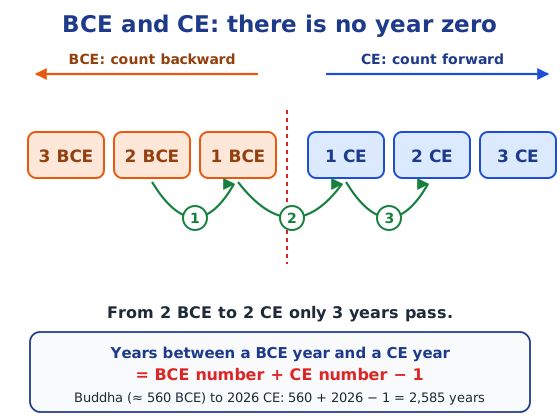
In the Gregorian calendar, the year 1 CE follows straight after 1 BCE. Mark every year from 2 BCE to 2 CE on a timeline and you will see only three steps, so only 3 years pass between those dates. That gives a rule:
Years between a BCE year and a CE year = BCE number + CE number − 1.
From 2 BCE to 2 CE: 2 + 2 − 1 = 3. The Buddha, born in about 560 BCE, was born 560 + 2026 − 1 = 2,585 years before 2026 CE.
Three kinds of date sums
| Dates | What to do |
|---|---|
| Both CE | Subtract: the Rani of Jhansi, born in 1828, was born 1947 − 1828 = 119 years before Independence |
| Both BCE | Subtract: from 560 BCE to 323 BCE is 560 − 323 = 237 years |
| BCE to CE | Add, then subtract 1: from 560 BCE to 320 CE is 560 + 320 − 1 = 879 years |
To turn “years ago” into a date, count back from the present year. In 2026 CE, 1,000 years ago was 1026 CE. When the number of years is bigger than the present year, the date is BCE: 12,000 years ago was 12,000 − 2026 + 1 = 9,975 BCE, or about 10,000 BCE.
Decades, centuries and millenniums
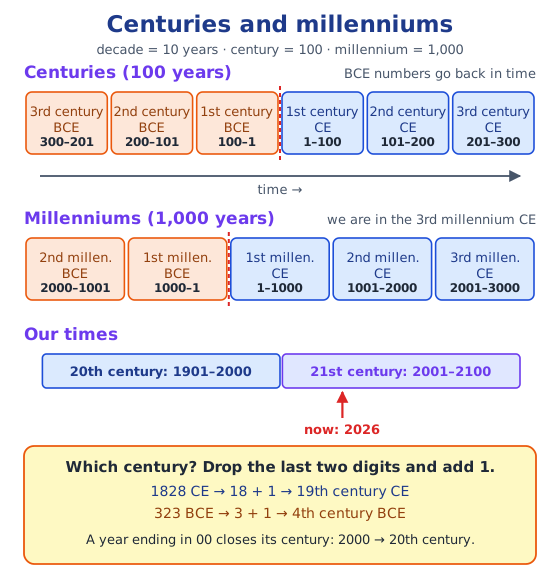
- A decade is a period of 10 years.
- A century is any period of 100 years. In history, centuries CE are counted from 1 CE: the 1st century CE is 1 to 100 CE, and the 21st century CE runs from 2001 to 2100. Centuries BCE are counted back from 1 BCE: the 1st century BCE is 100 to 1 BCE, and the 3rd century BCE is 300 to 201 BCE.
- A millennium is any period of 1,000 years. We are in the 3rd millennium CE, which began in 2001 CE and goes up to 3000 CE. The 1st millennium BCE is 1000 to 1 BCE. The plural is millenniums or millennia; both are correct.
Quick check (Extra: our own shortcut, not in the book): to find the century of a year, drop the last two digits and add 1. So 1828 is in the 19th century CE and 323 BCE in the 4th century BCE. A year ending in 00 is the last year of its century, so 2000 belongs to the 20th century, which ran from 1901 to 2000.
Putting dates in order
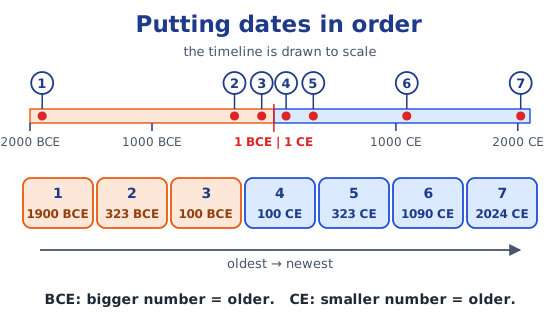
To arrange dates from oldest to newest, write the BCE dates first, starting with the biggest number, and then the CE dates, starting with the smallest: 1900 BCE, 323 BCE, 100 BCE, 100 CE, 323 CE, 1090 CE and 2024 CE.
Calendars from India
Many Indian calendars use the positions of the sun and the moon to define the months of the year. A pañchānga is a book of tables that lists the days of each month along with astronomical data. It predicts events such as solar and lunar eclipses and the times of sunrise and sunset, and it gives the dates and timings of festivals and often weather predictions for the year. Pañchāngas are still widely used in India.
To see how historians find out what happened in these years, read sources of history. For the textbook’s questions, see the Chapter 4 NCERT solutions; for the whole chapter, see the Chapter 4 notes.
Practice
-
Which is the oldest of these dates?
Show answer
Answer: (c) 323 BCE
-
How many years pass from 2 BCE to 2 CE?
Show answer
Answer: (b) 3
-
The year 1828 belongs to the:
Show answer
Answer: (b) 19th century
-
A coin was made in 150 BCE. How old is it in 2026 CE?
Show answer
Answer: 150 + 2026 − 1 = 2,175 years old.
-
Which years make up the 3rd century BCE?
Show answer
Answer: 300 BCE to 201 BCE. Centuries BCE are counted back from 1 BCE: the 1st century BCE is 100 to 1 BCE, the 2nd is 200 to 101 BCE and the 3rd is 300 to 201 BCE.
Questions students ask
What is the full form of BCE and CE?
BCE means Before Common Era and CE means Common Era. They are now used across the world in place of BC (Before Christ) and AD, which comes from a Latin phrase for the years after Jesus' birth.
Is there a year zero?
No. In the Gregorian calendar the year 1 CE comes straight after 1 BCE. That is why, between a BCE date and a CE date, you add the two numbers and subtract 1.
What is the difference between a century and a millennium?
A century is any period of 100 years and a millennium any period of 1,000 years. We live in the 21st century CE (2001 to 2100) and the 3rd millennium CE (2001 to 3000).
Stuck on a question?
Take a photo and Lagnever AI explains it step by step. Try it for 7 days for ₹2.
Get it on Google Play Open in browser
For parents: after the trial, the plan renews monthly by UPI or card autopay. You can cancel anytime in the app.