
Class 6 Social Science Chapter 6: The Beginnings of Indian Civilisation Notes
This chapter in five lines
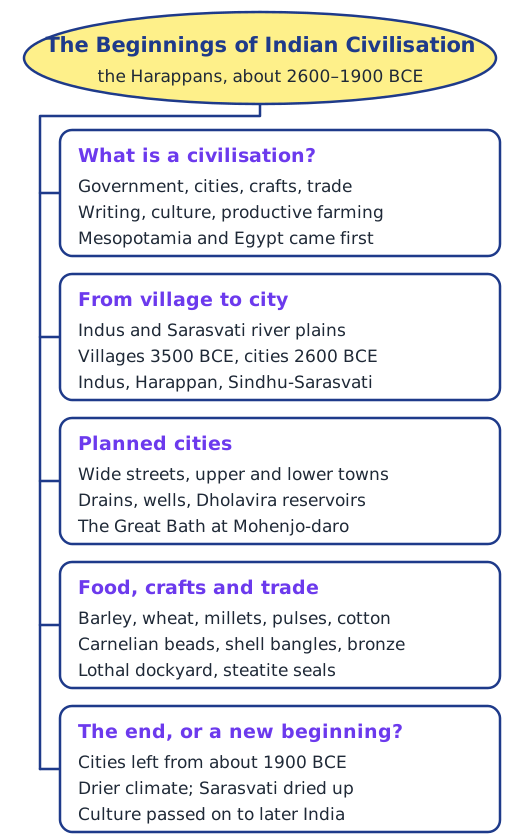
The Beginnings of Indian Civilisation is about India's earliest civilisation, called the Harappan, Indus or Sindhu-Sarasvatī civilisation. In the northwest, villages grew into towns from about 3500 BCE and into planned cities around 2600 BCE. The Harappans built drains, wells and reservoirs, grew barley, wheat and cotton, traded by land, river and sea, and used seals. From about 1900 BCE, a drier climate and the drying up of the Sarasvatī led people back to village life.
What is a civilisation?
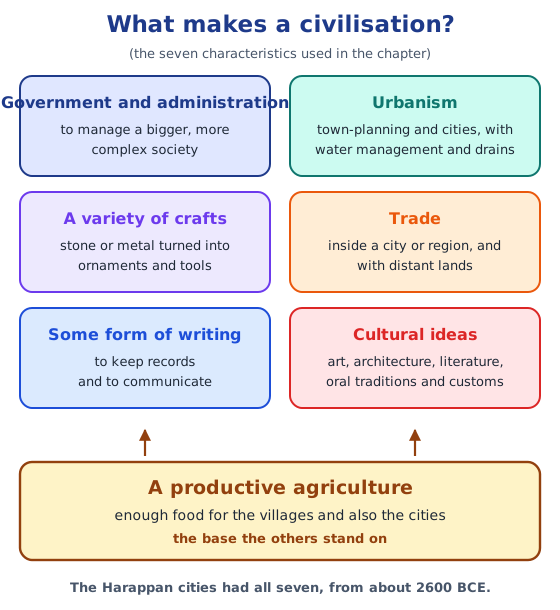
The chapter opens with the archaeologist B.B. Lal, who saw the Harappans as a well-balanced community in which the gap between rich and poor was not glaring, a society of mutual ‘accommodation’ rather than ‘exploitation’. It then asks what a civilisation is. In general the word means an advanced stage of human society. The book takes it to need at least seven things: some form of government and administration, urbanism (planned cities with water management and drains), a variety of crafts, internal and external trade, some form of writing, cultural ideas, and a productive agriculture that feeds the villages and the cities too.
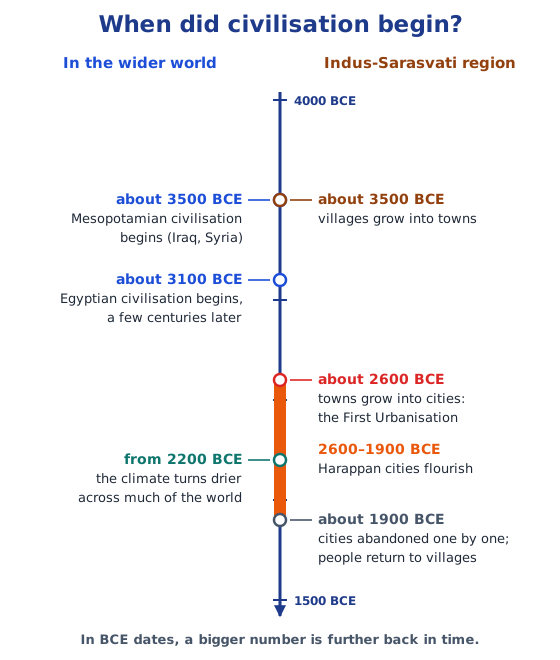
Civilisation began at different times in different places: in Mesopotamia (modern Iraq and Syria) about 6,000 years ago, and in Egypt a few centuries later. In the Indian Subcontinent, the story begins in the northwest.
From village to city
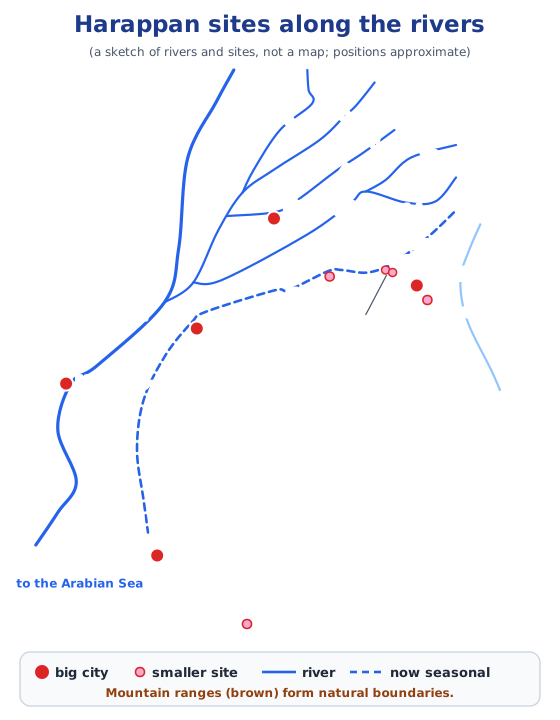
The plains of the Punjab and Sindh are watered by the Indus and its tributaries, which made them fertile. A little further east, a few millenniums ago, the Sarasvatī flowed from the Himalayan foothills through Haryana, Punjab, parts of Rajasthan and Gujarat. In this region, villages grew into towns from about 3500 BCE, and with growing trade the towns became cities around 2600 BCE. This is called the First Urbanisation of India, and the cities flourished till about 1900 BCE.
Archaeologists call it the Indus, Harappan, Indus-Sarasvatī or Sindhu-Sarasvatī civilisation, and its people the Harappans, because Harappa (now in Pakistan’s Punjab) was its first city to be excavated, in 1920–21. It is one of the oldest civilisations in the world.
The Sarasvatī is first mentioned in the Ṛig Veda, as a goddess and as a river flowing ‘from the mountain to the sea’; later texts describe it drying up. Today it is the seasonal Ghaggar in India and Hakra in Pakistan. Its basin had the big cities of Rakhigarhi and Ganweriwala, smaller cities such as Farmana and Kalibangan, and towns such as Bhirrana and Banawali. Since the sites spread so far beyond the Indus, the old term ‘Indus Valley civilisation’ is now obsolete.
Planned cities and water
Harappa and Mohenjo-daro were identified in 1924; Dholavira (Gujarat), Rakhigarhi (Haryana), Ganweriwala and hundreds of smaller sites such as Lothal followed. The larger cities were built to precise plans, with wide streets facing the cardinal directions, fortifications, an upper town for the local elite and a lower town for common people. Small and big houses were built with the same care, mostly of bricks. Drains below the streets carried waste water away, Mohenjo-daro drew water from hundreds of brick wells, and Dholavira built at least six large reservoirs. The famous Great Bath at Mohenjo-daro is still a puzzle. Read more in town planning in Harappan cities.
Food, crafts and trade
Settling along rivers gave water and fertile soil. The Harappans grew barley, wheat, millets and sometimes rice, with pulses and vegetables, and were the first in Eurasia to grow cotton. They used the plough; a small clay model comes from Banawali. They kept animals, fished in rivers and the sea, and their cooking pots held dairy products, turmeric, ginger and even banana.
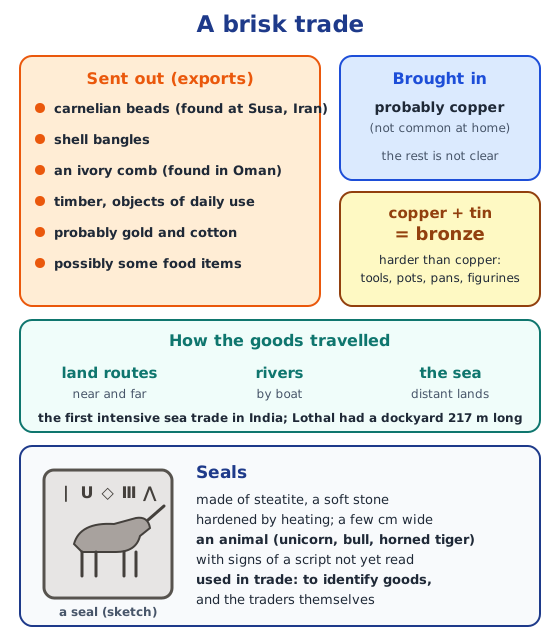
They traded within their own civilisation and with other cultures, by land, river and sea, the first intensive sea trade in India. They exported ornaments, especially beads of carnelian, a reddish stone found mostly in Gujarat; shell bangles; timber; objects of daily use; and probably gold and cotton. They probably imported copper, and by adding tin they made harder bronze. Lothal’s basin, 217 metres long, was probably a dockyard. Thousands of small seals of steatite, with an animal and a few signs of a script still not understood, helped traders identify their goods and each other.
The lives of the ancients
Archaeologists have found objects of daily use, such as a bronze mirror, a terracotta pot, stone weights, a bronze chisel, a gamesboard and a terracotta whistle, along with cultural and symbolic objects: the statuette often called the ‘Priest King’, a seal with a swastika, the three-faced figure on the Pashupati Seal, the bronze ‘Dancing Girl’ from Mohenjo-daro, a figurine seated in a ‘namaste’, and a pot from Lothal that seems to tell the story of the thirsty crow.
The end, or a new beginning?
Around 1900 BCE the cities were abandoned one by one, and people scattered into small villages. There is no trace of warfare or invasion; the Harappans do not seem to have kept armies. Two causes are now agreed: a drier climate that affected much of the world from 2200 BCE, and the Sarasvatī drying up in its central basin, which emptied cities such as Kalibangan and Banawali. Much of the Harappan culture and technology lived on into the next phase of Indian civilisation.
Read more in the Harappan civilisation. Answers to every question are in the NCERT solutions for Chapter 6.
Key terms
| Term | Meaning |
|---|---|
| Civilisation | An advanced stage of human society, with government, cities, crafts, trade, writing, cultural ideas and a productive agriculture. |
| Urbanism | Town-planning and the growth and management of cities, generally including water management and drains. |
| Metallurgy | The techniques of extracting metals from nature, purifying or combining them, and the scientific study of metals. |
| Tributary | A river that flows into a larger river or lake, as the Yamuna flows into the Ganga. |
| Harappans | The people of this civilisation, named after Harappa, the first of its cities to be excavated, in 1920–21. |
| First Urbanisation | The growth of the first cities in India, around 2600 BCE, in the Indus and Sarasvatī river region. |
| Fortification | A massive wall around a settlement or city, generally built for protection. |
| Elite | The higher layers of society, such as rulers, officials, administrators and often priests. |
| Reservoir | A large natural or artificial place where water is stored; Dholavira's largest was 73 metres long. |
| Dockyard | A structure used to receive and send boats; Lothal's basin, 217 metres long, was probably one. |
| Seal | A small carved piece of steatite, a few centimetres wide, showing an animal and a few signs, used in trade. |
| Bronze | A metal made by adding tin to copper; it is harder than copper and was used for tools, pots and figurines. |
Topics in this chapter
Practice
-
Which city of this civilisation was excavated first, in 1920–21?
Show answer
Answer: (b) Harappa
-
In India today, the Sarasvatī River is known as the:
Show answer
Answer: (a) Ghaggar
-
Lothal's huge basin, 217 metres long, was most likely a:
Show answer
Answer: (c) dockyard
-
Harappan seals were generally made of:
Show answer
Answer: (b) steatite
-
Which two factors are now agreed upon for the decline of the Harappan cities?
Show answer
Answer: (b) A drier climate and the drying up of the Sarasvatī
Questions students ask
What are the main topics of Class 6 SST Chapter 6?
What a civilisation is; how villages grew into the cities of the Harappan or Sindhu-Sarasvatī civilisation; town-planning, the Great Bath and water management; food, crafts, trade and seals; the objects the Harappans left; and why their cities declined after about 1900 BCE.
Is The Beginnings of Indian Civilisation in the new Exploring Society book?
Yes. It is Chapter 6 of Exploring Society: India and Beyond, the Class 6 Social Science textbook (2026-27 session). It comes after Chapter 5, India, That Is Bharat.
How many questions does Chapter 6 have at the end?
The “Questions, activities and projects” section has 8 questions. Our NCERT solutions page answers all of them, along with the Big Questions and every Let's Explore and Think About It box.
Stuck on a question?
Take a photo and Lagnever AI explains it step by step. Try it for 7 days for ₹2.
Get it on Google Play Open in browser
For parents: after the trial, the plan renews monthly by UPI or card autopay. You can cancel anytime in the app.