
The Harappan civilisation
Answer in short
The Harappan civilisation, also called the Indus or Sindhu-Sarasvatī civilisation, was India's earliest civilisation. Its planned cities grew in the northwest around 2600 BCE and flourished till about 1900 BCE. The Harappans farmed barley, wheat and cotton, made beads, bangles and bronze, traded by land, river and sea, and used seals with a script still not understood.
Stuck on a question? Take a photo and Lagnever AI explains it step by step. Try it for 7 days for ₹2. Get it on Google Play
India’s first cities
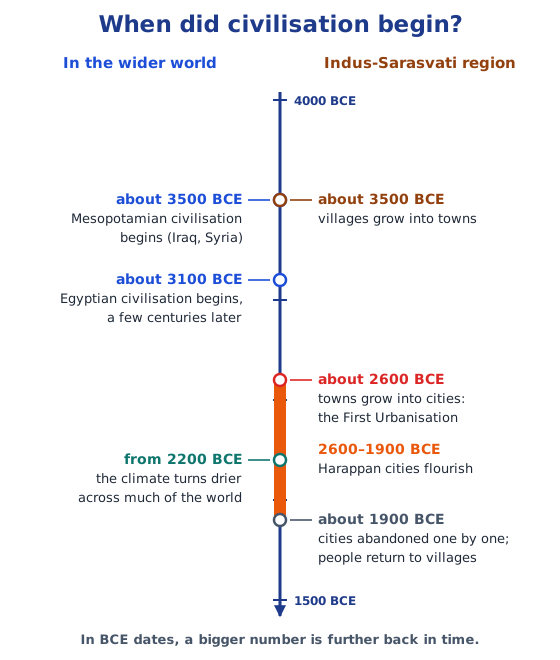
Around 2600 BCE, in the northwest of the Indian Subcontinent, towns that had grown out of villages since about 3500 BCE became cities. This First Urbanisation of India gave rise to one of the oldest civilisations in the world. Its people are called the Harappans, after Harappa, the first of its cities to be excavated, in 1920–21. The cities flourished for about seven centuries, till about 1900 BCE.
One civilisation, many names
| Name | Why it is used |
|---|---|
| Indus | the first sites were found in the Indus plains |
| Harappan | Harappa was the first city excavated |
| Indus-Sarasvatī | many sites also lie along the Sarasvatī |
| Sindhu-Sarasvatī | Sindhu is the Indian name of the Indus |
The book uses all of them. It avoids ‘Indus Valley civilisation’, because the civilisation spread much beyond the Indus region.
Where it grew
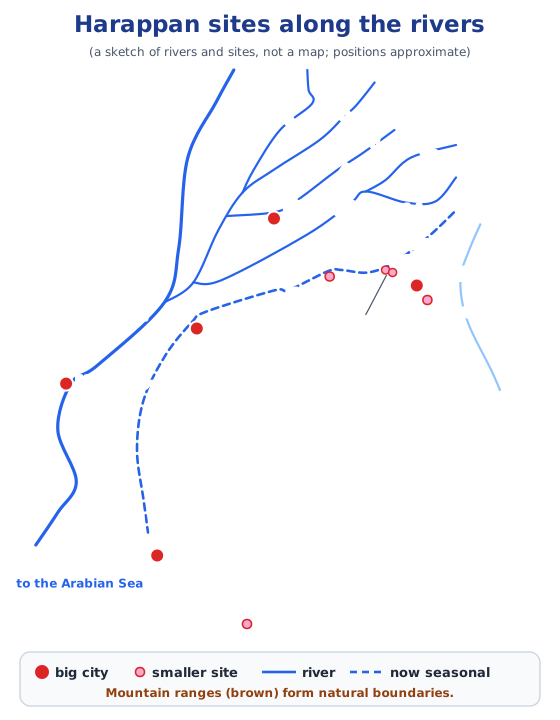
The plains of the Punjab and Sindh are watered by the Indus and its five main tributaries, which made them fertile. Further east flowed the Sarasvatī, from the Himalayan foothills through Haryana, Punjab, parts of Rajasthan and Gujarat; today it is the seasonal Ghaggar-Hakra. The main cities were Harappa and Mohenjo-daro (now in Pakistan), Dholavira (Gujarat), Rakhigarhi (Haryana) and Ganweriwala (in Pakistan’s Cholistan desert), with hundreds of smaller sites such as Lothal in Gujarat and Kalibangan in Rajasthan. Natural boundaries, such as the Himalayas, the Sulaiman Range and the Aravalli Range, frame the region.
What made it a civilisation
- Government and urbanism: cities built to precise plans, with drains, wells and reservoirs that someone had to organise and maintain. See town planning in Harappan cities.
- Agriculture: barley, wheat, millets, sometimes rice, pulses and vegetables, and cotton, which the Harappans were the first in Eurasia to grow. Hundreds of villages fed the cities.
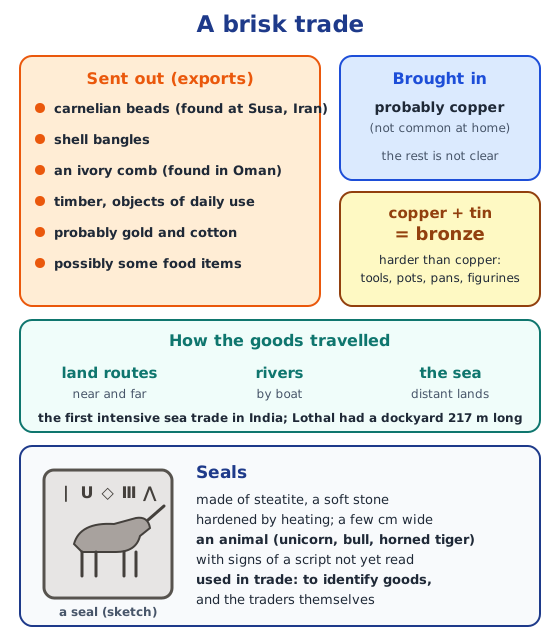
- Crafts: drilled and decorated beads of carnelian, shell bangles, and tools, pots and figurines of bronze, made by adding tin to copper.
- Trade: by land, rivers and the sea, the first intensive sea trade in India. Carnelian beads reached Susa in present-day Iran, and an ivory comb reached the coast of Oman. Lothal had a dockyard 217 metres long.
- Writing: signs carved above animal figures on small steatite seals. The script and the meaning of the animals are not yet understood.
- Cultural ideas: figurines such as the ‘Dancing Girl’, the ‘Priest King’, the Pashupati Seal, games, toys, and a pot that seems to tell the story of the thirsty crow.
A peaceful society?
The Harappans do not seem to have kept armies or weapons of war, and no trace of warfare has been found. The archaeologist B.B. Lal described their society as well balanced, without a glaring gap between rich and poor.
The end, or a new beginning?
From about 1900 BCE the cities were abandoned one by one, and their people spread into small villages, where food and water were easier to get. Two causes are agreed: a climate change from 2200 BCE that brought less rain, and the drying up of the Sarasvatī in its central basin, after which cities such as Kalibangan and Banawali were abandoned. Much of the Harappan culture and technology passed on to the next phase of Indian civilisation.
Answers to the textbook questions are in the NCERT solutions for Chapter 6; see all of Chapter 6 notes.
Practice
-
The Harappans were the first in Eurasia to grow:
Show answer
Answer: (b) cotton
-
Carnelian is a:
Show answer
Answer: (b) reddish semiprecious stone
-
About when did the Harappan towns grow into cities?
Show answer
Answer: (b) 2600 BCE
-
Why are the people of this civilisation called Harappans?
Show answer
Answer: Because Harappa, now in Pakistan's Punjab, was the first city of this civilisation to be excavated, in 1920–21.
-
Give two pieces of evidence that the Harappans traded with distant lands.
Show answer
Answer: Harappan carnelian beads were found at Susa in present-day Iran, and a Harappan ivory comb was found on the coast of Oman. Lothal also had a large dockyard for boats.
Questions students ask
What is the Harappan civilisation?
India's earliest civilisation, in the northwest of the Subcontinent. Its planned cities, such as Harappa, Mohenjo-daro, Dholavira and Rakhigarhi, flourished from about 2600 to 1900 BCE along the Indus, the Sarasvatī and their tributaries.
Why does the Harappan civilisation have several names?
Archaeologists named it after the Indus River, where the first sites were found, after Harappa, the first city excavated, and after both the Indus and the Sarasvatī, since many sites lie along the Sarasvatī. The book uses all these names.
Why did the Harappan cities decline?
From about 1900 BCE the cities were abandoned. A drier climate from 2200 BCE made farming harder, and the Sarasvatī dried up in its central basin. People moved to villages, but much of their culture lived on.
Stuck on a question?
Take a photo and Lagnever AI explains it step by step. Try it for 7 days for ₹2.
Get it on Google Play Open in browser
For parents: after the trial, the plan renews monthly by UPI or card autopay. You can cancel anytime in the app.