
NCERT Solutions Class 6 Social Science Chapter 6: The Beginnings of Indian Civilisation
Answers to the Big Questions, every Let’s Explore and Think About It box and all 8 “Questions, activities and projects” in Chapter 6, The Beginnings of Indian Civilisation, of Exploring Society: India and Beyond (2026-27 session). The page numbers match the book. Imaginative and discussion questions have sample answers; yours may differ. Short notes: Chapter 6 notes.
The Big Questions (page 85)
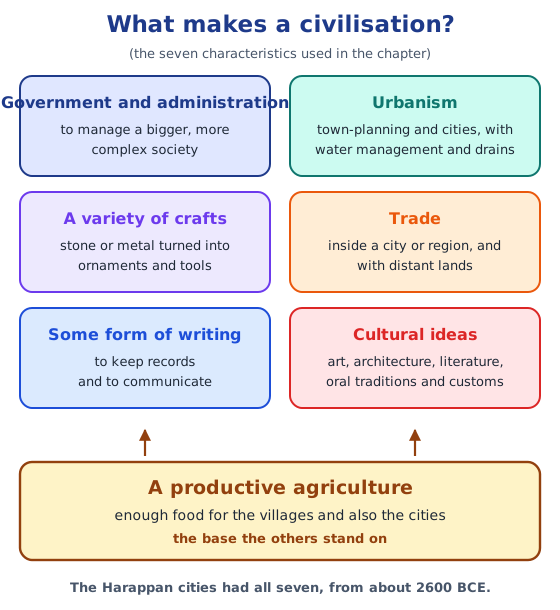
1. What is a civilisation?
An advanced stage of human society. The chapter takes a civilisation to have at least: some form of government and administration; urbanism, that is town-planning, cities and their water management and drainage; a variety of crafts; internal and external trade; some form of writing; cultural ideas expressed through art, architecture, literature, oral traditions or customs; and a productive agriculture that feeds the villages and the cities.
2. What was the earliest civilisation of the Indian Subcontinent?
The Harappan civilisation, also called the Indus, Indus-Sarasvatī or Sindhu-Sarasvatī civilisation. It grew in the northwest, along the Indus, the Sarasvatī and their tributaries; its towns became cities around 2600 BCE, and the cities flourished till about 1900 BCE.
3. What were its major achievements?
Cities built to precise plans; water management with drains, brick wells and Dholavira’s reservoirs; the Great Bath; a productive agriculture, including the first cotton in Eurasia; skilled crafts such as carnelian beads, shell bangles and bronze; trade by land, river and sea, with a dockyard at Lothal; seals with a writing system; and, as far as the evidence goes, a relatively peaceful society.
What is a civilisation? (pages 86–87)
Think About It: the most fundamental characteristic (sample). A productive agriculture. Only when farmers grow more food than they need can other people live in cities and work as rulers, officials, craftspeople, traders or scribes. As the book says, the cities could survive only if enough produce from the villages reached them every day.
Let’s Explore: professions for each characteristic (sample).
| Characteristic | Professions |
|---|---|
| Government and administration | rulers, officials, record keepers, guards |
| Urbanism | planners, brick makers, masons, drain and well cleaners |
| Crafts | bead makers, potters, metalworkers, shell-bangle makers, weavers |
| Trade | merchants, boatmen, porters, people who weigh goods |
| Writing | scribes, seal carvers |
| Cultural ideas | artists, sculptors, priests, storytellers, toy makers |
| Agriculture | farmers, herders, fishers, makers of ploughs |
From village to city (pages 88–91)
Let’s Explore: match the cities with modern states or regions.
| Harappan city | Modern state or region |
|---|---|
| Dholavira | Gujarat |
| Harappa | Punjab (Pakistan) |
| Kalibangan | Rajasthan |
| Mohenjo-daro | Sindh (Pakistan) |
| Rakhigarhi | Haryana |
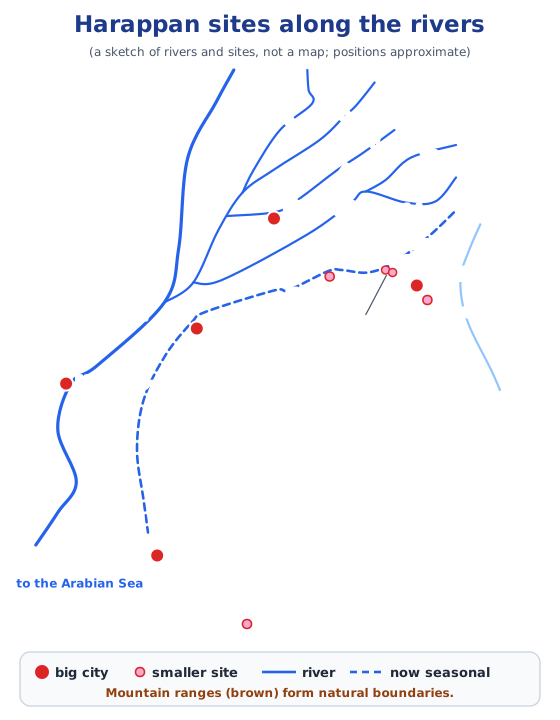
Think About It: why is ‘Indus Valley civilisation’ obsolete? The name fitted when the first sites were found in the Indus plains. The map shows sites far beyond that valley: along the Sarasvatī in Haryana, Punjab and Rajasthan, in Gujarat at Dholavira and Lothal, and even at Shortugai in the far north. A name tied to one river valley is too narrow.
The Great Bath (page 93)
Let’s Explore: debate the last two interpretations (sample points).
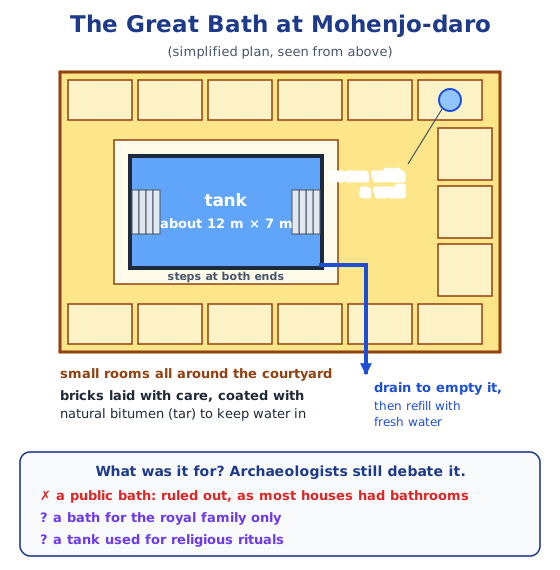
- A bath for the royal family: it stood in the upper town, where the elite probably lived, and its small size suits a small group.
- A tank for religious rituals: its careful waterproofing, its steps and surrounding rooms, and the trouble taken to refill it with fresh water suggest a special purpose, such as ritual bathing.
- Other ideas: a place for ceremonies on special days, or a store of clean water. Without an inscription, a text or a traveller’s account, every idea rests only on the structure itself.
Water management (pages 94–96)
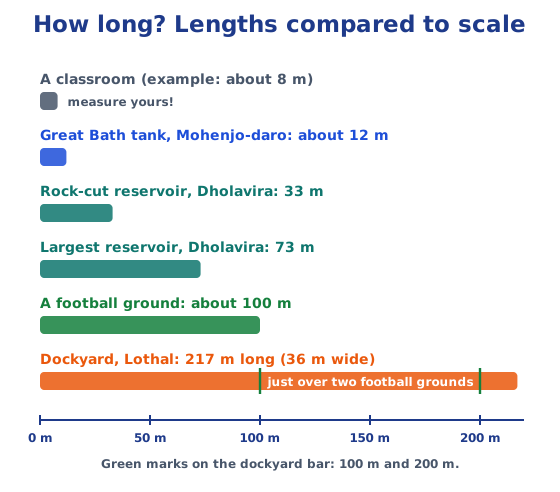
Let’s Explore: compare with Dholavira’s largest reservoir, 73 metres (sample). A classroom about 8 metres long: the reservoir is about 9 times longer (73 ÷ 8 ≈ 9). A corridor 30 metres long: about 2½ times longer. A playground 100 metres long: the reservoir is about three-quarters of it.
Think About It: the workers behind the reservoirs (sample). Engineers or officials working for the ruler or the city probably planned the work and gave precise instructions. With no money as we know it, workers may have been paid in grain, food, cloth or other goods. Since the reservoirs had to be cleaned from time to time, a local authority probably looked after them. All this suggests a ruler able to plan big projects and an organised municipal administration.
Food, trade and seals (pages 96–99)
Let us explore: a Harappan meal (sample). Barley or wheat bread with a dal of pulses flavoured with turmeric and ginger, cooked vegetables, curd or milk, fish for those near a river, and bananas to finish.
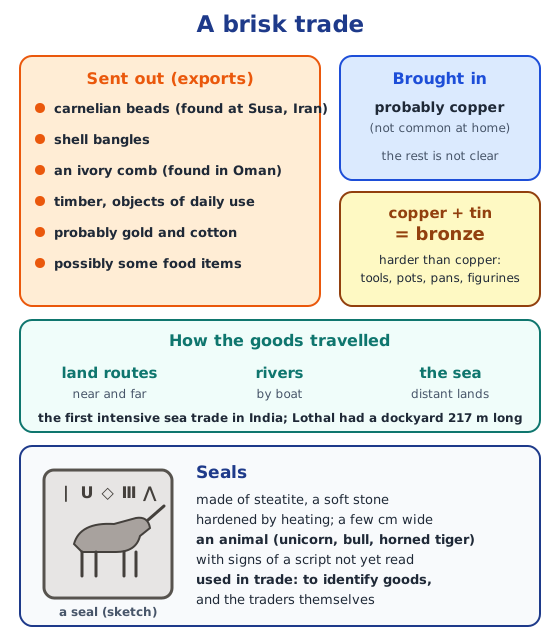
Let’s Explore: the three seals (sample). The unicorn, the bull and the horned tiger might stand for a family, a group of traders or a city, or have a sacred meaning. The signs above them might be the owner’s name or title. Pressed into clay, a seal could have marked whose goods were in a bundle.
The lives of the ancients (pages 100–102)
Think About It: what mattered to the Harappans? Trade and fair weighing (stone weights), crafts and tools (a bronze chisel), cooking and storing (pots), looks and fashion (a bronze mirror, bangles, beads), play (a gamesboard, a whistle), stories (the crow pot) and religious or symbolic life (the ‘Priest King’, the swastika seal, the Pashupati Seal, the namaste figurine).
Let’s Explore: the Lothal pot and the ‘Dancing Girl’ (sample).
- The thirsty crow: the crow finds a pot with a little water at the bottom, drops pebbles in one by one until the water rises, and drinks. The story was probably told by grandparents to children for generation after generation, and later written down.
- The ‘Dancing Girl’: she stands relaxed and confident, a hand on her hip. Her bangles cover an entire arm, and the figure on the Pashupati Seal also seems to wear bangles up its arms. Since women in parts of Gujarat and Rajasthan still wear bangles this way, some customs have lasted more than 4,000 years.
The end, or a new beginning? (pages 102–103)
Think About It. Villages are close to fields and water. When rain failed and rivers dried, city life became hard to support, so people moved to where food and water were easier to get.
Questions, activities and projects (page 104)
1. Why several names?
Indus: the first sites were found in the Indus plains; ‘Indus Valley’ is now obsolete. Harappan: archaeologists often name a culture after its first excavated site, Harappa (1920–21). Indus-Sarasvatī or Sindhu-Sarasvatī: many sites lie along the Sarasvatī, so these names cover both river systems; Sindhu is the Indian name of the Indus. Each name records how the civilisation was discovered and how far it spread.
2. A brief report (sample, about 160 words)
The Indus-Sarasvatī civilisation, from about 2600 to 1900 BCE, built some of the world’s first planned cities. Harappa, Mohenjo-daro, Dholavira and Rakhigarhi had wide streets facing the cardinal directions, fortifications, and separate upper and lower towns. Houses big and small were built with the same care, and covered drains carried waste water away. Mohenjo-daro had hundreds of brick wells and the elaborate Great Bath, while Dholavira cut huge reservoirs into rock to save water in a dry land. Farmers grew barley, wheat, millets, pulses and vegetables, and were the first in Eurasia to grow cotton. Craftspeople drilled carnelian beads, carved shell bangles and made bronze tools. Traders used land routes, rivers and the sea, reaching Iran and Oman, and Lothal had a dockyard 217 metres long. Steatite seals carried a script we still cannot read. The society seems to have been peaceful, with no sign of armies. Even after the cities declined, much of this culture lived on in India.
3. From Harappa to Kalibangan (sample)
The two sites are about 180 km apart in a straight line (more by any real route).
| Option | Rough time |
|---|---|
| On foot, about 25 km a day | 8–10 days |
| Bullock cart, about 20–30 km a day | about a week |
| Boat for part of the way | depends on the rivers; none links the two directly |
| Today, by car, about 60 km an hour | 4–5 hours of driving |
Today the India–Pakistan border also lies between them, so the real journey would be much longer.
4. A Harappan in a modern kitchen (sample)
- A gas stove that lights with a click, with no wood to gather.
- Water from a tap, and a refrigerator that keeps food cold.
- Steel and plastic vessels, and a pressure cooker that whistles.
- Potatoes, tomatoes and chillies, which reached India from the Americas only in the last 500 years or so (Extra).
- A mixer-grinder and packets of ready food.
Familiar things would be wheat, barley, dal, milk products, turmeric, ginger, bananas and clay pots.
5. Still familiar in the 21st century
Bangles worn up the whole arm, the namaste gesture, the swastika symbol, bead necklaces and shell bangles, a bronze mirror, a comb, clay pots, board games, clay whistles and toys, stone weights for weighing, the plough, and the story of the thirsty crow.
6. The mindset behind Dholavira’s reservoirs
Planning ahead and saving every drop of water in a dry region; working together on a big shared project; skill in engineering and in cutting stone; and the discipline to keep the reservoirs clean and repaired. Water was treated as precious and shared.
7. About 700 brick wells at Mohenjo-daro (discussion points)
- Most people had clean water close to home, which helped health and hygiene and explains why many houses had their own bathrooms.
- Building and repairing so many wells needed skilled masons and some authority or neighbourhood groups to organise the work.
- Using them for several centuries shows that the city was stable, and that people cared for shared things over many generations.
8. A high civic sense? (discussion points)
The evidence supports it: drains that carried waste water away, wells and reservoirs that were maintained, planned streets, and houses of equal quality. One may agree, while remembering that archaeologists judge only from what remains. In many large Indian cities today, open drains, garbage on roads and wasted water show weaker civic sense, though cities that keep winning cleanliness awards, such as Indore, show what citizens and a municipality can do together (Extra).
Read more in the Harappan civilisation and town planning in Harappan cities.
Practice
-
The largest reservoir at Dholavira measured about:
Show answer
Answer: (c) 73 metres
-
Which metal do you get when tin is added to copper?
Show answer
Answer: (c) Bronze
-
Kalibangan is in today's:
Show answer
Answer: (b) Rajasthan
-
Why is a public bath now ruled out as the purpose of the Great Bath?
Show answer
Answer: Because most houses in Mohenjo-daro had their own bathrooms.
-
Name the two major cities of the Sarasvatī basin.
Show answer
Answer: Rakhigarhi (in Haryana) and Ganweriwala (in the Cholistan desert of Pakistan).
Stuck on a question?
Take a photo and Lagnever AI explains it step by step. Try it for 7 days for ₹2.
Get it on Google Play Open in browser
For parents: after the trial, the plan renews monthly by UPI or card autopay. You can cancel anytime in the app.