
Class 7 Maths Chapter 3: A Peek Beyond the Point Notes
This chapter in five lines
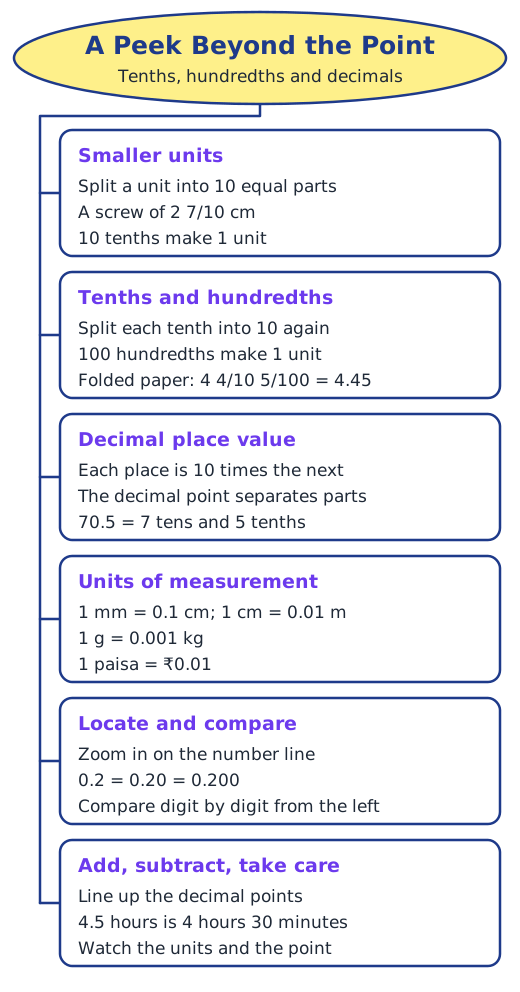
A Peek Beyond the Point introduces decimals. When a unit is too big to measure something exactly, we split it into 10 tenths, each tenth into 10 hundredths, and so on. The decimal point extends the Indian place value system to these parts, so 7.05 means 7 units and 5 hundredths. The chapter shows how to read, convert, locate, compare, add and subtract decimals.
What is this chapter about?
Sonu watches his mother fix a toy. One screw does not fit, the next one does, yet the two look the same. Measured on a fine ruler, they turn out to differ by a few tenths of a centimetre. This chapter is about such small parts of a unit, and about the notation that lets us write them: decimals.
Smaller units: tenths
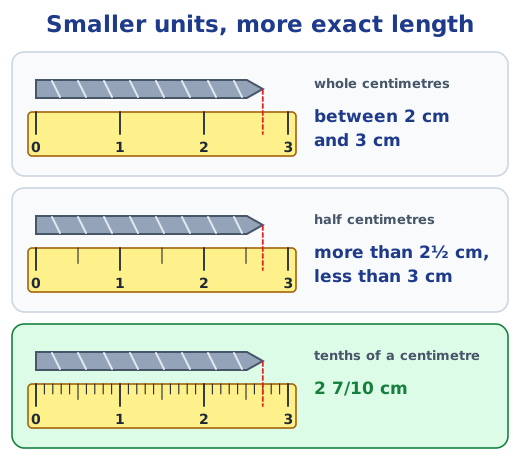
On a ruler marked only in whole centimetres, a screw might lie “between 2 cm and 3 cm”. With each centimetre split into 10 equal parts, we can say exactly where it ends: 2 cm and 7 of those parts, written 2 7/10 cm and read two and seven-tenth centimetres. Each part is a tenth, and 10 tenths make a unit, so a pencil 3 4/10 units long is also 34 tenths, or 34/10 units. Lengths in tenths can be added and subtracted part by part, regrouping 10 tenths as 1 unit. Read more in tenths and hundredths.
Hundredths
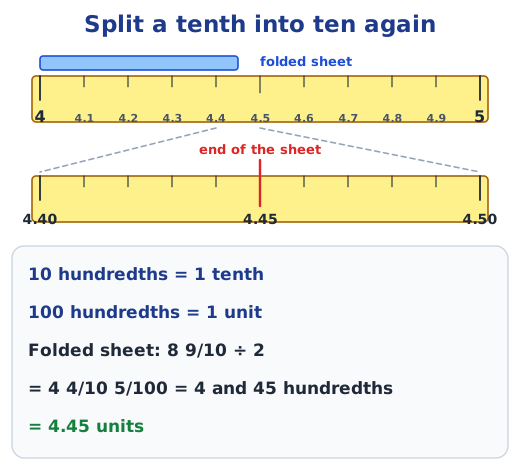
A paper 8 9/10 units long folded in half ends between 4 4/10 and 4 5/10. Splitting each tenth into 10 again gives hundredths, and 100 of them make a unit. Now the folded paper reads exactly 4 4/10 5/100: 4 units, 4 tenths and 5 hundredths, which is also 4 units and 45 hundredths.
Decimal place value and notation
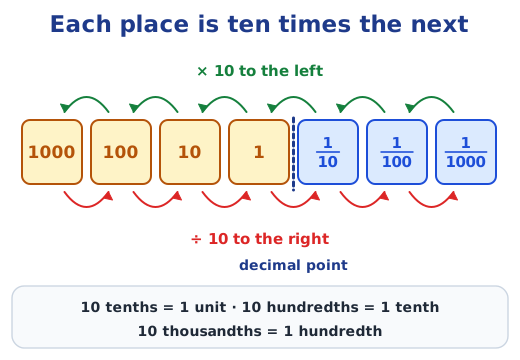
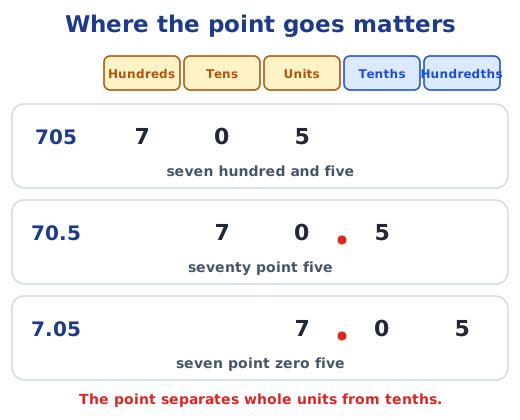
Why split into 10? In the Indian place value system each place is 10 times the one to its right. Continuing to the right of the units gives tenths, hundredths, thousandths and so on, the decimal system (Latin decem, ten, related to Sanskrit dasha). To show where the whole part ends, we use a decimal point: 705 is 7 hundreds and 5 ones, 70.5 is 7 tens and 5 tenths, and 7.05 is 7 units and 5 hundredths. We read 70.5 as seventy point five and 0.274 as zero point two seven four.
Decimals in everyday units
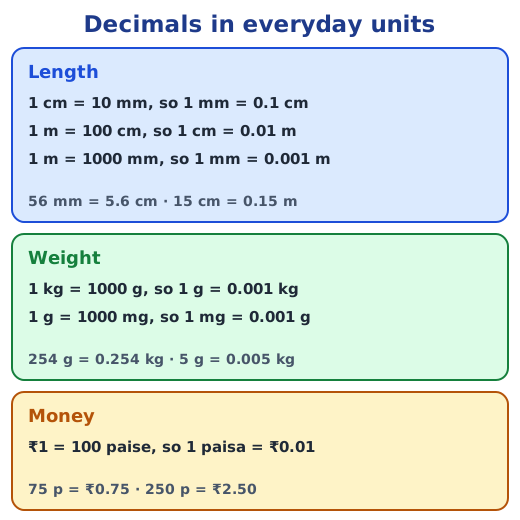
Units of measurement are full of decimals. Since 1 cm = 10 mm, 1 mm = 0.1 cm and 56 mm = 5.6 cm. Since 1 m = 100 cm, 1 cm = 0.01 m and 15 cm = 0.15 m. Since 1 kg = 1000 g, 1 g = 0.001 kg and 254 g = 0.254 kg. And since ₹1 = 100 paise, 75 paise = ₹0.75. Heaps of rice of 1 g, 10 g, 100 g, 1 kg and 10 kg together weigh 11.111 kg, one digit in each place.
Locating and comparing decimals
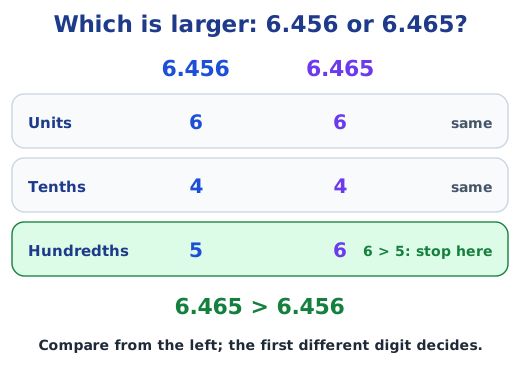
On a number line, 1.4 is the 4th of the 10 marks between 1 and 2, and zooming into the gap between 1 and 1.1 shows 1.01, 1.02 and so on. Zeros at the right end change nothing (0.2 = 0.20 = 0.200), but 0.02 and 0.002 are smaller. To compare, look at the digits place by place from the left: 6.465 is greater than 6.456 because its hundredths digit is larger. Read comparing decimals.
Adding and subtracting decimals
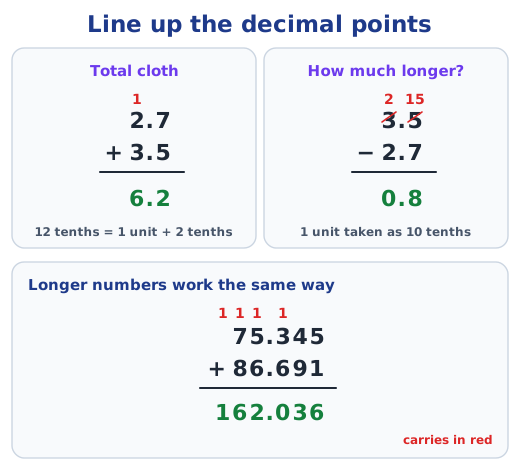
Priya needs 2.7 m of cloth and Shylaja 3.5 m. Written in columns with the points lined up, 2.7 + 3.5 = 6.2 m and 3.5 − 2.7 = 0.8 m, with carrying and borrowing exactly as for whole numbers. Estimating first helps catch mistakes: the sum of two decimals is more than the sum of their whole parts and less than that sum plus 2. See adding and subtracting decimals.
Take care with the point
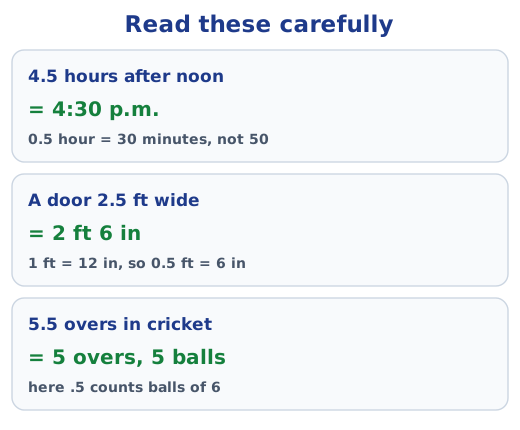
Decimal mistakes can be costly: in 2013 a city council in Amsterdam paid out €188 million instead of €1.8 million because cents were read as euros, and reading 0.05 mg of a medicine as 0.5 mg means ten times the dose. Some numbers only look like decimals: 4.5 hours is 4 hours 30 minutes, a door 2.5 ft wide is 2 ft 6 in, and 5.5 overs in cricket is 5 overs and 5 balls. Decimal fractions appear in ancient Indian works such as those of Shridharacharya, and the point as a separator spread from the 16th century.
Answers to every question, the Figure it Out exercises and the puzzles are in the NCERT solutions for Chapter 3.
Key terms
| Term | Meaning |
|---|---|
| Tenth | One of 10 equal parts of a unit, written 1/10 or 0.1. Ten tenths make one unit. |
| Hundredth | One of 100 equal parts of a unit, written 1/100 or 0.01. Ten hundredths make one tenth. |
| Thousandth | One of 1000 equal parts of a unit, written 1/1000 or 0.001. Ten thousandths make one hundredth. |
| Decimal point | The dot written just after the units digit, marking where the whole number ends and the parts smaller than one begin, as in 70.5. |
| Decimal place value | Each place is 10 times the place to its right: thousands, hundreds, tens, units, then tenths, hundredths and thousandths. |
| Decimal system | Writing numbers in places based on 10. The Latin decem means ten, related to the Sanskrit dasha. |
| Decimal fraction | A fraction whose denominator is 10, 100, 1000 and so on, such as 7/10 or 45/100. |
| Mixed number | A whole number and a fraction together, such as 2 7/10, which is 2.7 in decimal form. |
| Number line zoom | Splitting the gap between two marks into 10 to locate a decimal more exactly, as in finding 4.185. |
Topics in this chapter
Practice
-
How many hundredths make one tenth?
Show answer
Answer: (b) 10
-
What is 7 tens and 5 tenths in decimal form?
Show answer
Answer: (c) 70.5
-
How many metres is 15 cm?
Show answer
Answer: (c) 0.15 m
-
Which is the largest?
Show answer
Answer: (a) 0.2
-
What is 3.5 − 2.7?
Show answer
Answer: (b) 0.8
-
A bus arrives 4.5 hours after noon. At what time?
Show answer
Answer: (c) 4:30 p.m.
Questions students ask
What are the main topics of Class 7 Maths Chapter 3?
The need for smaller units; tenths and hundredths of a unit; decimal place value and the decimal point; reading and writing decimals; decimals in units of length, weight and money; locating and comparing decimals on number lines; adding and subtracting decimals; and decimal mistakes and decimal-looking numbers, with a short history of decimal notation.
Is A Peek Beyond the Point in the new Ganita Prakash book?
Yes. It is Chapter 3 of Ganita Prakash, the Class 7 Maths textbook Part 1 (Reprint 2026-27), on pages 46 to 80. It starts with Sonu noticing that two screws that look the same differ slightly in length.
Why do we split a unit into 10 parts and not 4 or 8?
We could split it into any number of equal parts, but 10 fits the Indian place value system, where each place is 10 times the next. Splitting a unit into tenths, hundredths and thousandths simply carries the same pattern to the right of the units place, so the decimal point is all we need to write these parts.
Is 0.2 the same as 0.20?
Yes. Both mean 2 tenths: 0.20 is 2 tenths and 0 hundredths. Zeros added at the right end of a decimal do not change its value. But a zero between the point and the digit does: 0.02 is 2 hundredths, ten times smaller than 0.2.
Stuck on a question?
Take a photo and Lagnever AI explains it step by step. Try it for 7 days for ₹2.
Get it on Google Play Open in browser
For parents: after the trial, the plan renews monthly by UPI or card autopay. You can cancel anytime in the app.