
Comparing decimals on the number line
Answer in short
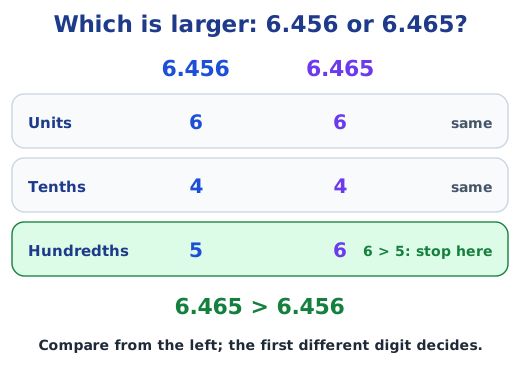
To compare two decimals, compare their digits place by place from the left: units, then tenths, then hundredths. The first place where the digits differ decides, and the number with the larger digit there is greater, so 6.465 > 6.456. On a number line the greater decimal lies further right. Zeros at the right end change nothing.
Stuck on a question? Take a photo and Lagnever AI explains it step by step. Try it for 7 days for ₹2. Get it on Google Play
Decimals on a number line
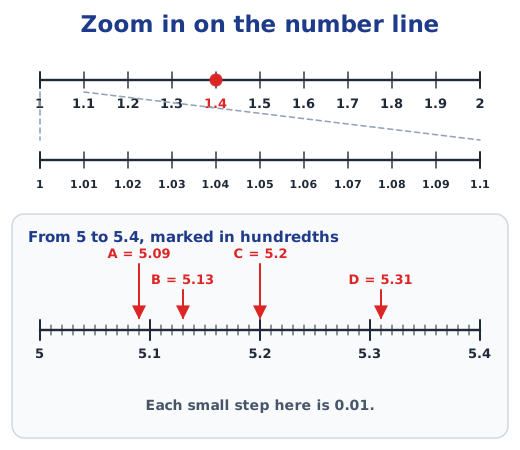
The decimal 1.4 is 1 unit and 4 tenths, so it lies between 1 and 2. To mark it, split the gap from 1 to 2 into 10 equal parts and count 4 parts from 1. The marks are 1.1, 1.2 and so on up to 1.9, and the tenth mark is 2.
Every small gap can be split again. Between 1 and 1.1 there are 9 marks in hundredths: 1.01, 1.02 and so on up to 1.09. On a line from 5 to 5.4 drawn in hundredths, a point one step before 5.1 is 5.09, a point three steps after 5.1 is 5.13, and a point one step after 5.3 is 5.31.
Zooming in
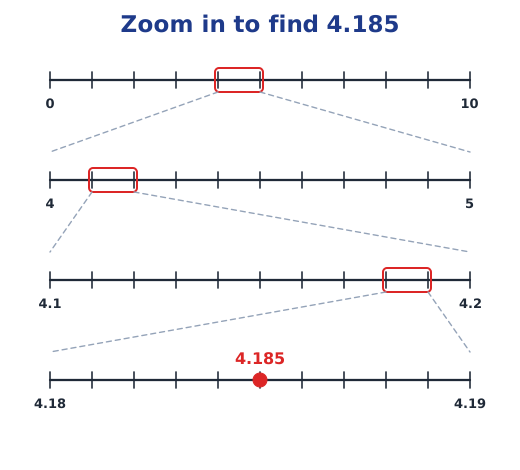
To find a number with three decimal places, such as 4.185, zoom in one place at a time. On a line from 0 to 10, 4.185 lies between 4 and 5. Magnify that unit and split it into tenths: the number lies between 4.1 and 4.2. Magnify that tenth and split it into hundredths: it lies between 4.18 and 4.19. One more split into thousandths, and 4.185 is the middle mark. The same steps locate 9.876 (between 9 and 10, then 9.8 and 9.9, then 9.87 and 9.88) or 0.407.
Not every number line is split into tenths of a unit. If the gap from 5 to 10, which is 5 units, is split into 10 equal parts, then each part is half a unit. The marks are 5.5, 6, 6.5 and so on, so the 3rd mark after 5 is 6.5 and the 5th is 7.5. Always work out the size of one division before reading a mark.
The zero dilemma
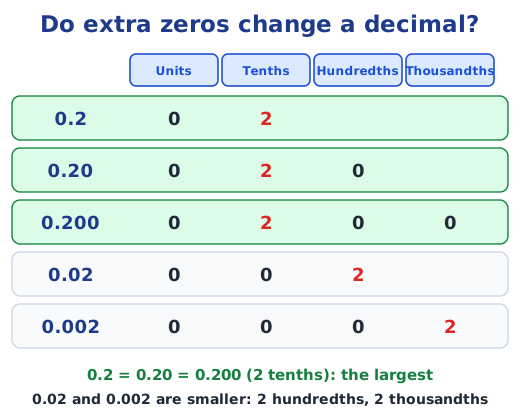
Sonu says 0.2 can be written as 0.20 or 0.200. Zara worries that zeros on the right might change the value. A place value table settles it: 0.2, 0.20 and 0.200 all have 2 in the tenths place and nothing else, so they are equal. But 0.02 has its 2 in the hundredths place and 0.002 in the thousandths place, so they are smaller: 0.2 is the largest and 0.002 the smallest.
So in the list 4.5, 4.05, 0.405, 4.050, 4.50, 4.005 and 04.50, the equal ones are 4.5 = 4.50 = 04.50 and 4.05 = 4.050, while 0.405 and 4.005 stand alone.
Comparing digit by digit
Which is larger, 6.456 or 6.465? Both have 6 units. Both have 4 tenths. In the hundredths, the first has 5 and the second 6, so 6.465 is larger, and we can stop. The digits that follow can never change this: whatever comes after the hundredths is worth less than one hundredth in all, so it cannot make up a gap of a full hundredth. This is the same rule used for whole numbers: compare the most significant digits first.
Line up the points before comparing. 13.800 is greater than 3.81, because it has a tens digit and 3.81 has none. 1.090 is greater than 1.009, because they first differ in the hundredths, where 9 beats 0. A number with more digits is not always larger: 2.05 < 2.5.
Which decimal is closest?
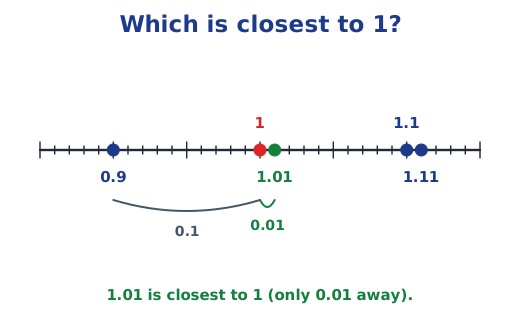
Which of 0.9, 1.1, 1.01 and 1.11 is closest to 1? In order they are 0.9 < 1 < 1.01 < 1.1 < 1.11. The nearest neighbours of 1 are 0.9, which is 1/10 away, and 1.01, which is only 1/100 away, so 1.01 is the closest. In the same list, 1.1 is closest to 1.09, being only 0.01 away from it.
Why it matters
Prices, race times and measurements are compared as decimals every day. What each place means is explained in tenths and hundredths, and how to work out sums and differences in adding and subtracting decimals. Answers to every question, including the digit puzzles, are in the NCERT solutions for Chapter 3; see all of the Chapter 3 notes.
Practice
-
Which is the greatest: 3.09, 3.9, 3.099 or 3.19?
Show answer
Answer: (b) 3.9
-
Which of these is equal to 7.3?
Show answer
Answer: (b) 7.300
-
Which is closest to 2?
Show answer
Answer: (c) 2.02
-
The gap from 3 to 4 on a number line is split into 10 equal parts. What is the 7th mark, and what lies halfway between the 7th and 8th marks?
Show answer
Answer: The 7th mark is 3.7. Halfway between 3.7 and 3.8 is 3.75: split that tenth into 10 hundredths and take the 5th.
-
Arrange 5.06, 5.6, 5.066 and 5.006 in ascending order.
Show answer
Answer: All have 5 units. In the tenths, 5.6 has 6 and the rest 0, so 5.6 is the largest. In the hundredths, 5.006 has 0, the smallest. Then 5.06 = 5.060 < 5.066. So 5.006 < 5.06 < 5.066 < 5.6.
Questions students ask
How do you compare two decimal numbers?
Start with the digits of the highest place value. If they are equal, move one place to the right and compare again, and keep going until two digits differ. The number with the larger digit at that place is greater. For 1.009 and 1.090, the units and tenths match, but 9 hundredths beats 0 hundredths, so 1.090 is greater.
Do zeros at the end change a decimal?
No. 0.2, 0.20 and 0.200 all mean 2 tenths, because the extra zeros only add 0 hundredths and 0 thousandths. Zeros between the point and a digit do matter: 0.02 is 2 hundredths and 0.002 is 2 thousandths, so 0.2 > 0.02 > 0.002. A zero at the far left, as in 04.50, changes nothing either.
How do you show 4.185 on a number line?
Zoom in step by step. Mark 4 on a line from 0 to 10. Split the gap from 4 to 5 into 10 parts and find the tenth from 4.1 to 4.2. Split that into 10 and find 4.18 to 4.19. Split once more: 4.185 is the 5th of the 10 small marks between 4.18 and 4.19, exactly halfway.
Stuck on a question?
Take a photo and Lagnever AI explains it step by step. Try it for 7 days for ₹2.
Get it on Google Play Open in browser
For parents: after the trial, the plan renews monthly by UPI or card autopay. You can cancel anytime in the app.