
Decimals: tenths and hundredths
Answer in short
A tenth is one of 10 equal parts of a unit, and a hundredth is one of 10 equal parts of a tenth, so 100 hundredths make a unit. The decimal point separates whole units from these parts: 4.45 means 4 units, 4 tenths and 5 hundredths. Splitting by 10 extends the Indian place value system.
Stuck on a question? Take a photo and Lagnever AI explains it step by step. Try it for 7 days for ₹2. Get it on Google Play
Why smaller units?
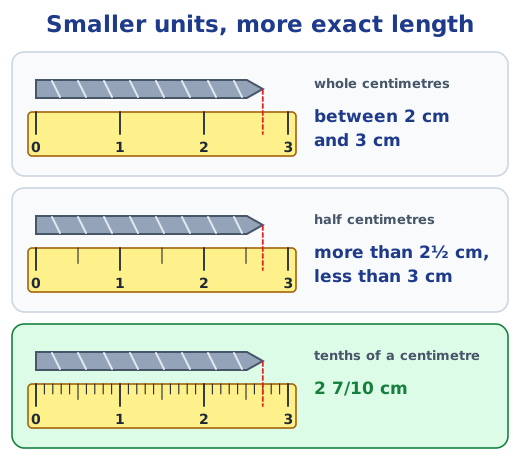
Two screws can look alike and still differ in length, so that only one of them fits. A ruler marked only in whole centimetres can say no more than that a screw ends between 2 cm and 3 cm. Marks at every half centimetre narrow it to more than 2½ cm but less than 3 cm. Only when each centimetre is split into 10 equal parts can we see where it ends: 2 cm and 7 of those small parts. We write this 2 7/10 cm and read it two and seven-tenth centimetres. The second screw measures 3 2/10 cm. Whenever a more exact measure is needed, we use a smaller unit.
Tenths
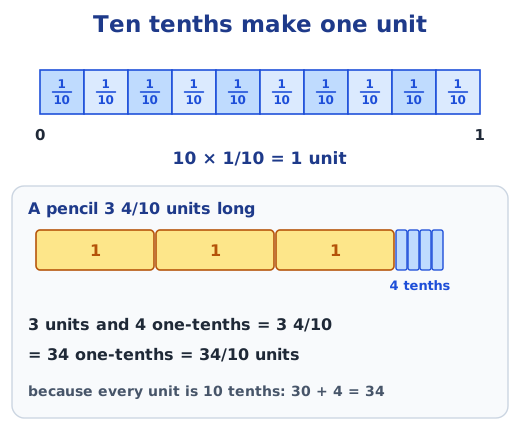
Each of the 10 equal parts of a unit is one-tenth, 1/10, and ten of them make one unit: 10 × 1/10 = 1. A pencil that is 3 4/10 units long is 3 units and 4 one-tenths. Because each unit is itself 10 tenths, the same pencil is 30 + 4 = 34 tenths long, so 3 4/10 = 34/10. Read the numbers carefully: 4 1/10 is four and one-tenth, 4/10 is four-tenths, 41/10 is forty-one tenths and 41 1/10 is forty-one and one-tenth. Putting 4/10, 4 1/10, 41/10 and 41 1/10 in order, the middle two are equal: 4/10 < 4 1/10 = 41/10 < 41 1/10.
Tenths are added and subtracted just like ones and tens. Join a ribbon of 2 7/10 m to one of 3 6/10 m: that is 5 units and 13 tenths, and since 10 tenths make a unit, the total is 6 3/10 m. To take 6 7/10 from 12 4/10, there are not enough tenths, so one unit of the 12 is changed into 10 tenths, giving 11 units and 14 tenths; then 14 − 7 = 7 tenths and 11 − 6 = 5 units, so the difference is 5 7/10.
Hundredths
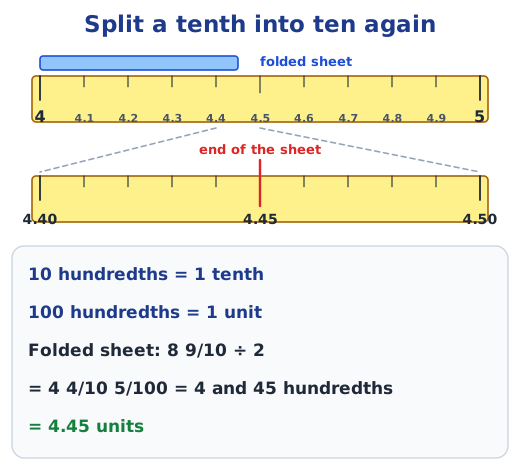
A strip of paper 8 9/10 units long is folded in half. Its new length lies between 4 4/10 and 4 5/10, but a tenths ruler cannot say exactly where. So we split each tenth into 10 parts again. Ten tenths in a unit, each split into ten, makes 100 small parts, so each part is one-hundredth, 1/100, of a unit. The folded paper ends at 4 4/10 5/100: 4 units, 4 tenths and 5 hundredths. Since 10 hundredths make a tenth, this is also 4 units and 45 hundredths.
One length can be written in several ways. A wire of 1 1/10 4/100 units is also 1 14/100 units, and also 114/100 units.
Why split into 10?
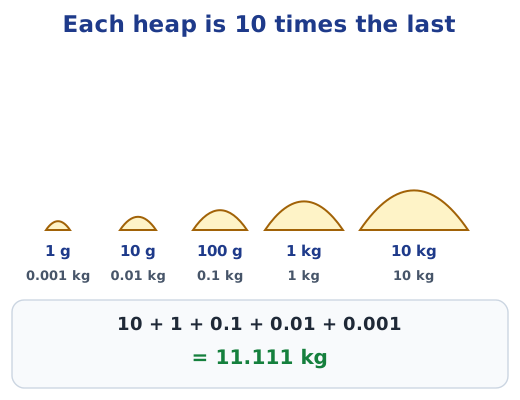
A unit could be split into 4 equal parts, or 16, or any other number. We choose 10 because of the Indian place value system: in 281 the 2 stands for hundreds, the 8 for tens and the 1 for ones, and each place is 10 times the place on its right. Dividing 1 by 10 gives the next place, tenths; dividing again gives hundredths, then thousandths, and so on without end. This is the decimal system, named from the Latin decem, ten, a word related to the Sanskrit dasha.
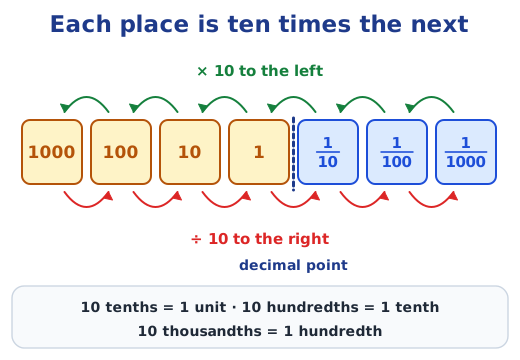
So 1000 thousandths make a unit, 100 thousandths make a tenth and 10 thousandths make a hundredth. Going the other way, 100 tenths make a ten and 1000 hundredths make a ten.
The decimal point
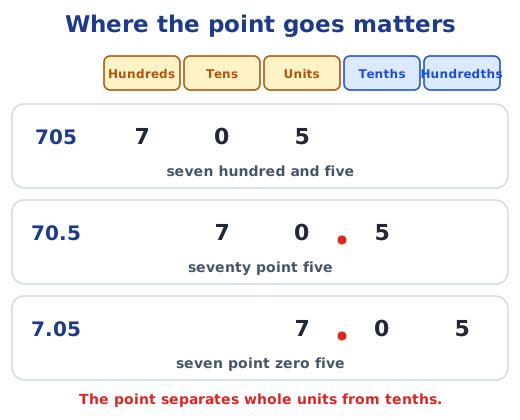
We write 456 instead of 4 hundreds + 5 tens + 6 ones. If we also drop the words for tenths, 705 could mean 7 hundreds and 5 ones, or 7 tens and 5 tenths, or 7 units and 5 hundredths. A decimal point after the units place removes the doubt: these are 705, 70.5 and 7.05. 70.5 is read seventy point five, 7.05 is seven point zero five, and 0.274 is zero point two seven four. Large counts of small parts convert easily: 234 tenths = 20 + 3 + 4/10 = 23.4, and 105 tenths = 10.5.
Decimals in units of measurement
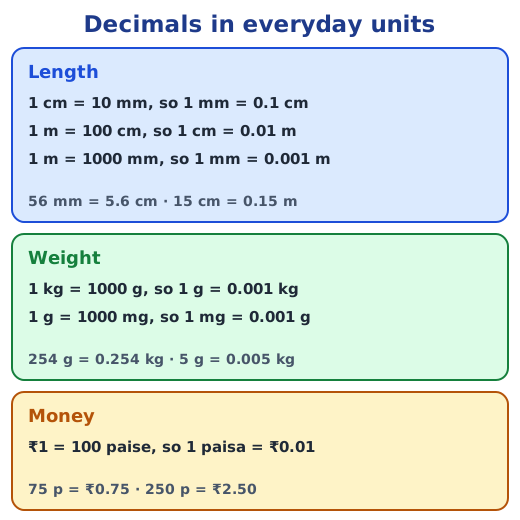
Everyday units follow the same pattern. A centimetre is 10 mm, so 1 mm = 0.1 cm, 5 mm = 0.5 cm and 12 mm = 1.2 cm. A metre is 100 cm, so 1 cm = 0.01 m and 36 cm = 0.36 m; a metre is also 1000 mm, so 1 mm = 0.001 m. A kilogram is 1000 g, so 1 g = 0.001 kg and 465 g = 0.465 kg, and a gram is 1000 mg. A rupee is 100 paise, so 1 paisa = ₹0.01 and 36 paise = ₹0.36. Coins of 25 paise and less went out of use in 2011, but paise still appear in bills and bank statements.
Why it matters
Tenths and hundredths are the building blocks for everything else in the chapter. Next, see how to place them on a number line in comparing decimals, and how to work with them in adding and subtracting decimals. Answers to every question are in the NCERT solutions for Chapter 3; see all of the Chapter 3 notes.
Practice
-
How many hundredths make one unit?
Show answer
Answer: (b) 100
-
Which number is 4 units and 45 hundredths?
Show answer
Answer: (c) 4.45
-
How many centimetres is 12 mm?
Show answer
Answer: (b) 1.2 cm
-
A ribbon is 2 7/10 m and another is 3 6/10 m. What is their total length?
Show answer
Answer: Add the units and the tenths separately: 5 units and 13 tenths. 13 tenths is 1 unit and 3 tenths, so the total is 6 3/10 m, which is 6.3 m. In tenths: 27/10 + 36/10 = 63/10.
-
Write 234 tenths in decimal form.
Show answer
Answer: 234 tenths = 200/10 + 30/10 + 4/10 = 20 + 3 + 4/10, which is 23.4.
Questions students ask
What are tenths and hundredths?
A tenth is one of 10 equal parts of a unit, written 1/10 or 0.1. A hundredth is one of 100 equal parts of a unit, which is the same as one of 10 equal parts of a tenth, written 1/100 or 0.01. So 10 tenths make a unit, 10 hundredths make a tenth and 100 hundredths make a unit.
How do you read a decimal number?
Read the whole number part as usual, say point, then read the digits after the point one at a time. So 70.5 is seventy point five, 7.05 is seven point zero five and 0.274 is zero point two seven four, because its digits are 2 tenths, 7 hundredths and 4 thousandths, not two hundred and seventy-four of anything.
How do you change mm to cm and cm to m?
Since 1 cm = 10 mm, divide the millimetres by 10: 56 mm = 5.6 cm and 9 mm = 0.9 cm. Since 1 m = 100 cm, divide the centimetres by 100: 15 cm = 0.15 m and 207 cm = 2.07 m. In the same way 1 g = 0.001 kg and 1 paisa = ₹0.01.
Stuck on a question?
Take a photo and Lagnever AI explains it step by step. Try it for 7 days for ₹2.
Get it on Google Play Open in browser
For parents: after the trial, the plan renews monthly by UPI or card autopay. You can cancel anytime in the app.