
Adding and subtracting decimals
Answer in short
To add or subtract decimals, write them in columns with the decimal points in a line, so that units sit under units, tenths under tenths and hundredths under hundredths. Then add or subtract from the right, carrying and borrowing exactly as for whole numbers: 2.7 + 3.5 = 6.2 and 3.5 − 2.7 = 0.8.
Stuck on a question? Take a photo and Lagnever AI explains it step by step. Try it for 7 days for ₹2. Get it on Google Play
From fractions to columns
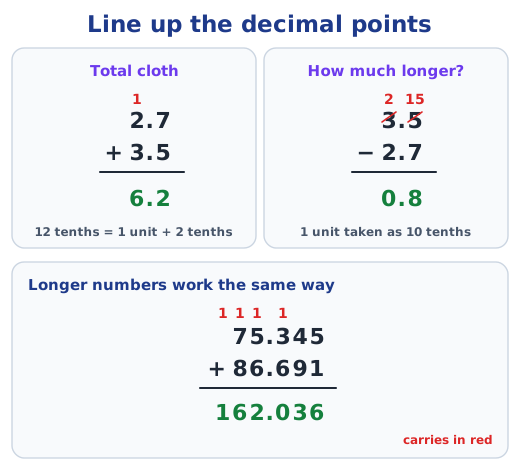
Priya needs 2.7 m of cloth for a skirt and Shylaja needs 3.5 m for a kurti. In tenths, 2 7/10 + 3 5/10 = 5 12/10, and since 12 tenths are 1 unit and 2 tenths, the total is 6 2/10 m. With decimals the same sum is done in columns: 7 tenths + 5 tenths = 12 tenths, write 2 and carry 1 unit; then 2 + 3 + 1 = 6 units. The answer is 6.2 m.
How much more does Shylaja need? 3 5/10 − 2 7/10 has too few tenths on top, so one unit is turned into 10 tenths, giving 2 15/10 − 2 7/10 = 8/10. In columns, 3.5 − 2.7: borrow 1 unit as 10 tenths, 15 − 7 = 8 tenths, and 2 − 2 = 0 units, so the difference is 0.8 m.
Why the column method works
Adding 483 + 268 means adding hundreds to hundreds, tens to tens and ones to ones: 600 + 140 + 11, which regroups to 751. Decimals simply have more places. In 15 3/10 4/100 + 2 6/10 8/100, the units make 17, the tenths make 9/10 and the hundredths make 12/100. Since 10 hundredths are a tenth, 12/100 = 1/10 + 2/100, the tenths become 10/10 = 1, and the sum is 18 2/100, that is 18.02. Lining up the decimal points is what keeps each place under its own kind.
Look at 75.345 + 86.691 place by place. Thousandths: 5 + 1 = 6. Hundredths: 4 + 9 = 13, so write 3 and carry 1 tenth. Tenths: 3 + 6 + 1 = 10, so write 0 and carry 1 unit. Units: 5 + 6 + 1 = 12, write 2 and carry 1 ten. Tens: 7 + 8 + 1 = 16. The sum is 162.036.
Subtracting with borrowing
In 653 − 268 we borrow a ten when the ones are too few, and a hundred when the tens are. Decimals work the same way. For 84.691 − 77.345, the thousandths 1 − 5 need a borrow from the hundredths: 11 − 5 = 6, then 8 − 4 = 4 hundredths and 6 − 3 = 3 tenths. The units 4 − 7 need a borrow from the tens: 14 − 7 = 7, and 7 − 7 = 0 tens. The difference is 7.346.
When the numbers have different lengths, write zeros in the empty places first. 17 − 0.05 becomes 17.00 − 0.05 = 16.95, and 34.505 − 18.1 becomes 34.505 − 18.100 = 16.405. Adding zeros at the right end of a decimal never changes its value.
Decimal sequences
In 4.4, 4.8, 5.2, 5.6, 6.0, each term is 0.4 more than the one before, so the next three are 6.4, 6.8 and 7.2. Sequences can go down too: in 5, 4.95, 4.90 each step takes away 0.05, so the pattern continues 4.85, 4.80, 4.75. Working these out in your head is good practice in carrying and borrowing.
Estimate before you calculate
Sonu claims that when two decimals are added, the answer always beats the total of their whole number parts, yet always stays below that total plus 2. For 25.936 + 8.202, the claim says the answer lies between 25 + 8 = 33 and 25 + 1 + 8 + 1 = 35. The sum is 34.138, so it holds. It holds for every pair, because each decimal part is at least 0 and less than 1, so together they add less than 2. Even 25.93603259 + 8.202 = 34.13803259 stays in range.
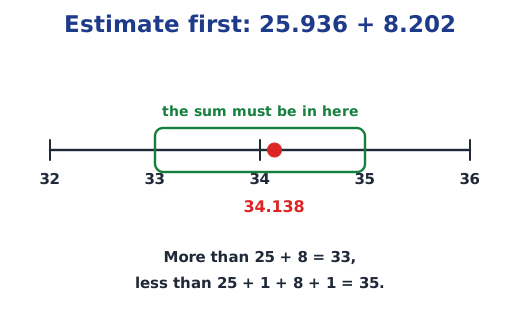
A difference can be boxed in the same way. If the whole number parts are A and B, the difference lies between A − B − 1 and A − B + 1. For 84.691 − 77.345 that is between 6 and 8, and the answer 7.346 fits.
Mind the point
Small slips with the point can cost a lot. In 2013 the finance office of the Amsterdam City Council paid about €188 million in housing benefits instead of €1.8 million, because its software treated amounts in cents as euros. In 1983 an Air Canada plane was fuelled using pounds where kilograms were needed, got only about half the fuel it required, and had to make an emergency landing at an unused airfield; everyone survived. A dose of 0.05 mg misread as 0.5 mg is ten times too much medicine.
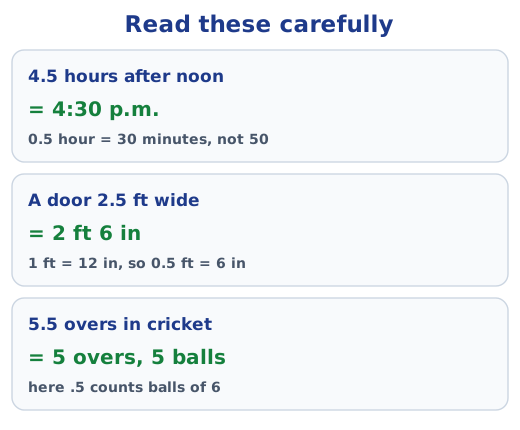
Some numbers only look like decimals. 4.5 hours is 4 hours and 30 minutes, because 0.5 of an hour is 5 parts of 6 minutes each. A door measured as 2 ft 5 in is not 2.5 ft, since 0.5 ft is 6 inches. A cricket score of 5.5 overs means 5 overs and 5 balls, as an over has 6 balls. Clock times such as 10.30, dates such as 15.08 and version numbers such as 2.10 are other examples.
Why it matters
Bills, measurements and scores all need decimal sums done right. What each digit means is explained in tenths and hundredths, and how to tell which decimal is larger in comparing decimals. Multiplying and dividing decimals comes later, in Part 2 Chapter 4, Another Peek Beyond the Point. Answers to every question are in the NCERT solutions for Chapter 3; see all of the Chapter 3 notes.
Practice
-
What is 4.75 + 2.6?
Show answer
Answer: (a) 7.35
-
What is 12 − 0.25?
Show answer
Answer: (a) 11.75
-
What comes next in 3.2, 3.5, 3.8, …?
Show answer
Answer: (b) 4.1
-
Without adding exactly, between which two whole numbers does 18.7 + 6.45 lie?
Show answer
Answer: It is more than 18 + 6 = 24 and less than 18 + 1 + 6 + 1 = 26. The exact sum, 25.15, is indeed between 24 and 26.
-
A scoreboard shows 7.3 overs. How many balls have been bowled?
Show answer
Answer: 7 overs and 3 balls, because the digit after the point counts balls out of 6. That is 7 × 6 + 3 = 45 balls, not 7 and 3 tenths of an over.
Questions students ask
How do you add decimals?
Write the numbers one below the other with their decimal points in one column, so each digit sits under a digit of the same place. Add from the right, carrying 1 whenever a column reaches 10, just as for whole numbers, and keep the point in the same column in the answer. For example, 75.345 + 86.691 = 162.036.
How do you subtract decimals with different numbers of digits?
Fill the empty places with zeros so both numbers have the same number of digits after the point; zeros at the right end do not change a decimal. Then subtract column by column from the right, borrowing when needed. For 17 − 0.05, write 17.00 − 0.05, which is 16.95.
How can you check a decimal sum quickly?
Estimate it first. Add only the whole number parts: the true sum is bigger than that total and smaller than that total plus 2, because each decimal part is less than 1. For 25.936 + 8.202 the sum must lie between 33 and 35, and it is 34.138. An answer outside the range has a mistake in it.
Stuck on a question?
Take a photo and Lagnever AI explains it step by step. Try it for 7 days for ₹2.
Get it on Google Play Open in browser
For parents: after the trial, the plan renews monthly by UPI or card autopay. You can cancel anytime in the app.