
NCERT Solutions Class 7 Maths Chapter 3: A Peek Beyond the Point
Answers to every question in Chapter 3, A Peek Beyond the Point, of Ganita Prakash Grade 7 Part 1 (Reprint 2026-27): the questions in the text, the Math Talk and Try This tasks, and every Figure it Out. Page numbers follow the book (pages 46–80). Lengths read off pictures are approximate. Short notes: Chapter 3 notes.
The Need for Smaller Units (pages 46–48)
Measure the screws. First screw: on the whole-centimetre ruler it ends somewhere from 2 to 3 cm; on the half-centimetre ruler, past 2½ cm and short of 3 cm; on the tenths ruler, at 2 7/10 cm. Second screw: from 3 to 4 cm; past 3 cm and short of 3½ cm; 3 2/10 cm.
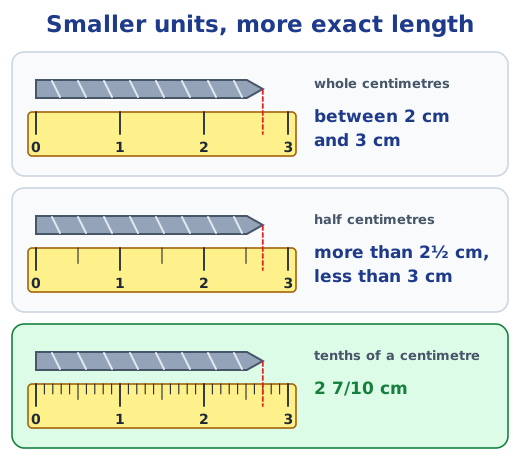
Which scale measured the screws accurately, and why? The third ruler, marked in tenths of a centimetre. The others only show which whole or half centimetres a screw lies between; the tenths show exactly where it ends.
What is the meaning of 2 7/10 cm? Go from 0 to 2 cm, then take 7 of the 10 equal parts of the next centimetre. It is 2 cm and 7/10 cm, read two and seven-tenth centimetres.
Why was the unit divided into smaller parts? The two screws differ by less than a centimetre, so whole centimetres cannot show the difference. Smaller parts give a more exact measure.
Measure a pen, a sharpener and an object of your choice. Answers depend on your objects, for example a pen of 14 3/10 cm and a sharpener of 2 5/10 cm. Read the whole centimetres first, then count the tenths.
Objects in the picture (page 47). As read from the picture: eraser 2 4/10 cm, pencil 4 5/10 cm, chalk 1 4/10 cm.
A Tenth Part (pages 48–52)
Write each length in two ways (page 49). As read from the pictures, each with its own unit: USB cable 4 8/10 = 48/10 units (the example); pencil box height 2 8/10 = 28/10 units; thumb 1 3/10 = 13/10 units; leaf 10 9/10 = 109/10 units. Read 2 8/10 as two and eight-tenths and 28/10 as twenty-eight tenths.
Arrange in increasing order (page 49). 4/10 < 9/10 < 1 7/10 < 6 7/10 < 7 6/10 < 10 5/10 < 130/10 < 13 1/10. (130/10 is 13.)
Arrange 4 1/10, 4/10, 41/10 and 41 1/10 in increasing order (page 50). 4/10 < 4 1/10 = 41/10 < 41 1/10. Note that 4 1/10 and 41/10 are the same length.
Honeybee (page 51). 2 3/10 + 5 4/10 + 7 5/10 = 14 12/10 = 15 2/10 units.
Discuss the subtraction for the finger (page 51). 4 tenths are too few to take away 7 tenths, so one unit of the 12 is split into 10 tenths, giving 11 units and 14 tenths. Then 14 − 7 = 7 tenths and 11 − 6 = 5 units: the finger is 5 7/10 units. Converting to tenths: 124/10 − 67/10 = 57/10 = 5 7/10.
The two fish (page 52). 2 4/10 − 9/10 = 24/10 − 9/10 = 15/10 = 1 5/10 cm. Both fish are far smaller than a finger: the danio is about as long as the top joint of a finger, and the goby is less than 1 cm long.
Extend the sequences (page 52).
- (a) Add 3/10 each time: 4 9/10, 5 2/10, 5 5/10, 5 8/10.
- (b) Add 5/10: 9 7/10, 10 2/10, 10 7/10, 11 2/10.
- (c) Add 1 1/10: 9 8/10, 10 9/10, 12, 13 1/10.
- (d) Take away 4/10: 4 9/10, 4 5/10, 4 1/10, 3 7/10.
- (e) Take away 5/10: 12, 11 5/10, 11, 10 5/10.
- (f) Take away 1 1/10: 8 2/10, 7 1/10, 6, 4 9/10.
A Hundredth Part (pages 52–58)
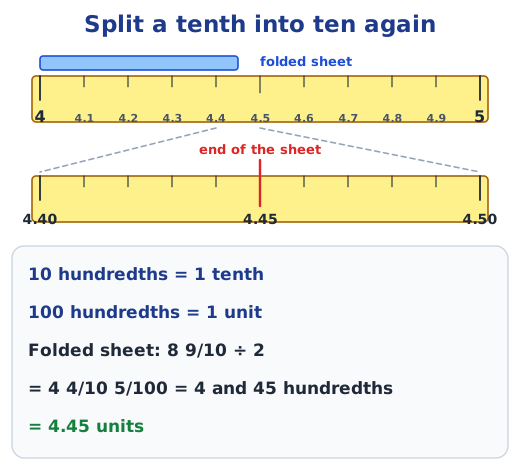
What is the length of each smaller part, and how many make a unit? Each tenth split into 10 gives parts of 1/100 of a unit, and 100 of them make a unit. The folded paper ends at 4 4/10 5/100.
How many hundredths make one tenth? Is the length also 4 units and 45 hundredths? 10 hundredths make one tenth. Yes: 4 tenths are 40 hundredths, and with 5 more that is 45 hundredths, so 4 4/10 5/100 = 4 45/100.
Fill the empty boxes (page 54). Measured from 0 in hundredths, from left to right: 55/100, 155/100, 174/100, 202/100 and 240/100.
How do the three forms show the same length? 1 1/10 4/100 = 1 14/100, because 1 tenth and 4 hundredths are 14 hundredths. And 1 14/100 = 114/100, because 1 unit is 100 hundredths.
Write and read the lengths of the wires (page 54). As read from the pictures: 5 37/100 (five and thirty-seven hundredths), 15 3/100 (fifteen and three hundredths), 7 52/100 (seven and fifty-two hundredths) and 9 80/100 (nine and eighty hundredths, which is 9 8/10).
Longest and shortest in each group (pages 55–56).
- (a) 3/10, 3/100, 33/100: longest 33/100, shortest 3/100.
- (b) 3 1/10, 30/10, 1 3/10: longest 3 1/10, shortest 1 3/10.
- (c) 45/100, 54/100, 5/10, 4/10: longest 54/100, shortest 4/10.
- (d) 3 6/10, 3 6/100, 3 6/10 6/100: longest 3 6/10 6/100, shortest 3 6/100.
- (e) 8/10 2/100, 9/100, 1 8/100: longest 1 8/100, shortest 9/100.
- (f) 7 3/10 5/100, 7 5/10, 7 41/100: longest 7 5/10, shortest 7 3/10 5/100.
- (g) 6 5/10 15/100, 5 87/100, 5 7/100: longest 6 5/10 15/100, which is 6 65/100; shortest 5 7/100.
Find 15 3/10 4/100 + 2 6/10 8/100. Are the two methods different? The sum is 18 2/100. Both methods add units to units, tenths to tenths and hundredths to hundredths, then regroup 10 hundredths as a tenth and 10 tenths as a unit. They differ only in layout, just like 483 + 268 = 600 + 140 + 11 = 751. Converting to hundredths gives the same: 1534/100 + 268/100 = 1802/100 = 18 2/100.
Find 25 9/10 − 6 4/10 7/100, also by converting to hundredths. 25 9/10 − 6 4/10 7/100 = 19 4/10 3/100. In hundredths: 2590/100 − 647/100 = 1943/100, the same answer.
Find 15 3/10 4/100 − 2 6/10 8/100. Borrow a tenth as 10 hundredths and a unit as 10 tenths: the difference is 12 6/10 6/100. It works like 653 − 268 = 385, where a ten and a hundred are borrowed.
Figure it Out (page 58)
- (a) 3/10 + 3 4/100 = 3 34/100.
- (b) 9 5/10 7/100 + 2 1/10 3/100 = 11 6/10 10/100 = 11 7/10.
- (c) 15 6/10 4/100 + 14 3/10 6/100 = 29 9/10 10/100 = 30.
- (d) 7 7/100 − 4 4/100 = 3 3/100.
- (e) 8 6/100 − 5 3/100 = 3 3/100.
- (f) As printed, 12 6/100 2/100 is 12 8/100, and 12 8/100 − 9/10 9/100 = 11 9/100. If 12 6/10 2/100 was meant, the answer is 11 6/10 3/100.
Decimal Place Value (pages 58–64)
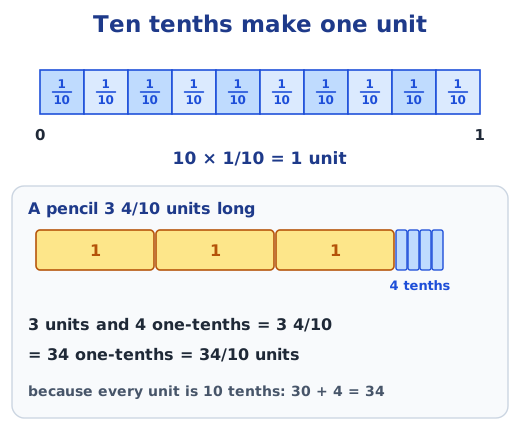
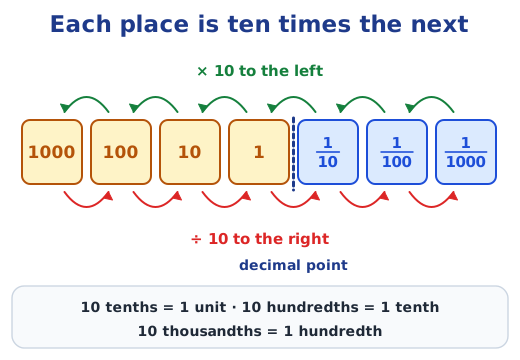
Can we split a unit into 4, 5 or 8 equal parts instead? Yes. Quarters, and quarters of quarters (sixteenths), measure lengths too. Splitting by 10 is chosen because it continues the place value system, where each place is 10 times the next.
What fraction do we get when 1/100 is split into 10 equal parts? 1/1000, a thousandth; 1000 of them make a unit.
How Big? (page 61)
- (a) 1000 thousandths make one unit.
- (b) 100 thousandths make one tenth.
- (c) 10 thousandths make one hundredth.
- (d) 100 tenths make one ten.
- (e) 1000 hundredths make one ten.
More questions of this kind: 10,000 hundredths make a hundred, and 10,000 thousandths make a ten.
Can 4 2/10 be written as 42? No. 42 already means 4 tens and 2 units, so we could not tell the two apart. That is why we need the decimal point: 4 2/10 = 4.2.
Place value table (page 63).
- (a) 2 ones, 3 tenths and 5 hundredths = 2.35, read two point three five.
- (b) 1 ten and 5 tenths = 10.5, read ten point five.
- (c) 4 ones and 6 hundredths = 4.06, read four point zero six.
- (d) 1 hundred, 1 one and 1 hundredth = 101.01, read one hundred and one point zero one.
- (e) 8/100 and 9/10 = 0.98, read zero point nine eight.
- (f) 5/100 = 0.05, read zero point zero five.
- (g) 1/10 = 0.1, read zero point one.
- (h) 2 1/100 = 2.01, 4 1/10 = 4.1 and 7 7/1000 = 7.007, read two point zero one, four point one and seven point zero zero seven.
Write in decimal form (page 64). (a) 234 hundredths = 2 + 3/10 + 4/100 = 2.34. (b) 105 tenths = 10 + 5/10 = 10.5.
Units of Measurement (pages 64–69)
mm and cm (page 65). 70 mm = 7 cm; 9 mm = 0.9 cm; 134 mm = 13.4 cm; 2036 mm = 203.6 cm.
Small things in nature. Measurements by eye vary; for example, a mustard seed of 1 to 2 mm is 0.1 to 0.2 cm, and a hair of 0.1 mm is 0.01 cm.
cm and m (page 66). 36 cm = 0.36 m; 50 cm = 0.5 m; 89 cm = 0.89 m; 4 cm = 0.04 m; 325 cm = 3.25 m; 207 cm = 2.07 m.
How many mm does 1 metre have? Is 1 mm = 1/1000 m? 1 m = 100 cm = 100 × 10 mm = 1000 mm, so yes, 1 mm = 1/1000 m = 0.001 m.
g and kg (page 68). 465 g = 0.465 kg; 68 g = 0.068 kg; 1560 g = 1.56 kg; 704 g = 0.704 kg; 560 g = 0.56 kg; 2500 g = 2.5 kg.
The rice heaps. 10 kg + 1 kg + 100 g + 10 g + 1 g = 10 + 1 + 0.1 + 0.01 + 0.001 = 11.111 kg.
Rupees and paise (page 69). 10 p = ₹0.10; 5 p = ₹0.05; 36 p = ₹0.36; 50 p = ₹0.50; 99 p = ₹0.99; 250 p = ₹2.50.
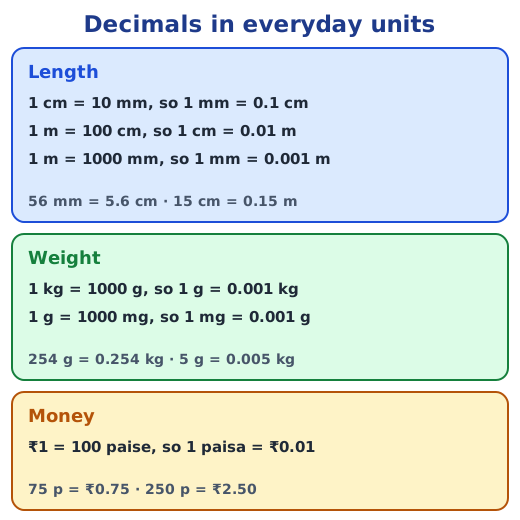
Try This: old prices. Answers come from your own family and teachers. Writing the prices in rupees and paise, such as ₹2.45 for a kilogram of rice in the 1970s, is good practice with decimals.
Locating and Comparing Decimals (pages 69–73)
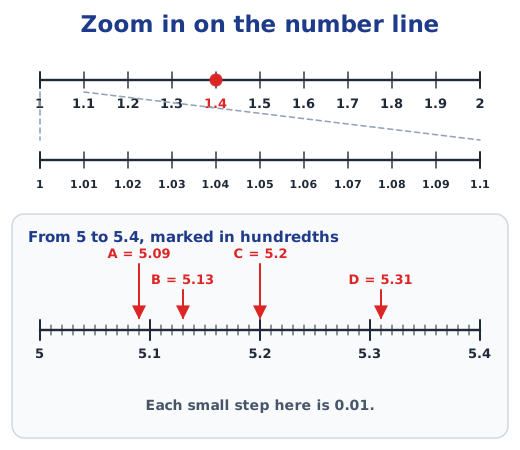
Name the divisions between 1 and 1.1. 1.01, 1.02, 1.03, 1.04, 1.05, 1.06, 1.07, 1.08 and 1.09.
Write the decimals for the letters (page 70). Each small division is 0.01: A = 5.09, B = 5.13, C = 5.2, D = 5.31.
Zero dilemma: who is right? Sonu. 0.2, 0.20 and 0.200 all mean 2 tenths, so they are equal. The largest is 0.2 (= 0.20 = 0.200) and the smallest is 0.002.
Which of these are the same? 4.5 = 4.50 = 04.50, and 4.05 = 4.050. 0.405 and 4.005 are different from all the others.
The number marked ? in Figure (b). The lines zoom from 0–10 into 3–4, then into 3–3.1, then into 3.05–3.06. The ? is the 9th of 10 marks in the last line, so it is 3.059.
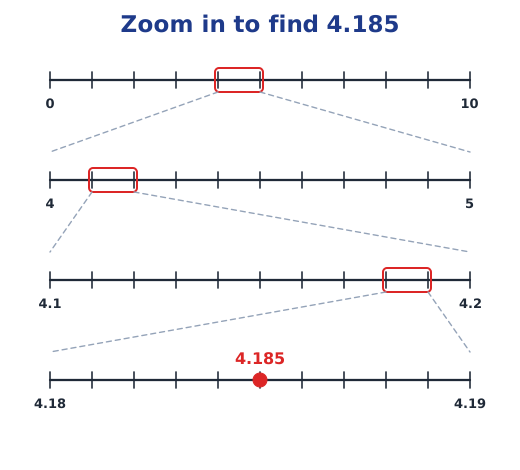
Number lines for 9.876 and 0.407. For 9.876, zoom from 0–10 into 9–10, then 9.8–9.9, then 9.87–9.88, and take the 6th mark. For 0.407, zoom from 0–10 into 0–1, then 0.4–0.5, then 0.40–0.41, and take the 7th mark.
Boxes a, b and c (page 71). The 5 units from 5 to 10 are split into 10 parts, so each division is half a unit: a = 6, b = 7.5, c = 9.5.
Boxes d to h (page 72). From 8 to 8.1 there are 10 divisions of 0.01: d = 8.01, e = 8.05. From 4.3 to 4.8 there are 10 divisions of 0.05: f = 4.35, g = 4.5, and h, one division past 4.8, is 4.85.
Which is larger: 6.456 or 6.465? 6.465. The units and tenths are the same, and in the hundredths 6 > 5.
Why can we stop comparing at the first different digit? Every digit after that place is worth less, and all of them together add up to less than one unit of that place. After the hundredths, for example, the rest adds less than 0.01, which cannot make up a difference of a whole hundredth.
Which decimal is greater? (a) 1.32 (b) 13.800 (c) 1.090.
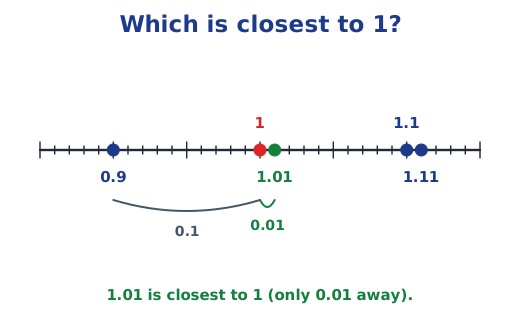
Closest decimals (page 73). Closest to 1.09: 1.1, only 0.01 away. Closest to 4: 3.65, which is 0.35 away (3.56 is 0.44 away and 3.099 is 0.901 away). Closest to 1: 1.08, which is 0.08 away (0.8 is 0.2 away and 0.69 is 0.31 away).
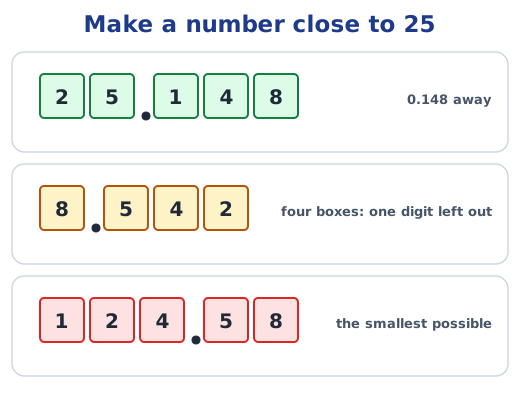
Use 4, 1, 8, 2 and 5 to get as close as possible to 25.
- Two boxes before the point and three after: 25.148, only 0.148 away. (24.851 is 0.149 away.)
- One box before the point and three after: every such number is less than 10, so make the largest, 8.542. There are only four boxes, so one digit is left out.
- Three boxes before the point and two after: every such number is more than 100, so make the smallest, 124.58.
Addition and Subtraction of Decimals (pages 74–76)
Cloth for Priya and Shylaja. Total 2.7 + 3.5 = 6.2 m; Shylaja needs 3.5 − 2.7 = 0.8 m more. Decimal columns give the same answers as the tenths: 2 7/10 + 3 5/10 = 6 2/10, and 3 5/10 − 2 7/10 = 8/10.
Place value working for 84.691 − 77.345. Thousandths: 1 − 5 is not possible, so borrow 1 hundredth: 11 − 5 = 6 thousandths. Hundredths: 8 − 4 = 4. Tenths: 6 − 3 = 3. Units: 4 − 7 is not possible, so borrow 1 ten: 14 − 7 = 7 units. Tens: 7 − 7 = 0. Compact form: 84.691 − 77.345 = 7.346.
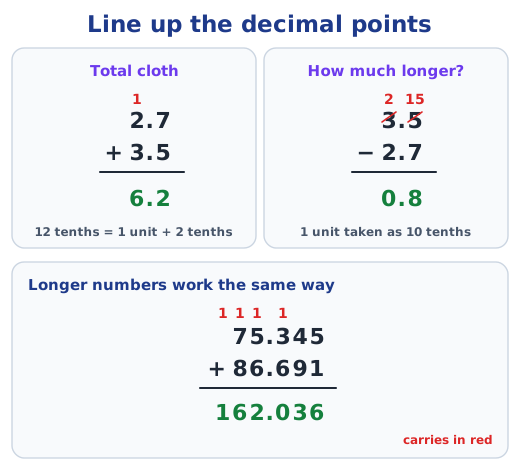
Figure it Out (page 75)
- Sums: (a) 5.3 + 2.6 = 7.9 (b) 18 + 8.8 = 26.8 (c) 2.15 + 5.26 = 7.41 (d) 9.01 + 9.10 = 18.11 (e) 29.19 + 9.91 = 39.10 (f) 0.934 + 0.6 = 1.534 (g) 0.75 + 0.03 = 0.78 (h) 6.236 + 0.487 = 6.723.
- Differences: (a) 5.6 − 2.3 = 3.3 (b) 18 − 8.8 = 9.2 (c) 10.4 − 4.5 = 5.9 (d) 17 − 16.198 = 0.802 (e) 17 − 0.05 = 16.95 (f) 34.505 − 18.1 = 16.405 (g) 9.9 − 9.09 = 0.81 (h) 6.236 − 0.487 = 5.749.
Decimal sequences (pages 75–76). In 4.4, 4.8, 5.2, 5.6, 6.0 each term adds 0.4, so the next three are 6.4, 6.8, 7.2.
- (a) Add 0.05: 4.55, 4.6, 4.65.
- (b) Add 0.5: 27.25, 27.75, 28.25.
- (c) Add 0.11: 10.89, 11.00, 11.11.
- (d) Add 2.5: 21, 23.5, 26.
- (e) Add 0.9: 11.2, 12.1, 13.0.
- (f) Take away 0.05: 4.85, 4.80, 4.75.
- (g) Take away 0.5: 10.95, 10.45, 9.95.
- (h) Take away 3.5: 26, 22.5, 19.
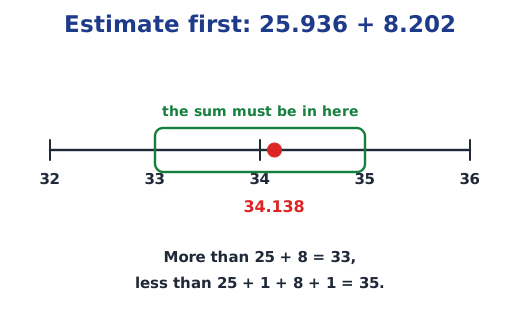
Is Sonu’s claim true? Yes. 25.936 + 8.202 = 34.138, which is more than 25 + 8 = 33 and less than 25 + 1 + 8 + 1 = 35. It works for any two decimals, because each decimal part is less than 1, so the two together add less than 2. For 25.93603259 + 8.202 the sum is 34.13803259, again between 33 and 35.
A range for the difference. If the whole number parts are A and B, the difference lies between A − B − 1 and A − B + 1. For 84.691 − 77.345 that is between 6 and 8, and the difference is 7.346.
More on the Decimal System (pages 76–78)
When will the bus reach the station? None of the three. 0.5 hours is 5 parts of 6 minutes, which is 30 minutes, so the bus arrives at 4:30 p.m.
Why did the door not close? The opening was 2 ft 5 in, but 2.5 ft means 2 ft 6 in, because 0.5 ft is half of 12 inches. The door was 1 inch too wide.
What does 5.5 overs mean? 5 overs and 5 balls: the digit after the point counts balls, and an over has 6 balls.
Where else do non-decimals look like decimals? Clock times such as 10.30, dates such as 15.08.2026, section numbers in a book (3.10 comes after 3.9), versions of an app (2.10 is newer than 2.9), and heights such as 5.6 said for 5 ft 6 in.
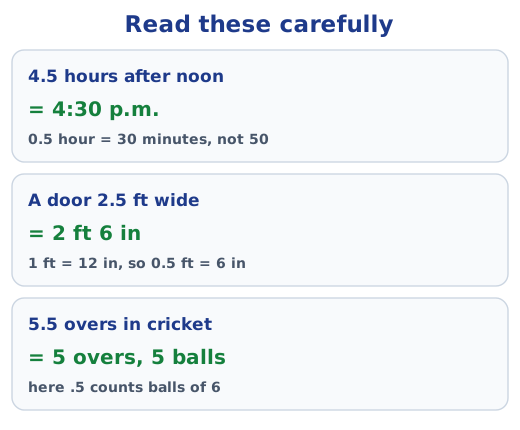
Figure it Out (pages 78–80)
- (a) 5/100 = 0.05 (b) 16/1000 = 0.016 (c) 12/10 = 1.2 (d) 254/1000 = 0.254.
- (a) 0.34 = 3/10 + 4/100 (b) 1.02 = 1 + 0/10 + 2/100 (c) 0.8 = 8/10 (d) 0.362 = 3/10 + 6/100 + 2/1000.
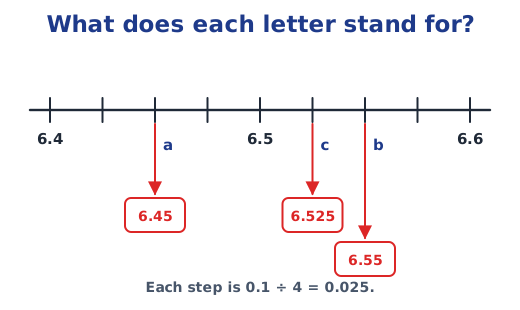
- Each tenth is split into 4 equal steps of 0.025. The boxes are labelled a, c, b from left to right, so a = 6.45, c = 6.525, b = 6.55.
- (a) 11.10, 11.01, 1.101, 1.011, 1.01
(b) 2.768, 2.698, 2.675, 2.567, 2.499
(c) 4.678 g, 4.666 g, 4.656 g, 4.600 g, 4.595 g
(d) 33.331 m, 33.313 m, 33.31 m, 33.133 m, 33.13 m - (a) 40.168. With 1 in the tens place the largest number is 18.640, more than 11 away from 30, while 40.168 is only 10.168 away. (b) A number between 100 and 1000 needs three digits before the point; the smallest is 104.68.
- No. 2.05 has more digits than 2.5 but is smaller, because 2.5 has 5 tenths and 2.05 has none. The places of the digits decide, not how many there are.
- 0.25 + 0.3 + 0.5 + 0.2 + 0.05 = 1.3 kg.
- First three days: 3.79 + 4.2 + 4.25 = 12.24 L. Last three days: 25 − 12.24 = 12.76 L.
- 35.75 − 34.50 = 1.25, so he lost 1.25 kg.
- The rule is add 0.9, then take away 0.01, again and again. The 6th and 7th terms should be 8.18 and 8.17 (the book prints 6.18 and 6.17), and the next two are 9.07, 9.06.
- 1 km = 1000 m = 1000 × 1000 mm = 10,00,000 mm.
- 45 paise × 1,00,000 = 45,00,000 paise = ₹45,000.
- (a) 1/10, since 10/1000 = 1/100. (b) 90 thousandths, which is 9 hundredths. (c) 90 hundredths, which is 0.9.
- (b) 12 tens and 12 tenths = 120 + 1.2 = 121.2 (c) 100 + 10 + 1 + 0.1 = 111.1 (d) 250 + 25 + 2.5 + 0.25 = 277.75.
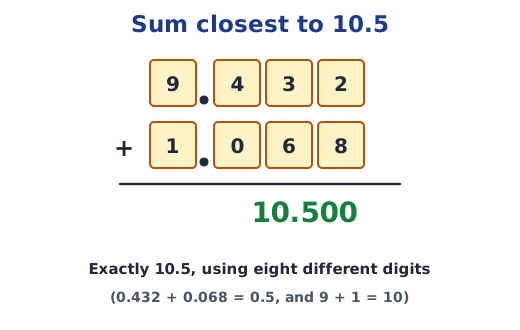
- 9.432 + 1.068 = 10.500, exactly 10.5, so no sum can be closer: the whole parts give 9 + 1 = 10 and the decimal parts 0.432 + 0.068 = 0.5. Many other fillings also give exactly 10.5, such as 5.603 + 4.897.
- (a) 1/2 = 0.5 (b) 3/2 = 1.5 (c) 1/4 = 0.25 (d) 3/4 = 0.75 (e) 1/5 = 0.2 (f) 4/5 = 0.8.
More practice and short notes are in the topic pages on tenths and hundredths, comparing decimals and adding and subtracting decimals.
Practice
-
Which decimal is 4 ones and 6 hundredths?
Show answer
Answer: (b) 4.06
-
What is 34.505 − 18.1?
Show answer
Answer: (a) 16.405
-
Which is greater: one-hundredth or 90 thousandths?
Show answer
Answer: (b) 90 thousandths
-
A milkman supplies 3.79 L, 4.2 L and 4.25 L in three days and 25 L in six days. How much does he supply in the last three days?
Show answer
Answer: The first three days give 3.79 + 4.20 + 4.25 = 12.24 L. The last three days give 25.00 − 12.24 = 12.76 L.
-
Using the digits 1, 4, 0, 8 and 6 once each, make the decimal number closest to 30.
Show answer
Answer: With 1 in the tens place the largest number is 18.640, more than 11 away. With 4 in the tens place the smallest is 40.168, only 10.168 away. So 40.168 is the closest.
Stuck on a question?
Take a photo and Lagnever AI explains it step by step. Try it for 7 days for ₹2.
Get it on Google Play Open in browser
For parents: after the trial, the plan renews monthly by UPI or card autopay. You can cancel anytime in the app.