
Mean and representative values
Answer in short
A representative value is one number that sums up a whole group of numbers. The most common one is the arithmetic mean, or average: add all the values and divide by how many there are. It is the fair share each would get if the total were split equally, so 3, 8, 10, 5 and 4 guavas give 6 each.
Stuck on a question? Take a photo and Lagnever AI explains it step by step. Try it for 7 days for ₹2. Get it on Google Play
Who batted better?
In one cricket series Shubman scored 0, 17, 21 and 90, and Yashasvi scored 67, 55, 18 and 35. Who did better? Vaishnavi points to Shubman’s 90, the highest score of all. Shreyas adds up the runs: 175 for Yashasvi and 128 for Shubman. Vaishnavi then notices that Yashasvi was steadier, since the gap between his highest and lowest scores is smaller. Each friend looks at the numbers in a different way, and each way says something true.
In the next series Shubman scored 23, 7, 10, 52 and 18, a total of 110, while Yashasvi scored 26, 53, 2 and 15 and missed one match, a total of 96. Now the totals are unfair: Shubman batted in five matches and Yashasvi in only four. What we need is a single number that represents each player’s batting, a representative value, which balances the high scores against the low ones.
The arithmetic mean
The simplest such number is the arithmetic mean, or average:
Mean = sum of all the values ÷ number of values
Shubman’s mean is 110 ÷ 5 = 22 runs a match and Yashasvi’s is 96 ÷ 4 = 24 runs a match, so in this series Yashasvi did better. (The book prints 110 ÷ 5 = 21; the right value is 22, and Yashasvi is still ahead.) Means need not be whole numbers. Two runners whose seven times add up to 122 seconds each have a mean of 122 ÷ 7 ≈ 17.43 seconds, so on average neither is quicker.
The mean as a fair share
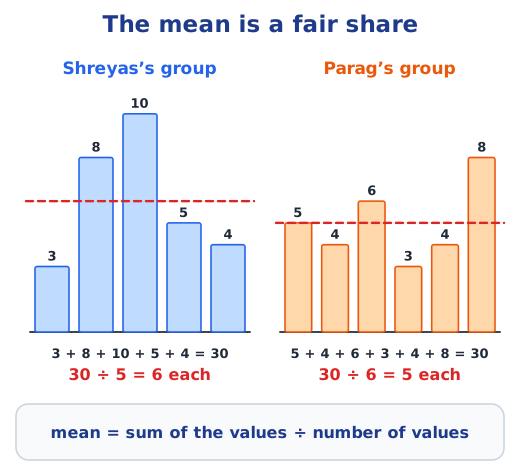
Shreyas and four friends collect 3, 8, 10, 5 and 4 guavas, 30 in all. Parag and five friends collect 5, 4, 6, 3, 4 and 8, also 30. If each group shares equally, Shreyas’s group gets 30 ÷ 5 = 6 each and Parag’s gets 30 ÷ 6 = 5 each. Same total, different shares, because the groups differ in size. Picture the bars being levelled: the tall ones give to the short ones until all stand at the mean. In the same way, 2, 7, 9, 4 and 3 hibiscus flowers on five days give a mean of 25 ÷ 5 = 5 flowers a day, the number that would bloom daily if every day were the same.
Indian mathematicians saw the mean in exactly this way. Their names for it include samarajju (Brahmagupta, 628 CE), samikarana, meaning levelling (Mahaviracharya, 850 CE), and samamiti, mean measure (Bhaskaracharya, 1150 CE). The word sama means equal.
Zero or no value?
A player’s scores read 57, 13, 0, 84, —, 51, 27. The 0 is a real innings that earned nothing, so it counts. The dash means the player did not bat, so that match is left out. The mean is (57 + 13 + 0 + 84 + 51 + 27) ÷ 6 = 232 ÷ 6 ≈ 38.67 runs a match.
Sometimes zeros should be left out on purpose. Sita’s mango tree gave 0, 0, 8, 24, 41, 16, 5, 0, 0, 0, 0 and 0 mangoes from January to December. For the typical harvest per month, use only the season, March to July: (8 + 24 + 41 + 16 + 5) ÷ 5 = 94 ÷ 5 = 18.8 mangoes a month. The mean over all 12 months, about 7.8, describes no real month at all.
Averages around us
Averages appear everywhere: average rainfall per day in a month, a scooter’s average mileage, wheat yield per hectare in a state, or the waste a person throws away each day. In Europe in the early 1500s, a land-measuring rod was set at 16 feet by lining up 16 men toe to heel. The rod was then cut into 16 equal parts, each one foot, which made the foot the mean length of sixteen real feet.
The mean also settles the onion question. Over the same twelve months, Yahapur’s prices add up to ₹458 and Wahapur’s to ₹450, so the means are about ₹38.17 and ₹37.50 a kilogram: onions were slightly costlier in Yahapur on average. But one number cannot show how much the prices jump about. For that, see median and outliers, where the median and dot plots come in.
Why it matters
A good representative value lets you compare groups fairly, whether players, classes, towns or farms. Draw the same data as pictures in visualising data. Answers to the textbook questions are in the NCERT solutions for Part 2 Chapter 5; see all of Part 2 Chapter 5 notes.
Practice
-
Shreyas bounced a ball on his bat 6, 2, 9, 5, 4, 6, 3 and 5 times. What is the mean number of bounces?
Show answer
Answer: (b) 5
-
The mean of five numbers is 12. What is their sum?
Show answer
Answer: (b) 60 Sum = mean × number of values = 12 × 5 = 60.
-
Riya scored 8, 0 and 10 in three tests and missed the fourth. What is her average per test?
Show answer
Answer: (b) 6 The 0 counts but the missed test does not: (8 + 0 + 10) ÷ 3 = 6.
-
Five friends have ₹20, ₹35, ₹15, ₹50 and ₹30. If they pool the money and share it equally, how much does each get?
Show answer
Answer: The total is 20 + 35 + 15 + 50 + 30 = ₹150, and 150 ÷ 5 = ₹30 each. This fair share is the mean of the five amounts.
-
The mean of four numbers is 10. Three of them are 8, 12 and 9. What is the fourth?
Show answer
Answer: The four numbers add up to 10 × 4 = 40. The three known ones add up to 29, so the fourth is 40 − 29 = 11.
Questions students ask
What is a representative value?
A single number chosen to stand for a whole group of numbers, so that groups can be described and compared. The mean (average) and the median are the two representative values in this chapter.
How do you find the mean of data?
Add all the values and divide the sum by the number of values. For 2, 7, 9, 4 and 3 hibiscus flowers on five days, the mean is (2 + 7 + 9 + 4 + 3) ÷ 5 = 25 ÷ 5 = 5 flowers a day.
Why is the mean called a fair share?
Because it is what each would get if the total were shared out equally. Parag’s group of 6 collected 5, 4, 6, 3, 4 and 8 guavas, 30 in all. Shared equally, each gets 30 ÷ 6 = 5, which is the mean.
Stuck on a question?
Take a photo and Lagnever AI explains it step by step. Try it for 7 days for ₹2.
Get it on Google Play Open in browser
For parents: after the trial, the plan renews monthly by UPI or card autopay. You can cancel anytime in the app.