
Class 7 Maths Part 2 Chapter 6: Constructions and Tilings Notes
This chapter in five lines
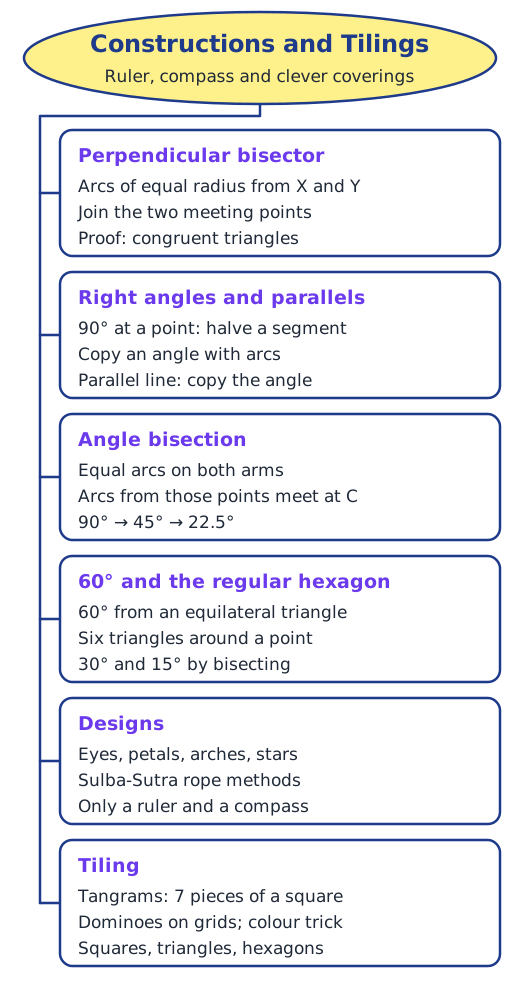
Constructions and Tilings has two parts. In constructions you use nothing but a compass and an unmarked ruler to draw perpendicular bisectors, 90°, 45° and 60° angles, angle bisectors, copies of angles, parallel lines and regular hexagons, and congruent triangles explain why each method works. In tilings you cover regions with shapes, without gaps or overlaps, from tangrams to grids to the whole plane.
What is this chapter about?
In Class 6 you drew an eye with two arcs, guessing where to put the compass. This chapter shows how to find such points exactly, with nothing but a compass and an unmarked ruler, and why each method works, using the congruent triangles of the Geometric Twins chapter. Its second part is about tiling: covering a shape with pieces so that nothing is left uncovered and nothing overlaps.
The perpendicular bisector
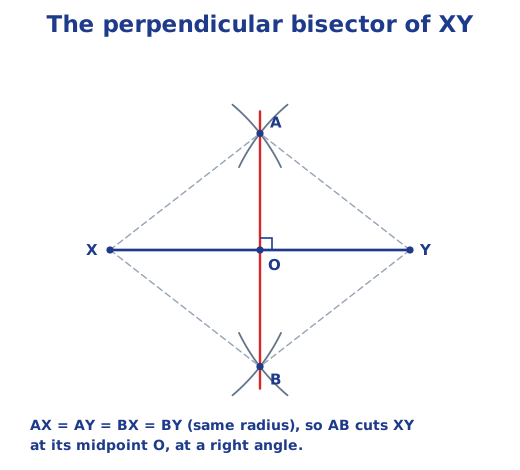
Draw arcs of the same radius from X and from Y, above and below the segment XY. They meet at A and B, and the line AB passes through the midpoint of XY at right angles: it is the perpendicular bisector. Why? ΔABX ≅ ΔABY by SSS, so the angles at A are equal; then ΔAOX ≅ ΔAOY by SAS, so OX = OY and the two angles at O are equal, each half of 180°, that is 90°. Every point that is equally far from X and Y lies on this line. Read more in geometric constructions.
Angles and parallel lines
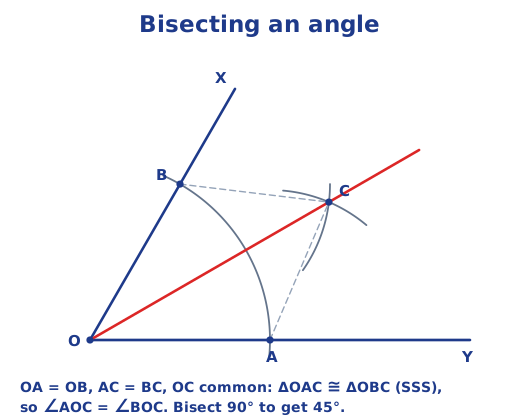
To make a 90° angle at a point O on a line, mark X and Y equally far from O and find one more point equally far from both. Bisect an angle with equal arcs: from O to points A and B on the arms, then from A and B to a meeting point C; OC halves the angle, so 90° becomes 45°. An angle can be copied by moving one arc and one chord with the compass, and copying the angle a transversal makes with a line gives a parallel line. The ancient Sulba-Sutras did the same jobs with a rope and two pegs.
The 60° angle and the regular hexagon
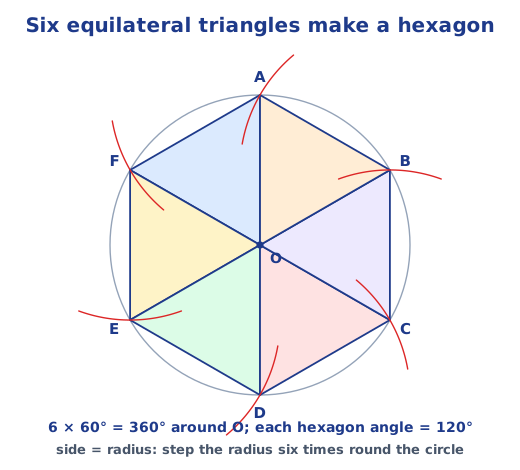
An arc from A and an arc of the same radius from B meet at C, and ABC is an equilateral triangle, so ∠CAB is 60°. Six such triangles fit exactly around a point, because 6 × 60° = 360°, and together they form a regular hexagon whose angles are 120° each. Bisecting 60° gives 30° and then 15°. See constructing a regular hexagon.
Tilings
The seven tangram pieces, cut from one square, can be rearranged into arrows, animals and letters. A grid can be tiled with 2 × 1 tiles only if it has an even number of squares, and colouring it like a chessboard shows more: every tile covers one dark and one light square, so the two colours must be equal in number. Among regular polygons, only equilateral triangles, squares and regular hexagons tile the whole plane, which is why honeybees build hexagonal cells. Read tiling patterns. Answers to every question, including the tangram figures and the tiling puzzles, are in the NCERT solutions for Part 2 Chapter 6.
Key terms
| Term | Meaning |
|---|---|
| Bisection | Dividing a line segment, an angle or any figure into two identical parts. |
| Perpendicular bisector | The line that cuts a segment into two equal halves and is perpendicular to it. Every point on it is the same distance from the two ends of the segment. |
| Angle bisector | The ray that divides an angle into two equal angles. It is found with equal arcs and congruent triangles. |
| Ruler-and-compass construction | Drawing a figure using only an unmarked ruler (for straight lines) and a compass (for circles, arcs and copying lengths), without measuring. |
| SSS and SAS congruence | Two triangles are congruent if all three sides match (SSS), or two sides and the angle between them match (SAS). Most constructions are proved this way. |
| Transversal | A line that crosses two or more lines. A line through B is parallel to m if it makes the same corresponding angle with the transversal. |
| Regular polygon | A polygon with all sides equal and all angles equal, such as an equilateral triangle, a square or a regular hexagon. |
| Regular hexagon | A six-sided regular polygon. It is made of six equilateral triangles around its centre, and each of its angles is 120°. |
| Tangram | A puzzle that began in China: a square cut into 7 pieces (2 large, 1 medium and 2 small triangles, a square and a parallelogram) that are rearranged into figures. |
| Tiling | Covering a region, or the whole plane, with shapes so that there are no gaps and no overlaps. |
Topics in this chapter
Practice
-
Which tools are used for the constructions in this chapter?
Show answer
Answer: (b) An unmarked ruler and a compass
-
Bisecting a 60° angle gives:
Show answer
Answer: (c) 30°
-
Each angle of a regular hexagon is:
Show answer
Answer: (d) 120°
-
Can a 5 × 7 grid be tiled with 2 × 1 tiles?
Show answer
Answer: (b) No, because 35 is odd
-
Which regular polygon cannot tile the plane on its own?
Show answer
Answer: (c) Regular pentagon
-
How many pieces make up a tangram?
Show answer
Answer: (c) 7
Questions students ask
What are the main topics of Class 7 Maths Part 2 Chapter 6?
Geometric constructions with a ruler and compass: the perpendicular bisector, a 90° angle at a point, angle bisection, copying angles, parallel lines, arches, the 60° angle and the regular hexagon, with proofs by congruent triangles and the rope methods of the Sulba-Sutras; and tilings: tangrams, tiling grids with 2 × 1 tiles, the chessboard colour trick and tiling the whole plane.
Is Constructions and Tilings in the new Ganita Prakash Part 2 book?
Yes. It is Chapter 6 of Ganita Prakash, the Class 7 Maths textbook Part 2 (2026-27), on pages 136 to 163. It follows the chapter Geometric Twins in Part 2, where congruent triangles were introduced.
Why do we construct with only a ruler and a compass?
Because these simplest tools give exact results. A compass copies lengths exactly and draws arcs, and the ruler joins points, so the figures are correct by reasoning, not by measuring. Finding a midpoint with a perpendicular bisector is more accurate than measuring with a marked scale.
Stuck on a question?
Take a photo and Lagnever AI explains it step by step. Try it for 7 days for ₹2.
Get it on Google Play Open in browser
For parents: after the trial, the plan renews monthly by UPI or card autopay. You can cancel anytime in the app.