
Constructing a regular hexagon
Answer in short
A regular hexagon is made of six equilateral triangles meeting at its centre, because six 60° angles fill the 360° around a point. So draw a circle whose radius equals the side, step that radius six times around the circle and join the points. Each angle of the hexagon is 60° + 60° = 120°.
Stuck on a question? Take a photo and Lagnever AI explains it step by step. Try it for 7 days for ₹2. Get it on Google Play
Regular polygons
A regular polygon has all its sides equal and all its angles equal. The equilateral triangle and the square are regular polygons you have already constructed. A pentagon or hexagon with equal sides is easy to draw with a compass, but its angles may not be equal. Constructing a regular pentagon needs ideas you will meet later; a regular hexagon is within reach now.
Six triangles around a point
Join the opposite corners of a regular hexagon and you expect six equilateral triangles meeting at the centre. To be sure, turn the question round: can six congruent equilateral triangles fit around a point with no gap and no overlap? The angles around a point add up to 360°. For example, angles of 40°, 60°, 50°, 30°, 40° and 90° add up to 310°, leaving a gap of 50°, so a 70° angle would not fit there. Equilateral triangles have 60° angles, and 6 × 60° = 360°, so six of them fit exactly.
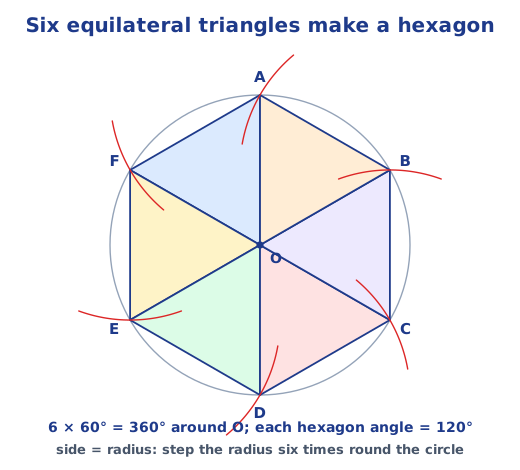
The figure they make has six equal sides, and each of its angles is made of two 60° angles: 120°. So it is a regular hexagon. Its long diagonals AD, BE and CF are straight lines, because three 60° angles add up to 180°.
Constructing a 60° angle
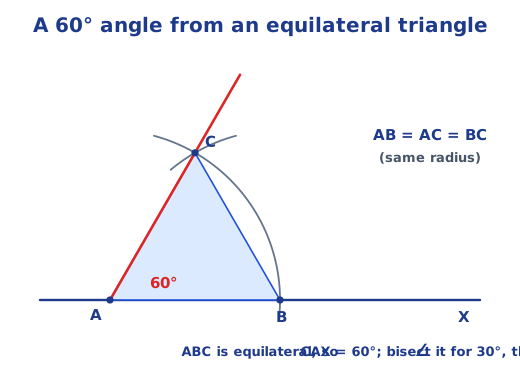
To make 60° at A on the segment AX, draw an arc with centre A cutting AX at B. Keeping the same radius, draw a second arc with centre B, cutting the first at C. Now AB = AC (the first arc) and BC = AB (the second arc), so triangle ABC is equilateral and ∠CAX = 60°. On a straight line, the angle on the other side of AC is 180° − 60° = 120°, which gives the hexagon’s angle directly.
Drawing the hexagon
The quickest way: draw a circle whose radius equals the side you want, say 4 cm or 5 cm. Keeping the same opening, mark a point on the circle and step the compass around it six times, then join the six points. Each side equals the radius, since each pair of neighbouring points forms an equilateral triangle with the centre. You can also build it from 120° angles at each corner, with sides of the chosen length.
Related constructions
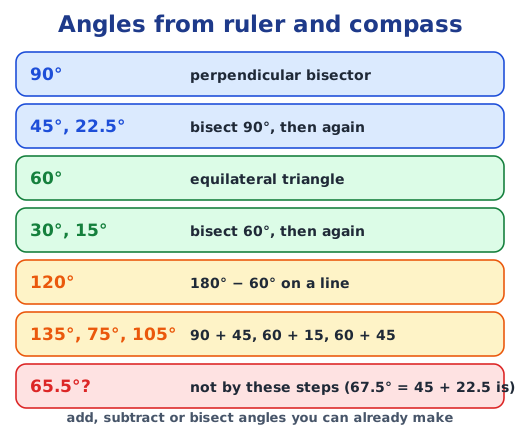
Bisecting 60° gives 30°, and bisecting 30° gives 15°. Adding and subtracting angles gives more: 75° = 60° + 15°, 105° = 60° + 45° and 135° = 90° + 45°. Joining alternate corners of a regular hexagon draws two equilateral triangles that overlap to form a 6-pointed star. The star’s six points are small equilateral triangles, because each sits beside a 120° angle of the inner hexagon, leaving 60° on the straight line.
Why it matters
Hexagons appear in floor tiles, bolt heads and honeycombs, and the 60° angle is the key to all of them. Review the basic methods in geometric constructions, and see why hexagons tile a floor in tiling patterns. Answers to the textbook questions are in the NCERT solutions for Part 2 Chapter 6; see all of Part 2 Chapter 6 notes.
Practice
-
Each angle of an equilateral triangle is:
Show answer
Answer: (c) 60°
-
Angles of 40°, 60°, 50°, 30°, 40° and 90° are placed round a point. What is the gap?
Show answer
Answer: (b) 50° The angles add to 310°, so the gap is 360° − 310° = 50°. A 70° angle would not fit.
-
A regular hexagon has side 5 cm. What radius should the compass have to draw it in a circle?
Show answer
Answer: (b) 5 cm
-
How do you construct a 15° angle?
Show answer
Answer: Construct 60° with an equilateral triangle, bisect it to get 30°, and bisect 30° to get 15°.
-
Why are the six points of the star in a regular hexagon equilateral triangles?
Show answer
Answer: Each angle of the regular hexagon is 120°, so the angle next to it on a straight line is 60°. Each point triangle therefore has two 60° angles, and its third angle is 180° − 120° = 60°. All three angles are 60°, so it is equilateral.
Questions students ask
How do you construct a regular hexagon of side 4 cm?
Draw a circle of radius 4 cm. Keeping the compass at 4 cm, mark a point on the circle and step around it, marking six points. Join them in order. Each side equals the radius, because each pair of neighbouring points makes an equilateral triangle with the centre.
How do you construct a 60° angle with a ruler and compass?
To make 60° at A on the line AX, draw an arc with centre A cutting AX at B. With the same radius draw an arc from B to meet the first arc at C. Join AC. Triangle ABC has AB = AC = BC, so it is equilateral and ∠CAX = 60°.
Why can six equilateral triangles fit around a point?
The angles around a point add up to 360°. Each equilateral triangle has 60° angles, and 6 × 60° = 360°, so six of them fit exactly, with no gap and no overlap. Together they form a regular hexagon.
Stuck on a question?
Take a photo and Lagnever AI explains it step by step. Try it for 7 days for ₹2.
Get it on Google Play Open in browser
For parents: after the trial, the plan renews monthly by UPI or card autopay. You can cancel anytime in the app.