
Tiling patterns
Answer in short
Tiling means covering a region with shapes, with no gaps and no overlaps. A grid can be tiled with 2 × 1 tiles only if it has an even number of squares, and colouring it like a chessboard shows when even that is not enough. Of the regular polygons, only equilateral triangles, squares and regular hexagons tile the whole plane.
Stuck on a question? Take a photo and Lagnever AI explains it step by step. Try it for 7 days for ₹2. Get it on Google Play
Covering without gaps
Covering a region with shapes, with no gaps and no overlaps, is called tiling. A floor of square tiles is a tiling; so is a brick wall. This half of the chapter asks which shapes can cover which regions, and how to be sure when a covering is impossible.
Tangrams
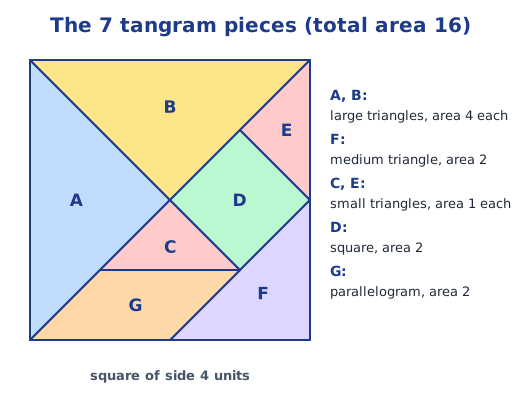
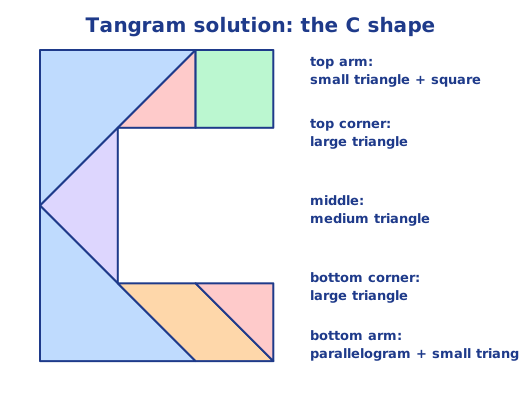
Tangrams are puzzles that began in China. A square is cut into seven pieces: two large triangles, one medium triangle, two small triangles, a square and a parallelogram. Rearranged, the same seven pieces make an arrow, a fish, a cat, a running man and much more. If the square has side 4 units, the pieces have areas 4, 4, 2, 1, 1, 2 and 2, so every figure made from all seven has area 16. A good way to start a tangram figure is to find where the two large triangles fit, since together they cover half the area.
Tiling a grid with 2 × 1 tiles
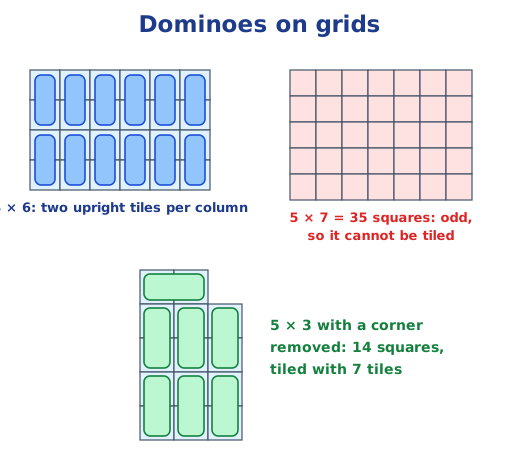
A 4 × 6 grid has 4 rows and 6 columns. It can be tiled with 2 × 1 tiles, which may be turned upright or laid flat: for example, two upright tiles fill each column. A 4 × 7 grid works the same way. A 5 × 7 grid cannot be tiled, because it has 35 squares and each tile covers exactly 2, so any number of tiles covers an even number of squares. In general, an m × n grid can be tiled when m or n is even, and never when both are odd.
The chessboard colour trick
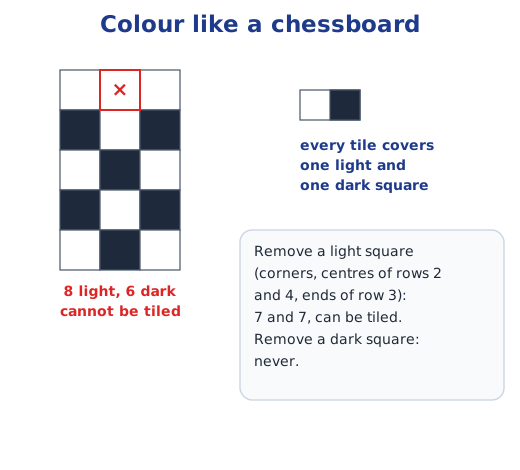
Remove one square from a 5 × 3 grid and 14 squares remain, an even number. Sometimes the grid can then be tiled, and sometimes it cannot, however hard you try. To be sure, colour the squares like a chessboard. Every 2 × 1 tile covers two neighbouring squares, one dark and one light, so any tiled region has equal numbers of the two colours. With the top middle square removed, 8 light and 6 dark squares remain, so no tiling exists. Making the problem more complicated with colours has made it easier to settle.
Tiling the whole plane
Squares can cover an endless floor, and so can equilateral triangles and regular hexagons. In each case the angles meeting at a point add up to exactly 360°: six 60° angles, four 90° angles or three 120° angles. A regular pentagon’s 108° angles cannot do this. The plane can also be tiled with more than one shape, or with irregular ones: the Dutch artist Escher (1898–1972) tiled it with animal shapes, and new tilings are still being discovered; one of those in the book was found only in 2023.
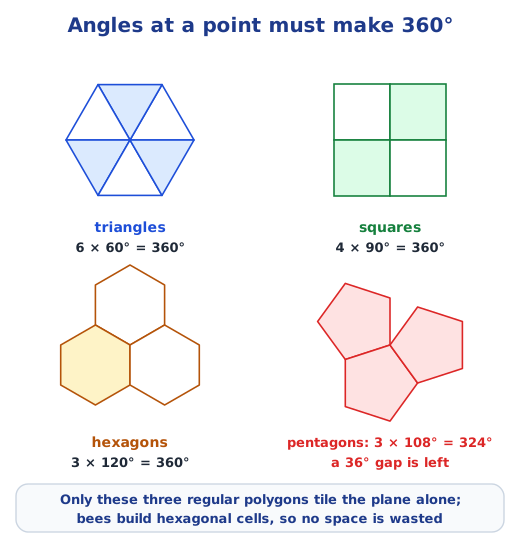
Nature tiles too. The front faces of beehives and some wasp nests are tiled with hexagonal cells that hold eggs, young insects and food, with no space wasted. How the insects build such regular hexagons is still a puzzle for scientists.
Why it matters
Tiling ideas are used in flooring, packaging and design, and they remain an active area of research in geometry. See how hexagons are drawn in constructing a regular hexagon, and review geometric constructions. Answers to the textbook questions, including all the tiling puzzles, are in the NCERT solutions for Part 2 Chapter 6; see all of Part 2 Chapter 6 notes.
Practice
-
Which grid cannot be tiled with 2 × 1 tiles?
Show answer
Answer: (c) 5 × 7
-
Each 2 × 1 tile on a chessboard-coloured grid covers:
Show answer
Answer: (c) one dark and one light square
-
Three regular hexagons meet at a point. The angles there add up to:
Show answer
Answer: (b) 360°
-
How can you tile a 6 × 9 grid with 2 × 1 tiles?
Show answer
Answer: The grid has 6 rows, an even number, so fill each of the 9 columns with 3 upright tiles. That uses 27 tiles for the 54 squares.
-
An 8 × 8 board has two opposite corners removed. Can it be tiled with 2 × 1 tiles?
Show answer
Answer: No. Coloured like a chessboard, the two opposite corners are the same colour, so 32 squares of one colour and 30 of the other are left. Every tile covers one square of each colour, so the colours would have to be equal.
Questions students ask
What is tiling in maths?
Covering a region, or the whole plane, with copies of one or more shapes so that there are no gaps and no overlaps. Floor tiles, brick walls and honeycombs are everyday tilings.
Which grids can be tiled with 2 × 1 tiles?
An m × n grid can be tiled when at least one of m and n is even: fill each column with upright tiles if the number of rows is even, or each row with flat tiles if the number of columns is even. If both are odd, the number of squares is odd and no tiling is possible.
Which regular polygons can tile the plane?
Only three: equilateral triangles (six meet at a point, 6 × 60° = 360°), squares (4 × 90° = 360°) and regular hexagons (3 × 120° = 360°). The angles at each meeting point must add up to exactly 360°.
Stuck on a question?
Take a photo and Lagnever AI explains it step by step. Try it for 7 days for ₹2.
Get it on Google Play Open in browser
For parents: after the trial, the plan renews monthly by UPI or card autopay. You can cancel anytime in the app.