
Geometric constructions with a ruler and compass
Answer in short
With only an unmarked ruler and a compass you can draw the perpendicular bisector of a segment, a 90° angle at a point, the bisector of an angle, a copy of an angle and a line parallel to a given line. Each method works because of congruent triangles: equal lengths drawn with the compass force the angles to be equal.
Stuck on a question? Take a photo and Lagnever AI explains it step by step. Try it for 7 days for ₹2. Get it on Google Play
Only a ruler and a compass
A compass draws circles and arcs and carries a length from one place to another; an unmarked ruler joins two points with a straight line. With just these two tools you can draw figures that are exact, not because you measured carefully, but because of reasoning. Congruent triangles, from the Geometric Twins chapter, are the reason each method works.
The eye and the perpendicular bisector
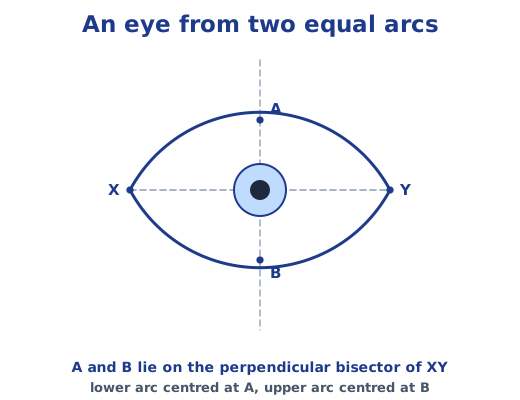
In Class 6 you drew an eye with two arcs through X and Y, guessing their centres A and B. For a symmetrical eye the two arcs need the same radius, so AX = AY = BX = BY. To find such points, draw arcs of equal radius from X and Y above and below XY; they meet at A and B. Joining A and B gives a line through the midpoint of XY at right angles: the perpendicular bisector. Bisection means dividing something into two identical parts.
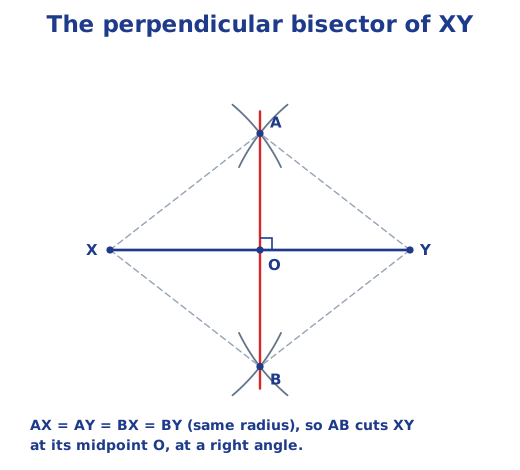
Why does it always work? ΔABX ≅ ΔABY by SSS, since AX = AY, BX = BY and AB is common, so ∠XAO = ∠YAO. Then ΔAOX ≅ ΔAOY by SAS, so OX = OY and ∠AOX = ∠AOY. These two angles together make 180°, so each is 90°. It follows that every point equally far from X and Y lies on this one line, so other pairs of points on it give eyes of other shapes.
A right angle at a point
To draw a 90° angle at a point O on a line, first make O the midpoint of a segment: with O as centre, cut the line at X and Y. Then draw arcs of a larger radius from X and Y that meet at A. OA is the perpendicular bisector of XY, so it makes 90° with the line. Only one pair of arcs is needed, because O already lies on the bisector.
The rope of the Sulba-Sutras
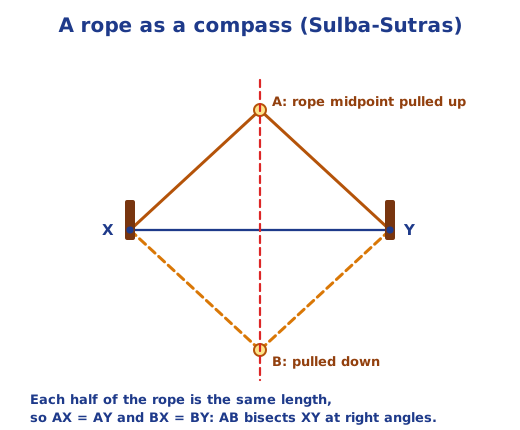
The Sulba-Sutras, Vedic texts on building fire altars, gave exact methods for perpendiculars using a rope as a compass. In one, from the Katyayana-Sulbasutra, pegs are fixed at X and Y and the ends of a rope are tied to them. The rope’s midpoint is pulled tight above XY to mark A and below XY to mark B. The two halves of the rope are equal, so A and B are each equally far from X and Y, and AB is the perpendicular bisector.
Bisecting an angle
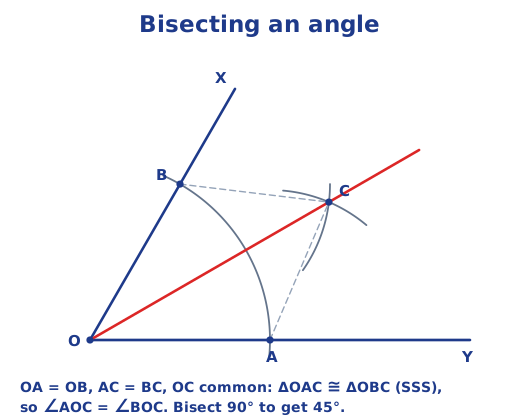
An eight-petalled flower needs eight lines 45° apart, and 45° is half of 90°. To bisect any angle XOY, draw an arc from O cutting the arms at A and B, so OA = OB. From A and B, with one radius, draw arcs meeting at C. Since OA = OB, AC = BC and OC is common, ΔOAC ≅ ΔOBC by SSS, so ∠AOC = ∠BOC. Bisecting 90° gives 45°, and bisecting again gives 22.5°.
Copying an angle and parallel lines
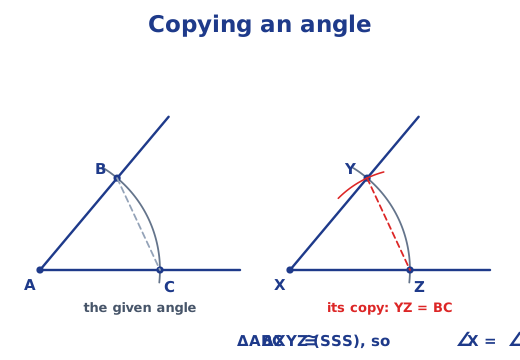
Repeating designs need exact copies of one angle. Draw an arc from the vertex A cutting the arms at B and C. Draw a ray from a new point X and an arc of the same radius cutting it at Z. Take the length BC in the compass and mark it from Z on the arc to get Y. Then ΔABC ≅ ΔXYZ by SSS, so ∠X = ∠A. The same idea gives parallel lines: through a point B, copy the angle that a transversal makes with the line m, in the corresponding position; the new line has equal corresponding angles, so it is parallel to m.
Why it matters
These five constructions, together with arches built on support lines, are the toolkit for every design in the chapter. Next, use them in constructing a regular hexagon, and see the second half of the chapter in tiling patterns. Answers to the textbook questions are in the NCERT solutions for Part 2 Chapter 6; see all of Part 2 Chapter 6 notes.
Practice
-
In the perpendicular bisector construction, the points A and B satisfy:
Show answer
Answer: (b) AX = AY and BX = BY
-
To bisect ∠XOY, the first step is to mark A and B on the arms so that:
Show answer
Answer: (a) OA = OB
-
Which congruence condition proves that a copied angle equals the original?
Show answer
Answer: (b) SSS
-
How do you draw a 90° angle at a point O on a line?
Show answer
Answer: With O as centre, cut the line at X and Y, so that OX = OY. With a larger radius, draw arcs from X and Y that meet at A. Then OA is the perpendicular bisector of XY, so the angle at O is 90°. Only one pair of arcs is needed, because O is already on the bisector.
-
Why does the angle bisector construction work?
Show answer
Answer: OA = OB (same arc), AC = BC (same radius) and OC is common, so ΔOAC ≅ ΔOBC by SSS. Matching parts of congruent triangles are equal, so ∠AOC = ∠BOC, and OC bisects the angle.
Questions students ask
How do you construct a perpendicular bisector?
Open the compass to more than half of XY. From X and then from Y draw arcs above the segment; they meet at A. With the same radius draw arcs below; they meet at B. Join AB. It cuts XY at its midpoint at right angles.
Why is AB the perpendicular bisector of XY?
Because AX = AY = BX = BY. ΔABX ≅ ΔABY by SSS, so ∠XAO = ∠YAO. Then ΔAOX ≅ ΔAOY by SAS, so OX = OY, and ∠AOX = ∠AOY. These two angles make a straight angle, so each is 90°.
How did the Sulba-Sutras construct a perpendicular bisector?
With a rope. Poles are fixed at X and Y and a rope with loops at its ends is tied to them. Its midpoint is pulled tight above XY to mark A and below XY to mark B. Both halves of the rope are equal, so A and B are each equally far from X and Y, and AB is the perpendicular bisector.
Stuck on a question?
Take a photo and Lagnever AI explains it step by step. Try it for 7 days for ₹2.
Get it on Google Play Open in browser
For parents: after the trial, the plan renews monthly by UPI or card autopay. You can cancel anytime in the app.