
Class 7 Science Chapter 4: The World of Metals and Non-metals Notes
This chapter in five lines
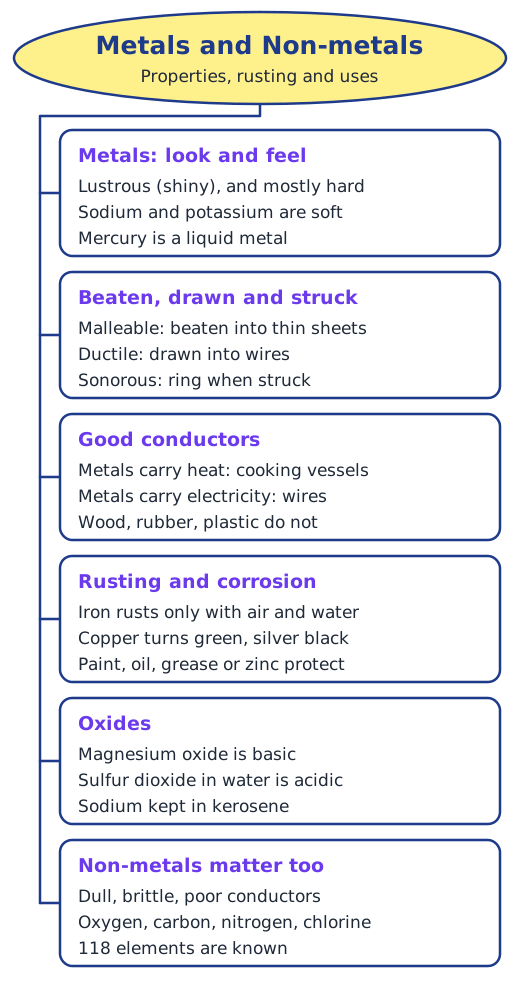
The World of Metals and Non-metals compares two groups of elements. Metals such as iron, copper and aluminium are usually lustrous, hard, malleable, ductile and sonorous, conduct heat and electricity well, and form basic oxides. Non-metals such as sulfur are dull, brittle and poor conductors, and form acidic oxides. Iron rusts in moist air, and coatings protect it.
What is this chapter about?
Yashwant and Anandi visit Sudarshan, an ironsmith in their Rajasthan village, for a school project. He makes tawas, buckets, tongs, spades, axes, trowels and rakes from iron, with wooden handles, heating the iron in a coal furnace. When he beats a red-hot iron block into the shape of an axe, Anandi wonders whether other metals can be flattened too. The chapter explores what metals can do, how they react with air and water, and how non-metals differ.
Lustre and hardness
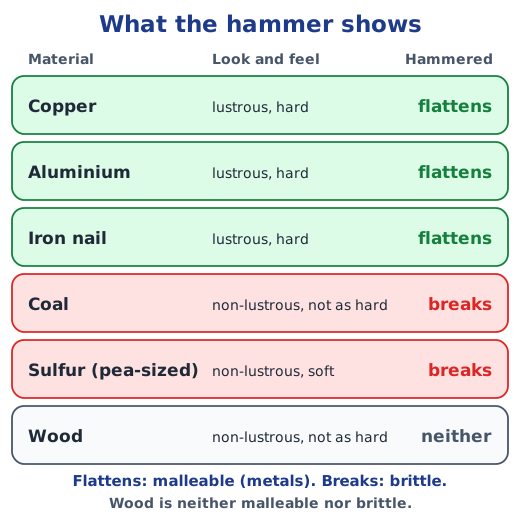
Hammering pieces of copper, aluminium, iron, coal, sulfur and wood shows a clear divide. Copper, aluminium and iron are shiny, or lustrous, and hard: they are metals, and their shine is called metallic lustre. Coal, sulfur and wood are dull and not as hard. Not every metal is a hard solid, though: sodium and potassium are soft enough to cut with a knife, and mercury is a liquid at room temperature.
Sheets, wires and sound
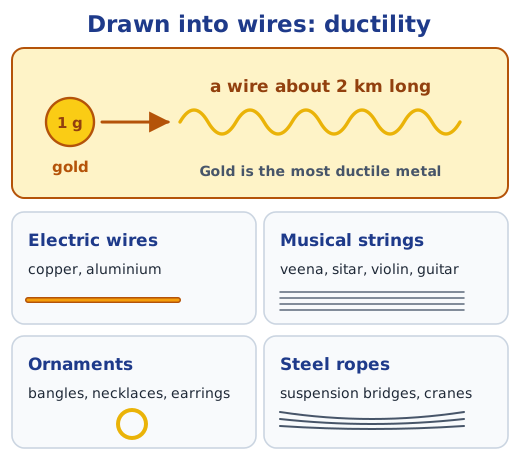
When hammered, the metals flatten into sheets. This is malleability: silver foil on sweets and aluminium foil for wrapping food come from it, and gold and silver beat into sheets more easily than any other metal. Coal and sulfur break into pieces instead, so they are brittle, and wood neither flattens nor breaks. Metals can also be drawn into wires, which is ductility: electrical wires, bangles, the strings of a veena or sitar, and steel ropes for bridges and cranes all depend on it. Gold is so ductile that one gram can make a wire about 2 km long. Metals are also sonorous: a dropped spoon or coin rings, as do school bells and ghungroos, while coal and wood just thud. Read more in properties of metals and non-metals.
Iron changed Indian history. The Harappans used copper and gold for tools and jewellery but hardly any iron, which came into everyday use much later. Once it did, strong iron ploughs and tools were far superior to earlier ones and helped civilisation advance.
Conductors of heat and electricity
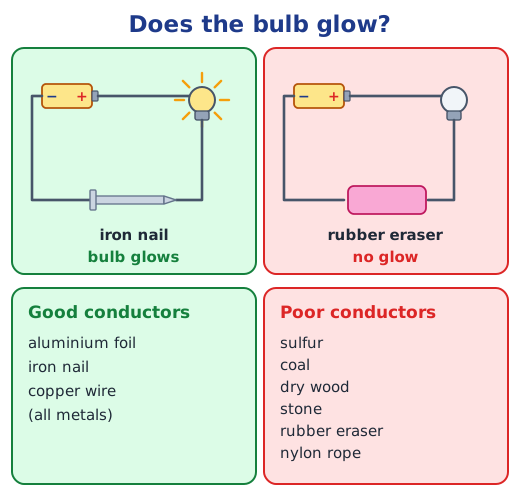
Stand a metal spoon and a wooden spoon in hot water, and only the metal spoon’s top gets hot: metals are good conductors of heat, which is why pots are metal and their handles wood or plastic. In a tester circuit, aluminium foil, an iron nail and a copper wire make the bulb glow, while sulfur, coal, wood, stone, rubber and nylon do not. Metals are good conductors of electricity; rubber gloves and plastic handles protect electricians because they are poor conductors.
Rusting and corrosion
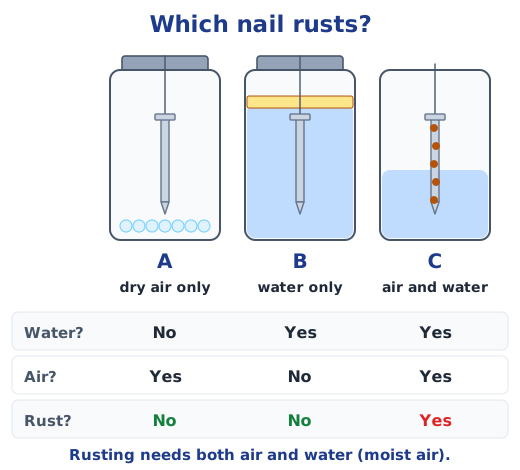
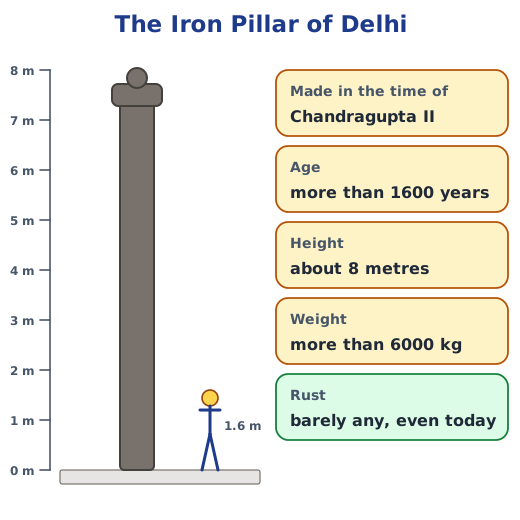
Three iron nails tell the story. A nail in dry air does not rust, nor does one under boiled water sealed with oil, but a nail in an open bottle, partly in water, gets brown deposits. Iron rusts only when it meets both air and water. The brown deposit is rust, and its formation is rusting. Other metals suffer corrosion too: copper gets a green coating and silver a black one. Painting, oiling, greasing and galvanisation, a layer of zinc, keep iron safe. The Iron Pillar of Delhi, made more than 1600 years ago, has barely any rust. Read rusting and corrosion.
Oxides of metals and non-metals
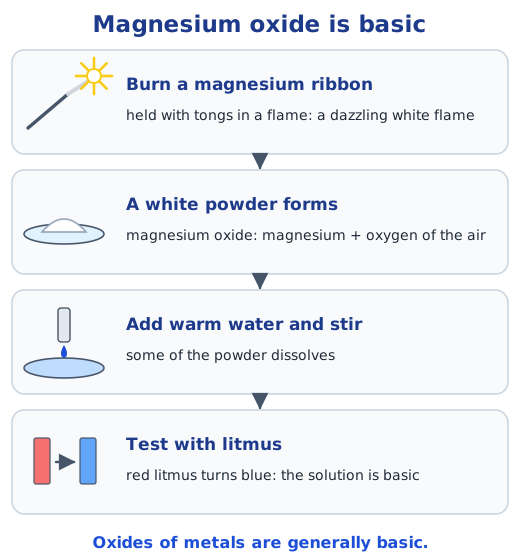
A magnesium ribbon burns with a dazzling white flame and turns into a white powder, magnesium oxide. Its solution turns red litmus blue, so it is basic: oxides of metals are generally basic. Sodium reacts so vigorously with oxygen and water that it is kept in kerosene. Burning sulfur forms sulfur dioxide, which dissolves in water to give sulfurous acid, turning blue litmus red: oxides of non-metals are acidic. Read oxides of metals and non-metals.
Non-metals in our lives
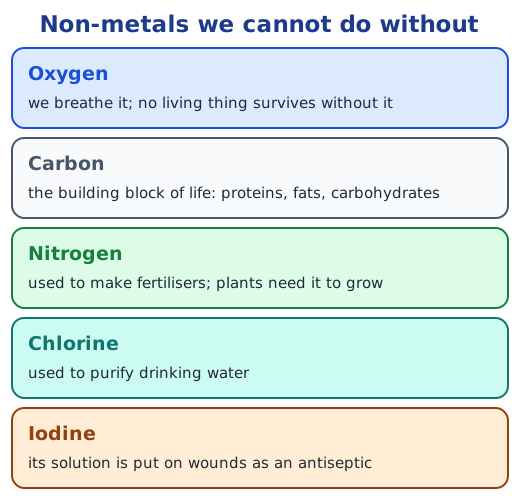
Non-metals such as sulfur and phosphorus are usually soft and dull, neither malleable nor ductile, not sonorous and poor conductors; phosphorus is kept in water because it catches fire in air. We cannot live without them: we breathe oxygen, carbon is the building block of all living things, nitrogen goes into fertilisers, chlorine purifies water and iodine is an antiseptic. Metals and non-metals are elements, of which about 118 are known; plastic, glass, wood, rubber and paper are not elements. Many metals and alloys, such as steel, run modern industry, and India recycles iron and aluminium.
In a nutshell
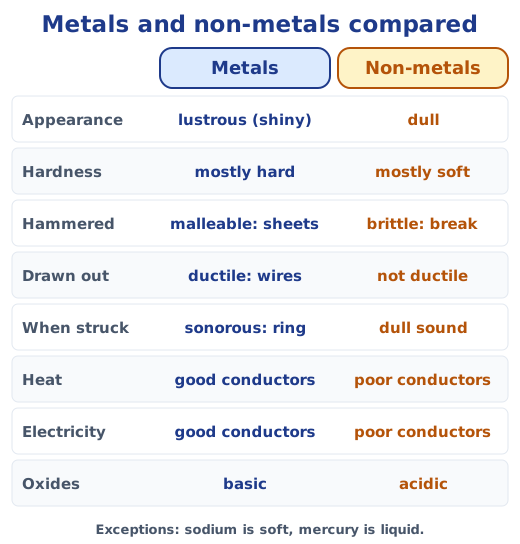
Metals and non-metals differ in how they look, feel, sound and conduct, and in how they react with air and water, and these properties decide their uses. Answers to every activity, Tables 4.1 to 4.3 and all twelve questions are in the NCERT solutions for Chapter 4.
Key terms
| Term | Meaning |
|---|---|
| Metal | An element such as iron, copper, aluminium or gold that is usually shiny and hard, can be beaten into sheets and drawn into wires, and conducts heat and electricity well. |
| Non-metal | An element such as sulfur, carbon, oxygen or phosphorus that is usually dull, soft or brittle, and a poor conductor of heat and electricity. |
| Metallic lustre | The shine of metals, as on a new copper coin or a clean iron nail. |
| Malleability | The property of being beaten into thin sheets, like aluminium foil or the silver foil on sweets. |
| Brittle | Breaking into pieces when hammered, as coal and sulfur do. |
| Ductility | The property of being drawn into wires; one gram of gold can be drawn into a wire about 2 kilometres long. |
| Sonority | The ringing sound that metals make when they are struck, as with bells and ghungroos. |
| Conductor | A material that lets heat or electricity pass through it easily. Metals are good conductors; wood, rubber and plastic are poor ones. |
| Rusting | The forming of a brown deposit, rust, on iron when it is in contact with both air and water. |
| Corrosion | The slow damage of a metal surface by air, water or other substances, such as a green coating on copper or a black one on silver. |
| Galvanisation | Putting a thin protective layer of zinc metal on iron to stop it from rusting. |
| Element | A pure substance that cannot be split into anything simpler. About 118 are known, and metals and non-metals are elements. |
Topics in this chapter
Practice
-
Which property lets aluminium be made into foil?
Show answer
Answer: (b) Malleability
-
Which metal is a liquid at room temperature?
Show answer
Answer: (b) Mercury
-
Why are cooking pots made of metal?
Show answer
Answer: (b) Metals are good conductors of heat
-
What does iron need in order to rust?
Show answer
Answer: (c) Both air and water
-
What is the nature of magnesium oxide?
Show answer
Answer: (b) Basic
-
Which of these is not an element?
Show answer
Answer: (c) Glass
Questions students ask
What are the main topics of Class 7 Science Chapter 4?
The properties that set metals apart: lustre, hardness, malleability, ductility, sonority and the conduction of heat and electricity. Then the rusting of iron, the corrosion of other metals and how to prevent them; burning magnesium and sulfur and the nature of their oxides; how non-metals differ from metals and why we need them; and what elements are.
Is The World of Metals and Non-metals in the new NCERT Class 7 Science book?
Yes. It is Chapter 4 of Curiosity, the Class 7 Science textbook (Reprint 2026-27), on pages 41 to 56. It opens with Yashwant and Anandi, two students from a village in Rajasthan, visiting Sudarshan, an ironsmith who beats red-hot iron into axes, pans and farm tools.
What is the difference between metals and non-metals?
Metals are usually lustrous, hard, malleable, ductile and sonorous, and they conduct heat and electricity well; their oxides are basic. Non-metals are usually dull and soft or brittle, cannot be made into sheets or wires, do not ring, and conduct heat and electricity poorly; their oxides are acidic, and they generally do not react with water.
Why has the Iron Pillar of Delhi not rusted?
The pillar dates from the reign of Chandragupta II, over 1600 years ago, and was made in a way that resists rusting, which shows how skilled ancient Indian metal workers were. Despite centuries of wind and rain it has barely any rust. (Extra: studies suggest that the phosphorus in its iron helps a thin protective film form on the surface.)
Stuck on a question?
Take a photo and Lagnever AI explains it step by step. Try it for 7 days for ₹2.
Get it on Google Play Open in browser
For parents: after the trial, the plan renews monthly by UPI or card autopay. You can cancel anytime in the app.